Why the barrel sauna and cold plunge belong together

Something has shifted in what buyers ask about when they order an outdoor sauna. Ten years ago the question was almost always about the sauna itself: the size, the wood, the heater, the design. Today, a growing share of enquiries includes a second question, usually near the end of the call. What about a cold plunge to go alongside?
The pairing is not new. Finnish sauna culture has included rolling in snow or plunging in a lake for centuries. What is new is that peer-reviewed research on the two together, described as contrast therapy, has caught up with what practitioners have known for generations. That research, combined with rising interest in home wellness infrastructure, has made the sauna-plus-cold-plunge combination the fastest-growing configuration in outdoor wellness across Europe. This is why it is happening, and how to think about it if you are planning your own installation.
## What contrast therapy actually is, and what the research says
Contrast therapy is the deliberate alternation between hot exposure, typically a sauna at 80 to 90 degrees Celsius, and cold exposure, typically water at 8 to 15 degrees Celsius. A typical session involves 10 to 15 minutes in the sauna followed by 1 to 3 minutes in the cold plunge, repeated two or three times.
The physiological mechanism is well documented. In the sauna, blood vessels near the skin dilate to release heat, heart rate rises to a level comparable with moderate cardiovascular exercise, and blood flow to peripheral tissue increases substantially. In the cold plunge, the opposite happens: blood vessels constrict rapidly, blood is redirected toward the vital organs, and the sympathetic nervous system activates. The cycling between these two states, over a session, is often described as a vascular pump.
The evidence base has strengthened significantly over the past decade. The long-running Finnish cardiovascular study published in JAMA Internal Medicine, which followed more than 2,300 men over roughly two decades, found that frequent sauna use was associated with substantially lower cardiovascular disease risk. Separate research on cold water immersion, published in the European Journal of Applied Physiology, has shown that cold immersion after exercise reduces muscle soreness and improves recovery compared to passive rest. Combined, the effects are not simply additive. Contrast therapy appears to produce results that neither modality alone reliably delivers.
None of this replaces medical treatment for a specific condition. It is a general observation, backed by increasingly serious research, that the pairing of heat and cold is more than the sum of its parts.
## Why the pairing works better than either alone
For anyone who has actually experienced contrast therapy, the effect is immediately obvious. The sauna alone is deeply relaxing but can leave the body sluggish. The cold plunge alone is bracing but can feel abrupt without the preparation of the heat. Together, they produce a state that is difficult to describe accurately and impossible to fake once you have felt it. Awake, calm, mentally clear, and physically restored, often within an hour.
The practical implications for home installations are becoming visible in the market. Buyers who install only a sauna often add a cold plunge within one or two years, having discovered the missing half of the experience. Buyers who install both together tend to use each substantially more than they would have used either in isolation. And distributors carrying both product categories report higher average project values and stronger customer retention than those selling saunas alone.
## What a home installation actually looks like
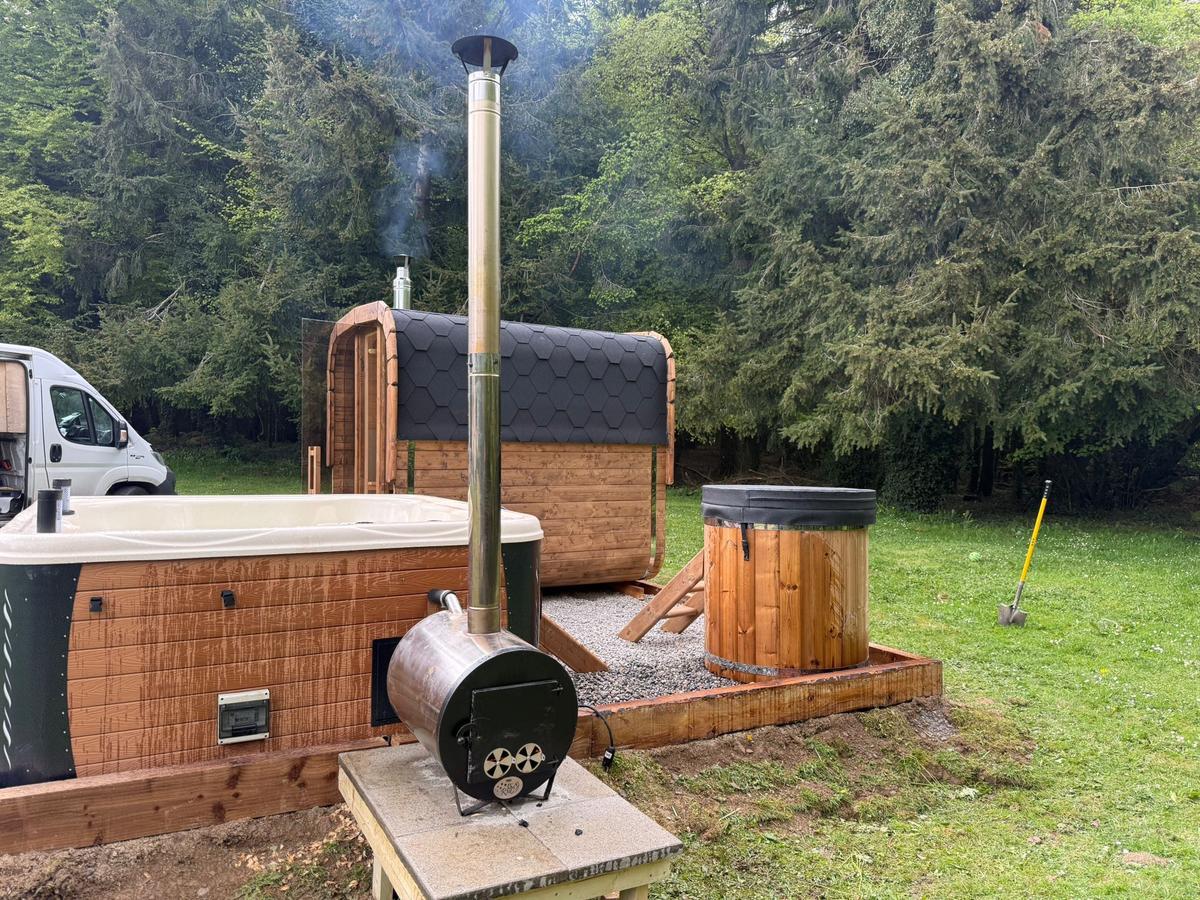
The good news is that the infrastructure for a full contrast setup is more accessible than it appears. A barrel sauna and a cold plunge together can fit in most European gardens with a footprint of roughly four by three metres, including the space between them and a small deck or paving connecting the two.
The sauna is the anchor. A 2.5 or 3 metre barrel sauna is enough for most households, heats in twenty to forty minutes depending on the heater choice, and provides a stable environment for the hot phase of contrast sessions. The cold plunge is the smaller of the two structures. Home cold plunges range from simple insulated tubs at a few hundred euros to fully filtered, chilled units at three to six thousand. All of them work, and the choice depends on how often the plunge will be used, how sensitive the buyer is to water quality, and whether the installation is permanent or semi-portable.
Two practical points that come up in almost every conversation. First, the cold plunge should be sited so that stepping from the sauna into the plunge takes a few seconds, not a walk across a wet garden path. The proximity is part of the experience and part of the safety, especially in winter. Second, the plunge water needs a plan for hygiene and temperature control, whether that means a small chiller unit, regular water changes, or a filtration system. Both are questions worth settling before installation, not after.
## Why this is a genuine market moment, not a passing trend
Trends in outdoor wellness come and go. Infrared saunas had a moment. Salt therapy had a moment. Various other home wellness formats have appeared, sold briefly, and faded when the underlying research or usage patterns did not sustain the initial interest.
Contrast therapy is different, and it is worth naming why. The research base is peer-reviewed, is decades deep, and continues to accumulate rather than reverse. The user experience produces immediately felt benefits, which drives repeat use rather than the abandonment pattern typical of trend-driven wellness purchases. And the equipment involved, a serious sauna and a functional cold plunge, is durable infrastructure rather than consumable content. Once installed, both products deliver value for years or decades rather than months.
For manufacturers, this has meant a genuine shift in how outdoor wellness projects are scoped. For distributors, it has meant expanding beyond sauna-only positioning to full wellness stack conversations. For buyers, it has meant that the right project scope is no longer "which sauna" but "which sauna paired with which plunge, on which site."
## What we recommend, and where we can help
At Wood Architects we build the sauna half of this equation. Our barrel sauna range is the workhorse of contrast installations, both because the round barrel geometry heats quickly and because the flat-pack format allows delivery to almost any European garden regardless of access constraints. We do not manufacture cold plunges ourselves, but we can recommend the plunge suppliers our existing partners across Europe have tested and stayed with.
For anyone planning a full contrast installation at home, or for a distributor considering how to broaden into contrast therapy conversations with their existing sauna customer base, we are happy to walk through what actually works and what does not. The category is still young enough that the practical knowledge is not yet fully public, and small differences in specification and siting produce disproportionate differences in the final experience.
Reach out and we will share what we see.
---
Filed under outdoor sauna and premium products.
1reading now
Get an email when Pijus publishes