Untethered. Adulting when the rug gets pulled out from under our feet

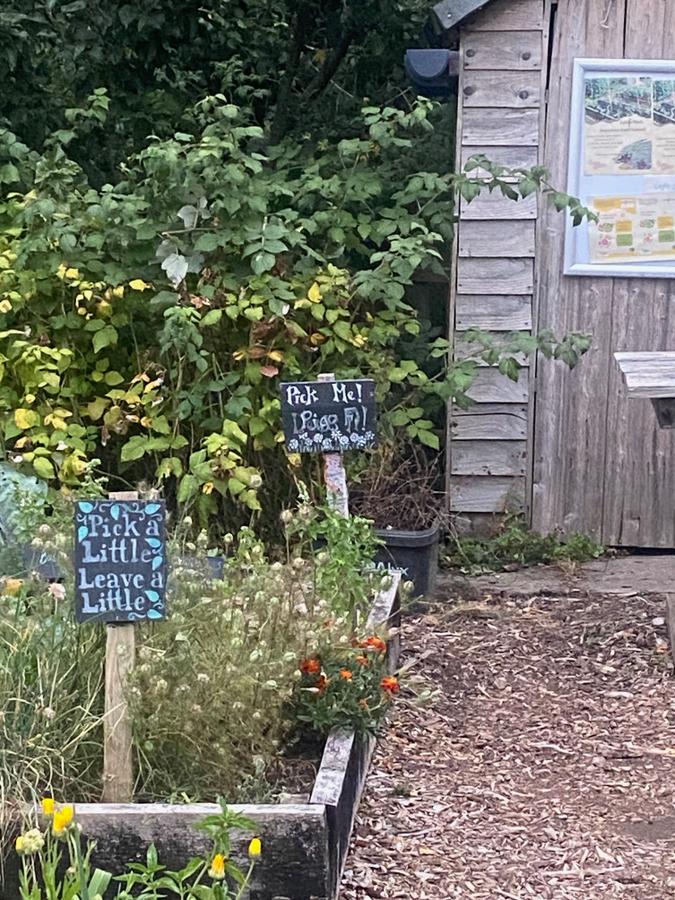
Cover picture - community garden in the town of Machynlleth. Where the spirit of 'take what you need, leave the rest for others who need' is alive and thriving.
*
‘The price of freedom is eternal vigilance’ - Aldous Huxley
*
When I was a child – same as most of us in the so-called Western world, I guess – I grew up trusting institutions. Not just ‘institutions’ in the most direct sense but in the broader sense, too. I grew up knowing that they’d have my back.
When some years ago my friend’s garage got broken into and my friend’s quad bike got stolen and the appropriate institutions did nothing other but send – by a text message – a crime number for insurance purposes, I wrote it off to the chronic lack of resources. No doubt, it was a big factor. My trust didn’t waver.
Later, when, working as an interpreter for the justice system, I started observing (mainly) women asking for help, for some measures of protection from domestic violence after already numerous incidents the evidence for which was deemed not sufficient to prosecute, and saw the system shrug its shoulders accompanied by ‘There’s nothing we can do until the crime is committed’, my mind boggled, but I wrote it off as, albeit systemic, an incidental poor phrasing of a particular law or regulation; a lack of thorough thinking through. It can be fixed, I thought. But it takes time, I accepted; it’s a long path to walk through all those bureaucratic corridors. My trust didn’t waver.
When I was diagnosed with rheumatoid arthritis and put on meds ‘for life’, without looking at how it came about and what, if anything, could be done to arrive at the root cause, I questioned the approach. My own research revealed so much more than what I was told during the investigations and the subsequent prescribing of the treatment (or, management, rather, as ‘cure’ does not exist), and so trust wavered but, still, I wrote it off as inherent slowness of the humongous system. After all, the evidence is there for anyone to access, and it’s only a matter of time until the system ‘catches up’.
As I watched from the side lines while trying to hold space for my friend who was fighting the proverbial windmills (you know, like Miguel Cervantes’ Don Quixote from the arguably the greatest novel ever written in the Spanish language) in the legal battles for years and years and what it was doing and had done to their health, I could no longer unsee the absurdity of how things work in these overinflated bureaucratic institutions that, supposedly, were created to protect the common person, but, in reality, due to the sheer size of it all, the institutionalized ‘role silos’ and, the worst part, the oft-unwillingness of those who represent it, plays out as anything but.
At some point, my trust stopped wavering, and entered the stage of slow erosion.
*
Then, I started paying more attention to what was happening around me. At first, not through choice, but through incidental exposure. There seems to be a limit to how much exposure we can continue to be blind to until our attention is grabbed. Until we can ignore things no longer. Until we start learning intentionally, too.
The trouble is, with learning comes unlearning. Unlearning of everything we knew to be the foundation on which we leant for rest when we became tired; for safety. The stability of the foundation on which we build our lives is no longer there. And it can be a shattering realisation.
*
When we are children, those lucky of us, know that, if we fall and graze our knees when running around, we can run to our parent, teacher or another adult we trust to comfort us and fix it.
When we enter adulthood, we trust the system to have our backs.
Until encounter after encounter, whether direct or by by-stander’s observation, slowly erodes. Not because we choose to become distrusting, but because it is only so long that we can willingly ignore the evidence for.
Until we have no choice but to learn that we, the common folk, more often than not, are a secondary consideration.
*
At first, it can come with feelings of confusion, of dumbfoundedness, of disbelief.
When acceptance finally comes, we may feel untethered. Alone. Frightened.
Exhausted not only from having had to hold ourselves upright for so long already, but also from the realisation that there isn’t, in fact, anything to lean against. That there isn’t a prospect where we can give ourselves permission to slump down in safety and security.
That the world – and adulting in it – isn’t what we knew it to be.
*
When I first reached the stage of acceptance, I found no comfort in it. It is probably inaccurate to say ‘when I first reached’; it felt more like the acceptance landed upon and enveloped me, with me still fighting against it, from underneath its cover. I didn’t want to accept that there isn’t a foundation against which I could rest when the going gets too hard. There isn’t a temporary refuge.
There’s only me.
And I’m already exhausted.
*
‘The price of freedom is eternal vigilance’, said Aldous Huxley to Mike Wallace during their conversation in 1958.
It took me by surprise. Not the words themselves, as I had already resigned to that truth, however unwillingly.
It was the feeling of validation that, unexpectedly, gifted me a ladder out of the pit of despair and resignation.
It lit a new fire in me. A fire of ‘I can do this.’
It will never be the same again.
The safety and security outside of myself will never return. And whilst I still mourn it sometimes, it helped me rediscover the might and power inside me. It’s strange, it’s unfamiliar, but it’s undoubtedly there. It’s always been there.
I can do this.
We can do this.
We really can.
It’s inside of us.
It is a matter of rediscovering it.
It’s not an easy thing, to ‘unlearn in order to re-learn’, because it often requires that we believe it first. And that’s the hardest thing for those of us who grew up in cultures where belief in something for which we have no evidence [yet] is ridiculed. And the effects on ridicule are not to be taken lightly; over time, they can chip away at our spirit.
I admire those who express their willingness to believe before they collected evidence. And I aspire to become like them one day.
But until I – until We – get to the point of having enough courage to believe explicitly, until we’ve built up the resources we need to face the collective pushback, we can do it quietly, in our own privacy.
We can choose to believe so that our minds and hearts open to experiencing. Because it is through experiencing that we collect evidence.
*
I wrote the above piece quite a while ago. As I sit here re-reading it and adding this post-edit in the form of almost unfiltered stream of consciousness, I am experiencing some discomfort. While recognising I should not feel the said discomfort.
The discomfort arises from looking back at how much doom I felt when I originally wrote this piece. And how untethered and alone in this world, despite having lots of good things and wonderful people around me, I must’ve felt at the time.
The recognition that feeling discomfort is misguided comes from my since-acquired self-compassion - the hardest kind of compassion - that arises from my learning to be with my feelings, whatever they are at any given time. The recognition that there are no invalid feelings; if they arise, if they are there, they just are. They are valid and they are to be felt. Our feelings are often the response to a situation and circumstances at any given moment, and their being is enough for them to be valid.
There’s no such thing as ‘objective feelings’, therefore, world-imposed but assimilated-by-us (not by choice but by our biological design from our pre-verbal stages of life) expectation that feelings must be ‘valid’ and somewhat a ‘rational response to a situation’ by the ‘outside judgement’ is, in itself, irrational.
If a feeling is, it just IS.
But I digress, as I often do.
The reason for this update on this old piece is that, since I felt so untethered by the then-recent acceptance of the fact that there is no feeling of safety to be found in the institutions around us, I have found safety in something much closer to home. Not necessarily geographically but feeling-wise.
I found it in people around me against which I can lean when I become too tired to carry on.
Against which I can rest before I pick up and carry on.
In people both old and new in my life.
People that feel like HOME.
And I found that because I opened myself up to it. It has always been there but, while I fancied myself separate and believing in ‘everyone’s there for themselves’, I had no way of seeing that which was around me.
I wish I could share a reliable recipe on how to become open to that which we don’t see before we see it, but I can’t. Because the recipe is personal and bespoke to each of us.
But I wanted to add this new discovery because it gave and continues to give me HOPE.
HOPE is a nicer state to be in than the feeling of doom.
And so what if it’s naïve?!
*
I guess, the only thing I can invite us all to do in the hope that it will deliver some degree of opening is that we accept the persons and happenings around us as they are, without measuring everything and everyone against our own subjective yard stick.
And then allow things to unfold and consciously choose to observe what is unfolding with curiosity.
1reading now
Watch & subscribe
Lina Jan also publishes on YouTube
18 subscribers
One click subscribes you on YouTube - you stay here on PUBlish.
Get an email when Lina publishes