
What Changes for Your Sauna Packaging Under PPWR?

Key Takeaways
PPWR applies across the EU from 12 August 2026, including transport packaging.
The date starts the legal framework, but the main transport redesign targets arrive later.
From 2026, identify the packaging manufacturer and build the conformity file.
Transport packaging is generally excluded from the future consumer sorting label.
A 40% reuse target covers listed transport formats from 2030, subject to exemptions.
Empty-space and reuse planning need real packaging data, not a sustainability slogan.
PPWR changes the file behind a sauna crate before it changes the crate itself. We ship completed outdoor saunas from Lithuania, where packaging has to protect a large, irregular product across several handovers. By the end of this article you'll know what starts in 2026, what waits until 2030 and what to ask your packaging supplier now.
What Changes for Your Sauna Packaging Under PPWR?
For sauna transport packaging, PPWR becomes the EU legal baseline on 12 August 2026. The immediate work is to classify each packaging format, identify the legal manufacturer and obtain the applicable conformity evidence. The largest operational targets don't all start that day. The 50% empty-space rule and the main transport-packaging reuse targets start in 2030 or later under their own timing rules. Transport packaging is also generally excluded from the future consumer sorting label, except e-commerce packaging.
The start date doesn't make every deadline immediate
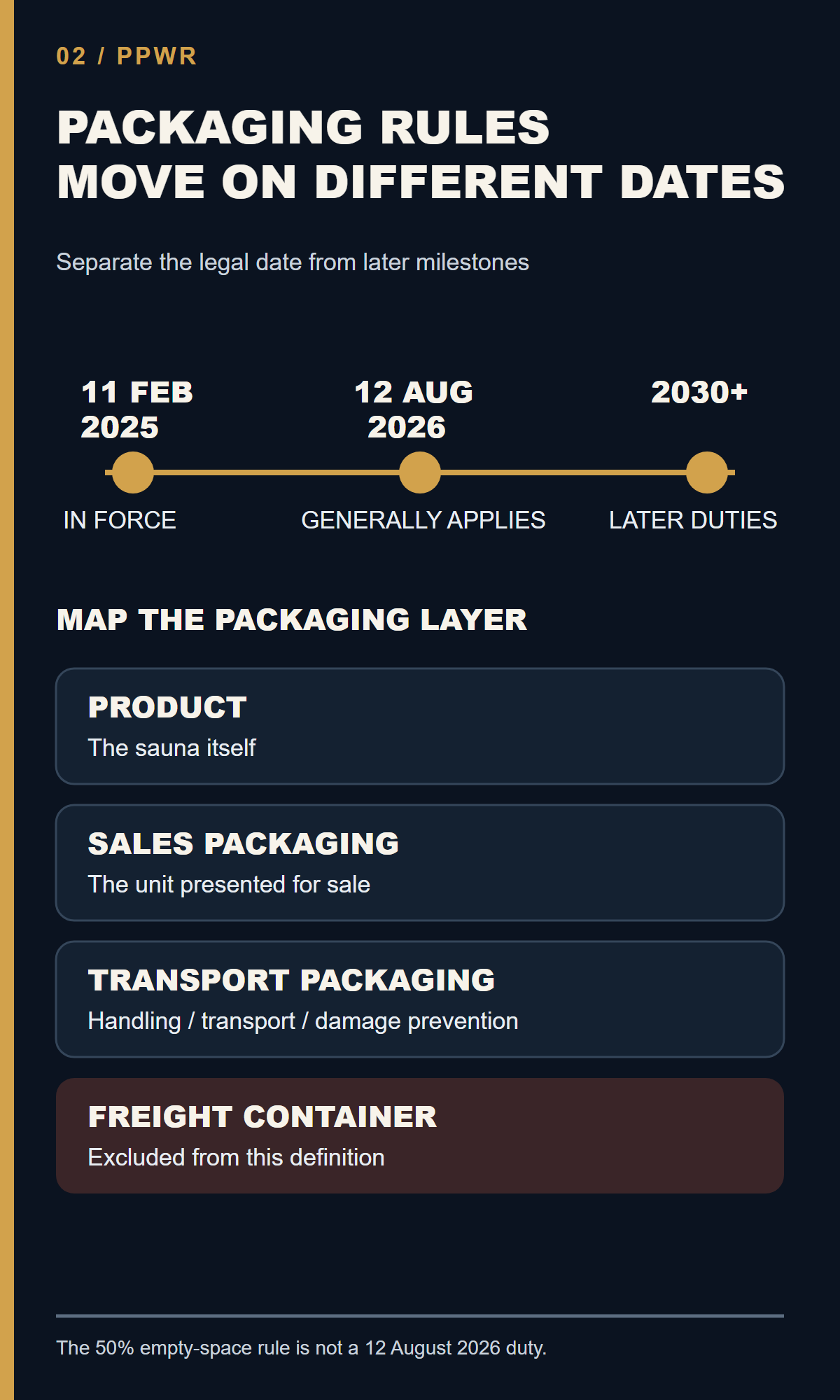
Regulation (EU) 2025/40 entered into force on 11 February 2025 and applies from 12 August 2026.
The dates inside it still matter. Article 10 sets packaging minimisation for 1 January 2030. Article 24 sets a 50% maximum empty-space ratio from 2030 or later. Article 29 starts the main transport-packaging reuse targets on 1 January 2030.
So the 2026 job isn't to stamp “PPWR compliant” on a crate. It is to create a packaging map that can survive those later tests.
Is the sauna crate transport packaging?
PPWR defines transport packaging as packaging designed to help handle and transport one or more sales units while preventing handling and transport damage. Road, rail, ship and air containers are excluded from that definition. A pallet, crate, box, tray, wrap or strap can still be transport packaging inside the container.
Item around the sauna | Likely PPWR question | Record to keep |
|---|---|---|
Pallet or skid | Is it a separate transport-packaging format? | Material, weight, dimensions and supplier |
Protective crate or box | Who designed and branded it? | Drawing, material list and identification |
Wrap and straps | Which listed format and reuse rule applies? | Material and units used per shipment |
Corner and surface protection | Packaging component or part of another unit? | Component specification and disposal route |
Freight container | Excluded from the transport-packaging definition | Keep it outside packaging calculations |
Who owns the packaging conformity file?
The role isn't always the sauna brand. The European Commission's June 2026 PPWR guidance says the manufacturer of transport packaging will normally be the company that makes it. If the user clearly has that packaging designed or manufactured under its own name or trademark, the user normally becomes the manufacturer.
There is a narrow exception. If that brand owner is a micro-enterprise and the packaging supplier is located in the same Member State, the supplier remains the manufacturer for PPWR purposes. Both conditions matter. Record the brand owner's status and the supplier's location before assigning the conformity file.
Situation | Role to test | First document question |
|---|---|---|
Packaging company supplies an unbranded crate | Packaging company is normally the manufacturer | Where are the technical file and EU declaration? |
Sauna company clearly brands the transport packaging | User is normally the packaging manufacturer | Does the micro-enterprise and same-Member-State exception apply? |
Micro-enterprise brand owner, packaging supplier in the same Member State | Packaging supplier remains the manufacturer | Is the micro-enterprise status and supplier location documented? |
Packaging enters the EU from a third country | EU importer duties may apply | Who checked the manufacturer documentation? |
Another party modifies the packaging | Manufacturer duties may move to that party | Could the change affect conformity? |
Article 15 places responsibility on the packaging manufacturer for the applicable requirements in Articles 5 to 12. The manufacturer carries out the conformity assessment, prepares the technical documentation and draws up the EU declaration of conformity. Suppliers must provide the information needed for that file.
This is separate from the product-side role map. Our guide to GPSR duties for an imported outdoor sauna covers the product chain. A product file doesn't replace a packaging file.
Which packaging duties matter from August 2026?
The Commission's 2026 guidance says Article 6 recyclability applies from 12 August 2026, even though later design-for-recycling grades and recycling-at-scale dates phase in after that. The same guidance confirms that the manufacturer owns the conformity assessment and declaration for the requirements that apply to that packaging.
Your first file should identify the packaging and intended use, list materials, hold relevant drawings and include available test reports. Annex VII describes the file. Keep it for 5 years for single-use packaging and 10 years for reusable packaging.
Don't add a consumer sorting label by reflex. Article 12 starts in 2028 or later and excludes transport packaging unless it is e-commerce packaging. Reusable-packaging information has its own timeline.
Does the 40% reuse target catch every sauna crate?
No single answer covers every crate. Article 29 names pallets, boxes, trays, plastic crates, bulk containers, pails, drums, canisters, flexible formats, wraps and straps. For those formats used within the Union, the general target is at least 40% reusable packaging within a reuse system from 2030.
Then test the exceptions. The same article excludes transport packaging for large-scale machinery, equipment and commodities when it is custom-designed for the buyer's individual requirements. It also excludes cardboard boxes. A micro-enterprise is exempt for a calendar year only when it also makes no more than 1,000 kg of packaging available in that Member State.
A sauna crate isn't automatically “large-scale equipment” because it feels large at the loading bay. Record the product, packaging design and order-specific reason, then ask the competent adviser or authority to confirm the classification. Don't build a return system around an untested assumption. Don't claim an exemption on one either.
For imports, the reuse target applies from the first EU warehouse through onward distribution. A consignment going from that warehouse to one final destination doesn't need repacking solely for this rule.
That is the practical answer to: What Changes for Your Sauna Packaging Under PPWR?
What should you ask your packaging supplier now?
Copy-ready PPWR packaging request
Packaging format and intended use: [PALLET / CRATE / BOX / WRAP / STRAP].
Legal manufacturer name and contact: [DETAILS].
Brand or trademark shown on the packaging: [DETAILS].
Material composition and unit weight: [DETAILS].
Dimensions and unavoidable protection space: [DETAILS].
Single-use or reusable within a defined reuse system: [DETAILS].
Applicable PPWR conformity assessment and EU declaration: [FILE REFERENCES].
Technical evidence retained by the manufacturer: [DRAWINGS / SPECIFICATIONS / TESTS].
Planned 2030 reuse or exemption assessment: [OWNER AND REVIEW DATE].
Put one row beside every physical packaging unit. Then photograph the finished pack and reconcile it with the list. Your 2030 calculation starts with units actually used, not the number of packaging lines in a policy document.
You don't need to predict every implementing act this week. Take one packing drawing, identify the legal manufacturer and request the applicable technical file. The declaration beside the drawing is more useful than a green claim printed on the wrap.
Frequently Asked Questions
Does PPWR apply to wooden transport packaging?
Yes. Regulation (EU) 2025/40 covers packaging regardless of material, including packaging used in industry, manufacturing and distribution. A wooden pallet, skid or crate can be transport packaging when it facilitates handling and protects the sauna during transport. Separate plant-health rules such as ISPM 15 may also apply.
Does every transport package need a consumer sorting label?
No. Article 12 excludes transport packaging from the harmonised consumer material-label obligation, except e-commerce packaging. That label also begins in 2028 or later under the implementing timetable. Reusable packaging has separate information rules, so confirm the packaging type before deciding that no future label is needed.
Must every sauna crate be 40% reusable in 2030?
Not automatically. The 40% target applies to named transport formats used within the Union, but Article 29 includes format, use and operator exemptions. Custom packaging for certain large-scale machinery, equipment or commodities can be excluded. Classification needs evidence, and micro-enterprise relief also requires the 1,000 kg threshold.
Who is the manufacturer when a sauna company brands the crate?
The Commission says the transport-packaging maker is normally the manufacturer. A user that has packaging made under its own name or trademark normally takes that role. The exception is a micro-enterprise brand owner whose packaging supplier is in the same Member State. Settle all three facts before assigning the conformity file.
Does filling material reduce the PPWR empty-space ratio?
No. Article 24 says space filled with paper cuttings, air cushions, bubble wrap, foam, wood wool or similar fillers counts as empty space. The 50% maximum for grouped, transport and e-commerce packaging starts in 2030 or later under its implementing timetable and calculation method.
Is PPWR the same as packaging EPR registration?
No. PPWR contains product-design, conformity, labelling, minimisation, reuse and extended producer responsibility rules, but those duties have different actors and dates. A packaging technical file doesn't prove national EPR registration. Keep the conformity workstream and each Member State's producer-registration workstream separate, with named owners for both.
1reading now
Get an email when Giedrius publishes