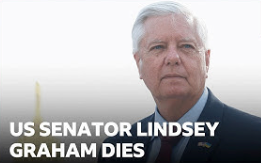
Graham died Saturday evening at 71 - what does it mean for EU?

Graham died Saturday evening at 71 after what his office called a "brief and sudden illness," just after returning from Kyiv — emergency responders were called to his Capitol Hill home for cardiac arrest around 8:30 p.m. The timing is the whole story for Europe: on Friday he had announced an agreement with the Trump administration to move forward on a package of sanctions against Russia, and told reporters in Kyiv "It means it's going to become law" after concluding his 10th wartime visit to Ukraine. He died roughly 24 hours later, at the peak of his leverage.
The sanctions bill loses its engine at the worst moment. The Sanctioning Russia Act — first introduced in 2025 by Graham and Blumenthal, with 500 percent tariffs on countries purchasing Russian-origin petroleum and uranium — has 85 co-sponsors, but stalled for over a year as Thune put it on ice to give Trump space to negotiate. The Friday breakthrough was real, but the legislation hasn't been formally rolled out yet. Two ways this breaks now. Scenario one: memorial momentum — the coalition exists on paper, Blumenthal, Shaheen and Wicker remain, and "pass it for Lindsey" becomes irresistible. Scenario two: death by calendar — the Senate faces the defense policy package and a government funding deadline with only a handful of weeks in session before the midterms, and without Graham personally dragging it to the floor, it slips. The next two to three weeks tell you which.
Europe loses its translator inside Trump's Washington. Graham's unique function was converting Trump's episodic pro-Kyiv moods into durable policy — he was the one Republican who could argue for Ukraine inside the Oval Office without being cast out as a neocon enemy. That mattered right now specifically, because Trump had just agreed to let Ukraine co-produce air defense interceptors and sign a drone deal. Moods pass; laws persist. Graham was the mechanism for making the mood permanent, and the Republican hawk bench behind him is thin and aging — McConnell, 84, was hospitalized just weeks ago.
The seat stays red; the worldview might not. South Carolina is safely Republican and the governor will name a replacement, so the Senate math doesn't move. But Graham had just won the GOP primary to run for re-election in November, so the party also has to pick a new nominee — and if a restrainer replaces a hawk, the internal GOP debate on Ukraine shifts even if the vote count doesn't.
For the eastern flank, this is personal. Zelensky said Graham visited Ukraine ten times during the full-scale invasion and called him a true defender of freedom. The Baltic reaction says everything about how the region saw him — Lithuania's FM Budrys said his commitment earned respect and gratitude across Europe, with Estonia and Latvia calling him a steadfast friend of NATO's eastern flank. One fewer senator who reliably showed up in Vilnius and Kyiv and vouched for Article 5 back in Washington.
The uncomfortable implication for Europe. Graham himself laid it out in February: he said Europe's 20 sanctions packages had limited impact and Europe "needs to up its game". His death sharpens that. Less personal advocacy in Washington means Europe carries more of the weight itself — secondary-sanctions enforcement, defense industrial ramp-up, frozen-asset decisions. Moscow will read this as an irritant removed; Iranian state TV openly celebrated his death on air. The counter-signal Europe needs to send is that pressure on Russia is institutional, not one man's project.
Bottom line — watch two indicators: whether the sanctions text gets introduced and voted within weeks as a tribute, and who South Carolina puts in the seat. If both break right, his death paradoxically locks in his agenda. If not, Europe just lost its most reliable Republican voice at the exact moment the architecture was about to be cemented.
1reading now
- views
Get an email when What's publishes