
What Should You Check in a Sauna Declaration of Performance?

Key Takeaways
First confirm that the Declaration of Performance applies to the exact product and intended use.
Read the product identity, technical reference and declared performance together.
Compare each relevant value or class with the project requirement, not with a generic idea of quality.
“No performance determined” is information, not automatically a defect or approval.
Check versions, variants, dates and authorised sign-off before relying on the document.
A correct declaration does not prove that the completed sauna project complies with every rule.
A Declaration of Performance can be short, technical and easy to overread. We manufacture completed outdoor saunas in Lithuania, but our brand name can't make a declaration fit the wrong product or use. The useful question isn't whether a PDF exists but whether the applicable declaration identifies the product being bought and provides the performance information needed for the intended project.
What Should You Check in a Sauna Declaration of Performance?
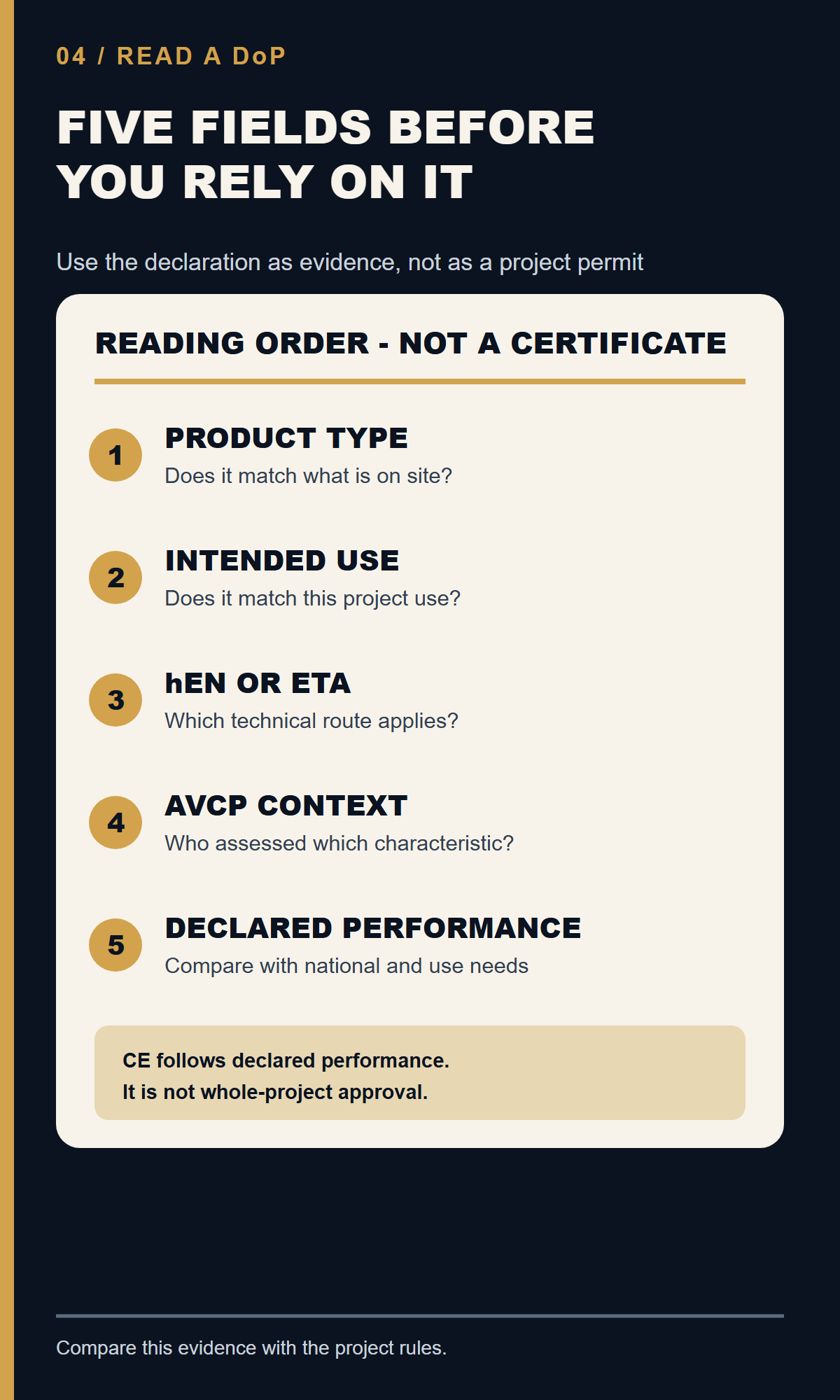
Check that the declaration applies to the exact product or kit, variant and intended use. Verify the manufacturer, product identity, harmonised specification or European Technical Assessment, and any assessment-body details required by that route. Then compare the declared performance for relevant essential characteristics with the project specification. Note missing or undetermined performance, version changes and conditions. This review tests product information. It does not confirm the compliance of the entire sauna project.
Confirm that this is the right declaration
Begin with the document number, unique product type, commercial designation and any serial, batch, size or variant information. Match them against the offer, order and product label. A declaration for a related façade panel, door or cabin variant cannot safely be assumed to cover the item delivered.
Next read the declared intended use. Performance is assessed against a stated use and technical basis. If the project expects another use, environment or installation arrangement, stop and ask the manufacturer to explain the route before comparing numbers.
Identify the technical basis
An applicable declaration should identify the harmonised technical specification, or the European Assessment Document and European Technical Assessment used. Check the precise reference and version. During the transition to Regulation (EU) 2024/3110, declarations can sit under different legal forms, so record the stated legal basis rather than renaming the document yourself.
Where assessment and verification involves a notified body or technical assessment body, check the named body and the role stated. Do not expect the same body entry on every declaration. The required system depends on the product family, technical basis and characteristic being assessed.
Compare declared performance with a written project need
The performance table is the working core. Read the essential characteristic, the declared value, level or class, the assessment method and any conditions together. Then compare it with a requirement written by the architect, engineer, authority or responsible project designer.
A high number is not universally better. A class is only useful when it answers the project requirement. If no requirement has been specified, the declaration cannot make the design decision on the project’s behalf. Ask the responsible designer to define the required performance first.
Declaration field | Review question | Stop signal |
|---|---|---|
Product identity | Does it match the ordered product, variant and label? | Similar name, different size, system or product type |
Intended use | Does it cover the proposed installation and function? | Use is narrower or materially different |
Technical reference | Is the correct specification or ETA and version stated? | Missing, obsolete or unmatched reference |
Declared performance | Does each project-critical value or class meet the written requirement? | Shortfall, unclear unit, condition or classification |
NPD or undetermined entry | Is performance required for this project or destination? | Project needs a result that is not declared |
Issue and sign-off | Is this the current version, signed for the manufacturer? | Superseded, incomplete or unauthorised copy |
Read “NPD” as a prompt for a decision
Older declarations use “NPD”, meaning no performance determined, where a result isn't declared. Under Regulation (EU) 2024/3110, Annex V uses “NULL” for an essential characteristic where no performance is declared. A blank mandatory performance field isn't a third permitted expression. Treat it as a stop signal and ask the manufacturer to correct or explain the document.
Don't quietly replace an NPD or NULL entry with a value from a brochure, test report or another product. Ask for a traceable document that connects the performance to the same product type and assessment route.
Separate document validity from product suitability
A declaration may be correctly prepared while the product is unsuitable for a specific project. Conversely, an unfamiliar document layout is not proof of non-compliance. Review validity and suitability as two separate gates.
The first gate asks whether the declaration is authentic, complete for its applicable framework and matched to the product. The second asks whether the declared performance meets the project brief. This is also why a declaration cannot by itself settle building permission, structural integration, ventilation, electrical design or local fire rules.
Preserve the review trail
Save the declaration version reviewed, the product identifier, the project requirement used for comparison and the date of review. If a supplier replaces a component or updates a product type, repeat the match. A neat record is more useful than an undocumented “CE checked” tick.
The Commission’s Construction Products Regulation FAQ explains that designers prescribe the performance needed for the intended use, while the declaration provides the manufacturer’s assessed performance. The official Regulation (EU) 2024/3110 text sets the newer declaration structure. For the related manufacturer-role question, see our guide to private-label CE responsibilities.
Copyable declaration review sheet
DECLARATION REVIEW
Project and destination country:
Product required by specification:
Delivered product and variant:
Declaration number and issue date:
Manufacturer named:
Declared intended use:
Technical specification or EAD and ETA:
Assessment body and stated role, where applicable:
Project-critical characteristic 1: requirement / declared result / outcome
Project-critical characteristic 2: requirement / declared result / outcome
Project-critical characteristic 3: requirement / declared result / outcome
NPD, NULL, blank or conditional entries requiring action:
Product identity match: YES / NO / UNCLEAR
Project performance match: YES / NO / DESIGNER DECISION
Open questions, owner and due date:
Reviewer and review date:
Frequently Asked Questions
Does a Declaration of Performance approve the whole sauna project?
No. It declares assessed performance for an identified construction product under an applicable technical route. The project team must still select suitable performance and address site design, planning, structural, fire, ventilation and electrical requirements. A valid product document is one input to those decisions, not their replacement.
Does NPD mean the product has failed?
No. Under the older form, NPD means no performance has been determined. The newer Annex V uses NULL where no performance is declared. The practical question is whether the project needs a result. A blank mandatory field is different: pause and request correction. Don't substitute another product's value.
Must every declaration name a notified body?
Not in the same way. The assessment and verification system depends on the product family, technical basis and characteristic. Check what the applicable specification requires, then confirm the body’s stated role and identifier where relevant. An empty field should be assessed against that route, not a generic template.
Can one declaration cover several sauna variants?
It can only be relied on where the product type and declared scope genuinely cover the delivered variant. Match dimensions, materials, system configuration, intended use and identifiers. If a change could affect declared performance, obtain the manufacturer’s written explanation or an updated declaration before accepting the substitute.
When should you request an updated declaration?
Ask when the supplied product, variant, intended use, technical reference or declared performance differs from the reviewed version, or when the manufacturer says the product type has changed. Keep the previous copy in the project record and document why the newer version became the basis for selection.
1reading now
Get an email when Giedrius publishes