Crawls, Sightings, and Referrals: What's Really Happening When AI Reads Your Page

If you have been watching your PUBlish dashboard, you have probably asked yourself this question. Why do we see thousands of crawls, but only a handful of sightings and referrals?
This is normal. It is also one of the most important things to understand if you want AI engines to recommend you. Let's break it down in simple words.
What is a crawl?
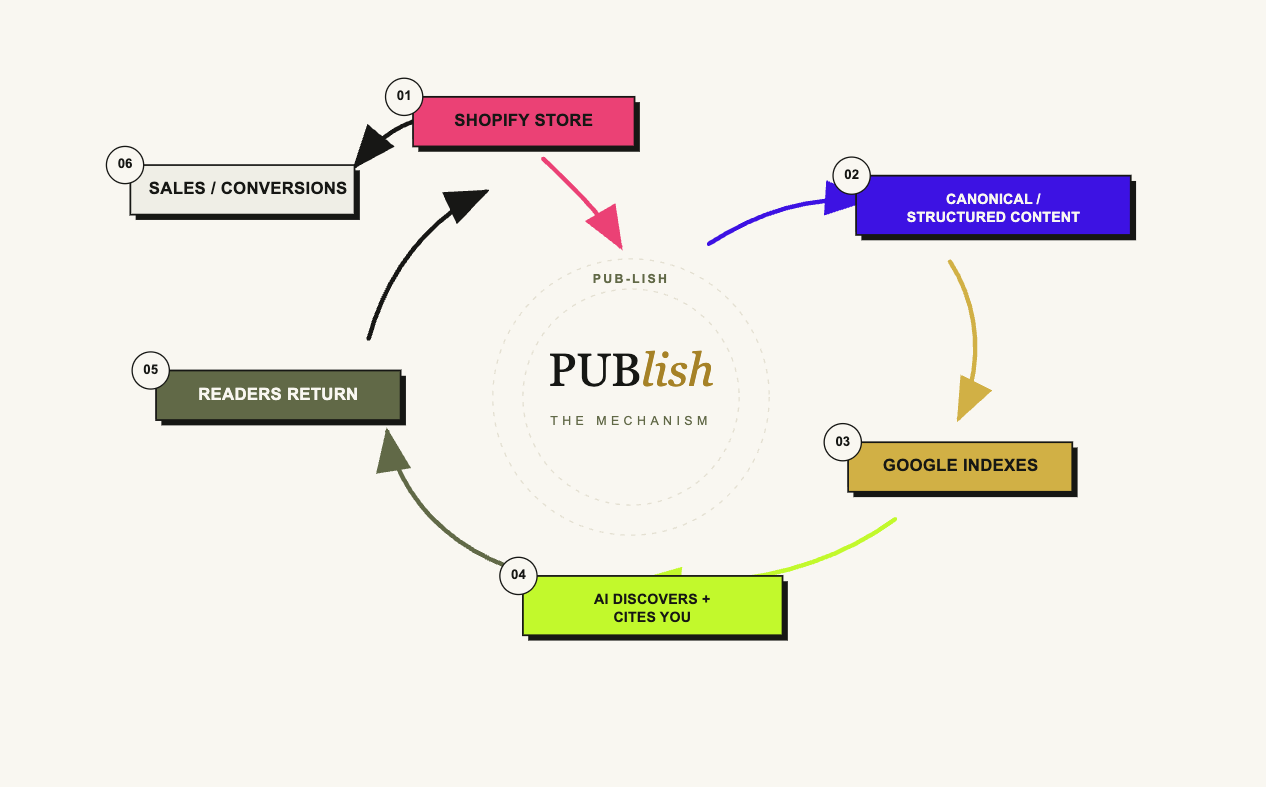
A crawl happens when an AI engine, like ChatGPT, Perplexity, or Google's AI systems, visits your page and reads it. Think of this as the AI walking into a library and picking up a book off the shelf. It is looking, scanning, learning what is inside.
Crawls happen constantly and in huge numbers. Every page you publish can get crawled many times. This is a good sign. It means the AI knows you exist.
But being read is not the same as being chosen.
What is a sighting?
A sighting is different. It happens when the AI actually uses your content to answer someone's question. Someone asks "what's the best software for X" or "who would you recommend for Y", and the AI picks your page, your brand, or your article to build its answer from.
This is the moment your business gets mentioned inside an AI conversation, even if the person never clicks a link.
Why are sightings so much rarer than crawls?
Here is the part that confuses most people. The AI does not crawl one page and answer from it. It crawls tens of thousands of pages on a topic. Then, when someone asks a question, it has to choose which of those thousands of pages actually deserves to be part of the answer.
Being crawled gets you into the room. Being chosen is a different competition entirely.
That choice depends on four things.
Grounding
Does your page actually answer the question clearly, in a way the AI can lift and use? Vague marketing language does not ground well. A direct answer to a direct question does.
Structure
Is your content organized so a machine can understand it fast? Clear headings, FAQ sections, and structured data all help. A wall of unstructured text is much harder for an AI to trust and extract from.
Freshness
Was this page written or updated recently? AI engines lean toward content that feels current, especially for anything comparison or recommendation related.
Authority
Has this brand been mentioned elsewhere? In other articles, in Wikidata, in directories, in other people's writing? The AI is not just reading your page. It is checking whether the rest of the internet agrees you are worth mentioning.
Why does having more sightings matter so much?
Because sightings compound. Every time your brand gets cited by an AI, or mentioned in another article, or referenced somewhere online, it adds a small signal of trust. On its own, one mention feels small. But these signals stack over time, the same way interest compounds in a savings account.
A brand with ten real mentions across the web looks far more trustworthy to an AI than a brand with zero, even if both have equally good pages. This is why chasing likes and short term attention misses the point. Citations and mentions build a foundation that keeps paying you back, long after the content was published.
More sightings today mean a much higher chance of being the answer tomorrow, when someone asks an AI what to buy, who to hire, or what to choose.
So what should you actually do?
Focus on the four things that drive selection.
Answer real questions directly, in plain language. Structure your pages so they are easy to read and easy to extract from. Keep your most important pages fresh and updated. And build authority by getting mentioned, cited, and referenced beyond your own site, not just on it.
Crawls tell you that you exist. Sightings tell you that you are trusted. Referrals tell you that people are ready to act. All three matter, but they are not the same thing, and they should not be measured the same way.
Frequently asked questions
1. Why do I have so many crawls but almost no sightings? Crawling is just the AI reading your page. Sightings happen only when the AI decides your page is the best answer among thousands of others it has read. High crawls with low sightings usually means you need stronger grounding, structure, or authority signals, not more content volume.
2. Does posting more content increase my sightings? Only if the new content is grounded, well structured, and adds real authority. Publishing more low quality pages does not help. A smaller number of clear, well structured, authoritative pages will outperform a large volume of thin ones.
3. How long does it take to see more sightings? Authority builds over time, similar to SEO. Consistent, well structured publishing combined with external mentions tends to show compounding results over weeks and months, not days.
4. HOT QUESTION: Is it okay to publish AI written content? Yes. AI engines do not penalize content just because it was AI assisted. What matters is whether the content is accurate, clear, and genuinely useful. Quality and grounding are what get you chosen, not who typed the first draft.
5. Even if the AI did a good job, should I still edit it before publishing? Yes, always. Read it once as your customer would. Add a real detail only you would know, a specific number, a product fact, a small story. This is what separates a page that sounds like everyone else from one that sounds like you. It also builds the authority signal we talked about above, because it makes your page harder to confuse with a generic answer.
6. How important are images? Very important for readers, and helpful for AI too. A page with real, relevant images looks more trustworthy and complete, both to a human and to an AI evaluating whether your page deserves to be cited. Use real product or brand photos where you can. Avoid generic stock images that could belong to anyone.
7. Should I use tags? Yes, but keep them simple and specific to your topic. Tags help organize your content and help search and AI systems understand what your page is actually about. Avoid stuffing in tags that do not truly relate to the piece.
8. What about hashtags? Use a few relevant hashtags when you share the PUBlish post on social platforms. Do not add hashtags inside the article itself, they do not help AI engines or search engines understand your content.
9. Should I link to my own previous articles inside a new post? Yes. Linking to your own related pieces helps AI and search engines see your content as connected and complete, not a single isolated page. It also shows depth on a topic, which supports the authority signal. Only link when it is genuinely relevant, do not force it.
10. Does sharing my post on other social media platforms actually help? Yes, and here is what it actually does. It does not directly change how an AI engine reads your page. What it does is create more mentions and more traffic signals around your brand across the internet. Over time, those extra mentions add to your authority signal, the same one we described earlier. More places talking about you, in a real and organic way, means AI systems have more reasons to trust and cite you.
11. Can sharing everywhere ever hurt me instead of helping? Not really, only if it is done badly, like a spam. Posting the exact same text everywhere with no context on Whatsapp with no explanation, or spamming links on email without real value, does not build authority, it just creates noise. Sharing your piece with a short, honest introduction on each platform, in a way that fits that platform, is what actually helps.
Have questions about your own crawl and sighting numbers? Reach out to your PUBlish team, we are always happy to walk through your dashboard together.
1reading now
Watch & subscribe
PUBlish also publishes on YouTube
4 subscribers
One click subscribes you on YouTube - you stay here on PUBlish.
Get an email when PUBlish publishes