What Test Conditions Make Sauna Heat-Up Times Comparable?
Key Takeaways
Comparable heat-up times need the same start state, finish rule and measurement boundary.
Record the cabin, heater, controls, ventilation and enabled auxiliary loads before every run.
Use one agreed sensor position rather than the controller display alone.
Start the meter and timer together, then retain the raw time-stamped records.
Door openings, control changes and interrupted runs belong in the deviation log.
Reject a heat-up claim when its test conditions cannot be reconstructed.
A heat-up time becomes useful only when another team can repeat the test. We preassemble and check each sauna at our Klaipėda facility, where small configuration changes are visible before shipment. The method below fixes one test boundary and one recording sheet so a second team can reproduce the comparison.
What Test Conditions Make Sauna Heat-Up Times Comparable?
Sauna heat-up times are comparable when both tests use the same cabin configuration, starting condition, surrounding climate, control settings, sensor position and finish rule. The electrical measurement boundary must also match. Start the energy meter and timer together. Record temperature and control events on one time base. If a door opens, a setting changes or a run is interrupted, mark the deviation. A time without those conditions is a product claim, not comparable evidence.
Why can two precise heat-up times still disagree?
A stopwatch looks objective. The start and finish are not.
One test may begin with a cold cabin after an overnight shutdown. Another may begin while the timber, stones or surrounding structure still hold heat. One operator may stop when the controller display reaches its set point. Another may stop when a separate sensor reaches the agreed condition.
The cabins can differ too. Glazing, internal volume, ventilation state, heater and controller all belong in the record. So do lights or other loads if they sit inside the meter boundary. A polished time figure cannot repair an undefined test.
ISO reviewed and confirmed ISO 50015:2014 in 2025. It remains current and gives general principles for measuring and verifying energy performance. It doesn't prescribe a universal hotel-sauna heat-up test. The useful discipline is to define the measurement and the conditions that can change it.
The U.S. Department of Energy reaches the same practical point in its measurement and verification guidance. It lists equipment, occupancy, nameplate data, energy use and control strategies among baseline physical conditions. A hotel sauna is a smaller system. The need for a written baseline remains.
Which boundary should the hotel freeze before testing?
Freeze the test on paper before anyone switches the heater on. Six fields are enough to expose most non-comparable results.
Field | Record before the run | Stop condition |
|---|---|---|
Cabin | Model revision, internal volume, glazing and construction | Unknown or changed configuration |
Plant | Heater, controller and enabled auxiliaries | Different equipment or operating mode |
Start | Cabin, heater-stone and surrounding condition | Residual heat is not documented |
Climate | Location, ambient condition and exposure | Surroundings differ without explanation |
Measurement | Meter boundary, sensor identity, position and logging clock | Different loads or time bases |
Finish | Target condition and exact end rule | The endpoint depends on operator judgement |
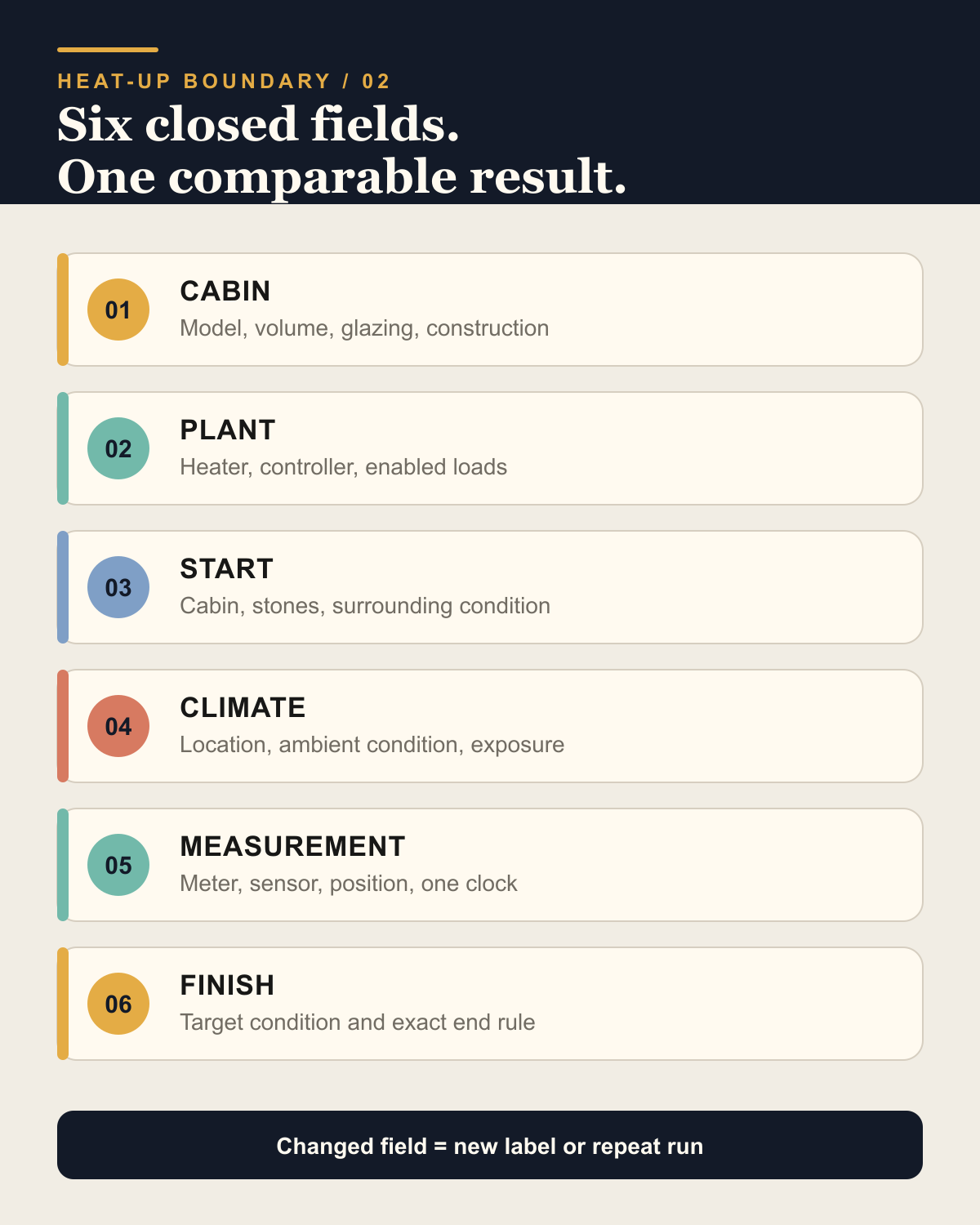
A comparable heat-up result closes six boundaries before the run. If one boundary changes, the result needs a new label or a repeat test.
The electrical arrangement belongs in the test boundary because heater and supply configuration shape the job being measured. For the installation handover, read How Should Your Electrician Wire an Outdoor Sauna Heater?. Keep this heat-up protocol narrower. Record the exact heater, controller, supply and enabled loads used in the test.
How should the sensor and finish rule be written?
Choose the sensor and finish rule together. A target temperature without a named sensor position is incomplete. The controller's own reading can remain in the log, but it shouldn't silently replace the agreed test sensor.
Write the endpoint as an observable event:
“The heat-up run ends when [identified sensor] at [recorded position] satisfies [agreed target rule], while the controller remains in [recorded mode].”
This wording does two jobs. It keeps the finish out of the operator's judgement, and it lets another team reconstruct the test. If the sensor moves between runs, label the results as a different series.
Don't promote one point reading into proof that every bench or surface has reached the same condition. If the hotel needs a wider comfort or safety assessment, specify that separately with the responsible technical team.
How should the hotel run and record each heat-up test?
Use one written sheet for preparation, the live run and the exception record. The order matters.
1. Confirm the prepared state
Identify the cabin, heater, controller, sensor and meter. Photograph their positions. Record the surrounding condition, ventilation mode, set point and auxiliary loads. Confirm that the agreed start rule has been met before starting either clock.
2. Start one clock
Start the meter record, temperature log and elapsed-time record from the same event. Keep their clocks aligned. Don't rebuild the result later from screenshots with different time bases.
3. Protect the run
Keep the agreed door state and control mode. Record any intervention immediately. A door opening, controller adjustment, power interruption or sensor movement doesn't disappear because the graph still looks smooth.
4. Apply the finish rule
Stop at the defined sensor event. Retain elapsed time, measured energy and the full trace. A single result line without its raw record is not enough for procurement or commissioning.
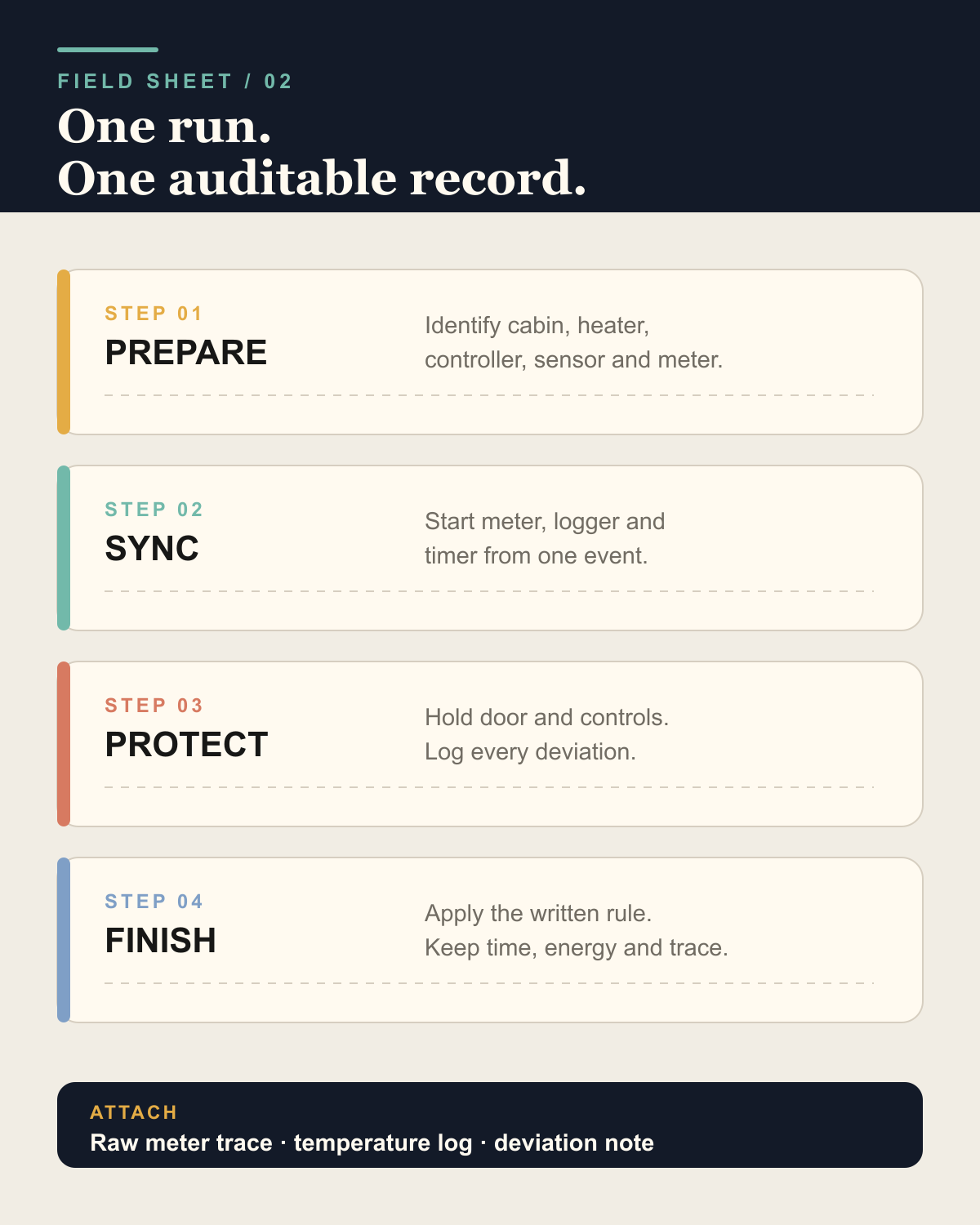
The recording sheet keeps preparation, timing, conditions and deviations on one page. It turns a stopwatch result into evidence another team can audit.
What should the final result line contain?
Report the result as a sentence, not a floating duration. Include the exact sauna configuration, starting state, ambient record, sensor and finish rule, meter boundary, elapsed time, energy and deviations. Keep the raw files attached.
Use this copyable line:
“[Sauna identification] moved from [start rule] to [finish rule] in [measured elapsed time], using [measured energy] inside [electrical boundary], under [recorded climate and controls], with [deviations or none recorded].”
STOP: don't compare two heat-up times when their starting state, sensor, finish rule or electrical boundary differs. Re-run the test or present the difference as a condition, not as performance.
You don't need to redesign the whole commissioning plan today. Print the boundary diagram and make the next supplier complete it before testing. The completed page is the thing procurement can compare.
Frequently asked questions
Should a sauna heat-up test begin from room temperature?
Only if “room temperature” is defined and measured for that test. Record the cabin, heater-stone and surrounding conditions under one start rule. A cabin that retains heat from an earlier run isn't comparable with one that has reached the agreed cold start, even when both room readings look similar.
Can the controller display be the heat-up test sensor?
It can be part of the record when the hotel identifies its sensor and position. It shouldn't become an unnamed proxy for the room condition. For comparisons, use the same agreed sensor position and finish rule, while keeping the controller reading as supporting operational data.
Should heat-up energy and heat-up time be reported together?
Yes. Time describes service availability, while measured energy describes consumption inside the stated boundary. Neither alone proves a better result. Report both beside the start state, target rule, controls and deviations so the hotel can judge the same delivered job.
How many heat-up runs does a hotel need?
There is no universal count for every cabin and site. Repeat enough matched runs to show whether the result is stable under the hotel's chosen conditions. Keep every valid trace, document exclusions and investigate wide variation before publishing an average or ranking suppliers.
Does an outdoor factory test predict hotel heat-up time?
Not by itself. A factory test can compare products under a controlled protocol. The hotel's location, surrounding climate, installation, ventilation and operating schedule can change the installed result. Treat factory and site records as different evidence sets unless their conditions genuinely match.
1reading
Written by
 Giedrius PatlabaCEO & co-founder, Wood Architects163 pieces · 30 followers
Follow Giedrius to see new posts in your feed, on your phone or by email.