Should Your Hotel Connect Its Sauna to a Building Management System?
Key Takeaways
Connect a sauna only when the BMS solves a named operating problem.
Begin with trustworthy status and meter data before allowing commands.
Pass five gates: purpose, source, points, authority and failure state.
The EPBD does not create a blanket duty to connect every sauna.
A Wi-Fi app is not proof of a documented BMS interface.
Block command integration when the exact controller and safety documentation are missing.
A BMS connection can make sauna operation visible, but visibility isn't the same as safe control. We build and factory-check saunas in Klaipėda, so we treat every control boundary as part of the supplied system. The five gates below define what the hotel may monitor, command and refuse.
Should Your Hotel Connect Its Sauna to a Building Management System?
Your hotel should connect its sauna to a building management system only when the integration solves a defined operating problem and the exact equipment documentation supports every exchanged point. Start with read-only status, schedule and independently metered energy. Add commands only after the controller manufacturer, sauna supplier, electrical designer and hotel operator agree the command path, safety devices, permissions and failure state. A mobile app, Wi-Fi label or generic gateway does not prove BMS compatibility or safe remote starting.
What problem should the connection solve?
Don't begin with a protocol. Begin with the decision the hotel cannot make today. Perhaps engineering cannot see whether the sauna is energised after closing. Perhaps operations cannot compare the booking schedule with actual runtime. Perhaps a technical manager wants one place to see controller faults and submeter data.
Those are different jobs. They need different points, owners and responses. A dashboard-only project may need status and energy data. A scheduling project may need a controlled start request. A maintenance project may need a fault code with exact controller meaning. Combining them under “BMS integration” hides the risky part.
At building level, the consolidated Energy Performance of Buildings Directive says building automation and control systems should monitor, log and analyse energy use, support adjustment, detect efficiency losses and communicate with connected systems. It does not say that every hotel sauna must be connected to a BMS.
The same directive defines building automation around energy-efficient, economical and safe operation, including manual management. That ordering matters. The integration must preserve the sauna system's own safety logic. Convenience sits behind that boundary.
Which five gates must an integration pass?
Use one page before anyone prices hardware. Each gate ends in a signed answer. An empty gate means the connection is not ready for commands.
Gate | Evidence to record | Stop condition |
|---|---|---|
Purpose | The operating decision and accountable owner | No named problem or user |
Source | Exact heater, controller, revision and interface document | Generic brochure or assumed compatibility |
Points | Each status, value, alarm and command with units | Unknown meaning, stale value or undocumented write |
Authority | Who may view, acknowledge, schedule or command | Shared access without named roles |
Failure state | Behaviour after lost network, bad data or rejected command | No tested safe response |
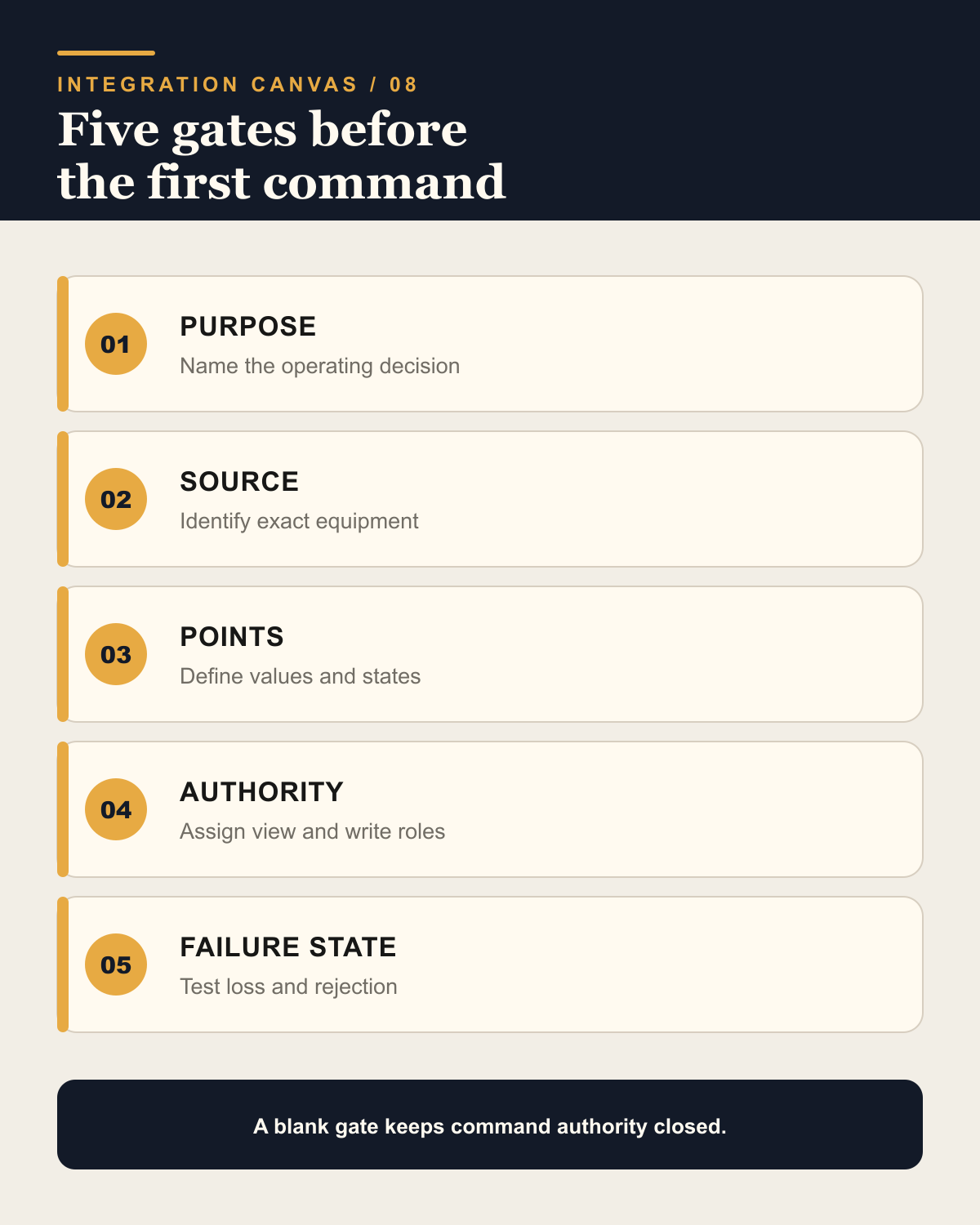
The five gates turn a vague integration request into an evidence trail. Monitoring may pass while command authority remains closed.
This is what a hotel should ask for:
“Operating problem this connection solves: [one sentence].”
“Exact equipment and firmware or revision: [identifiers].”
“Read points with units and update behaviour: [point list].”
“Write points with accepted and rejected states: [command list].”
“Local safety devices that remain authoritative: [document references].”
“Network-loss and restart behaviour tested on: [date and witness].”
Where should the command boundary sit?
Put observation on one side and actuation on the other. Energy, run status, controller state and faults may be useful read points. Start, stop, set-point and schedule changes are commands. They alter the service. Some can also interact with product-specific remote-use conditions.
The U.S. Department of Energy's EMIS guidance, checked on 25 August 2026, separates interval analytics, fault detection and supervisory control. That is a useful design discipline. The presence of data does not automatically grant authority to write back.
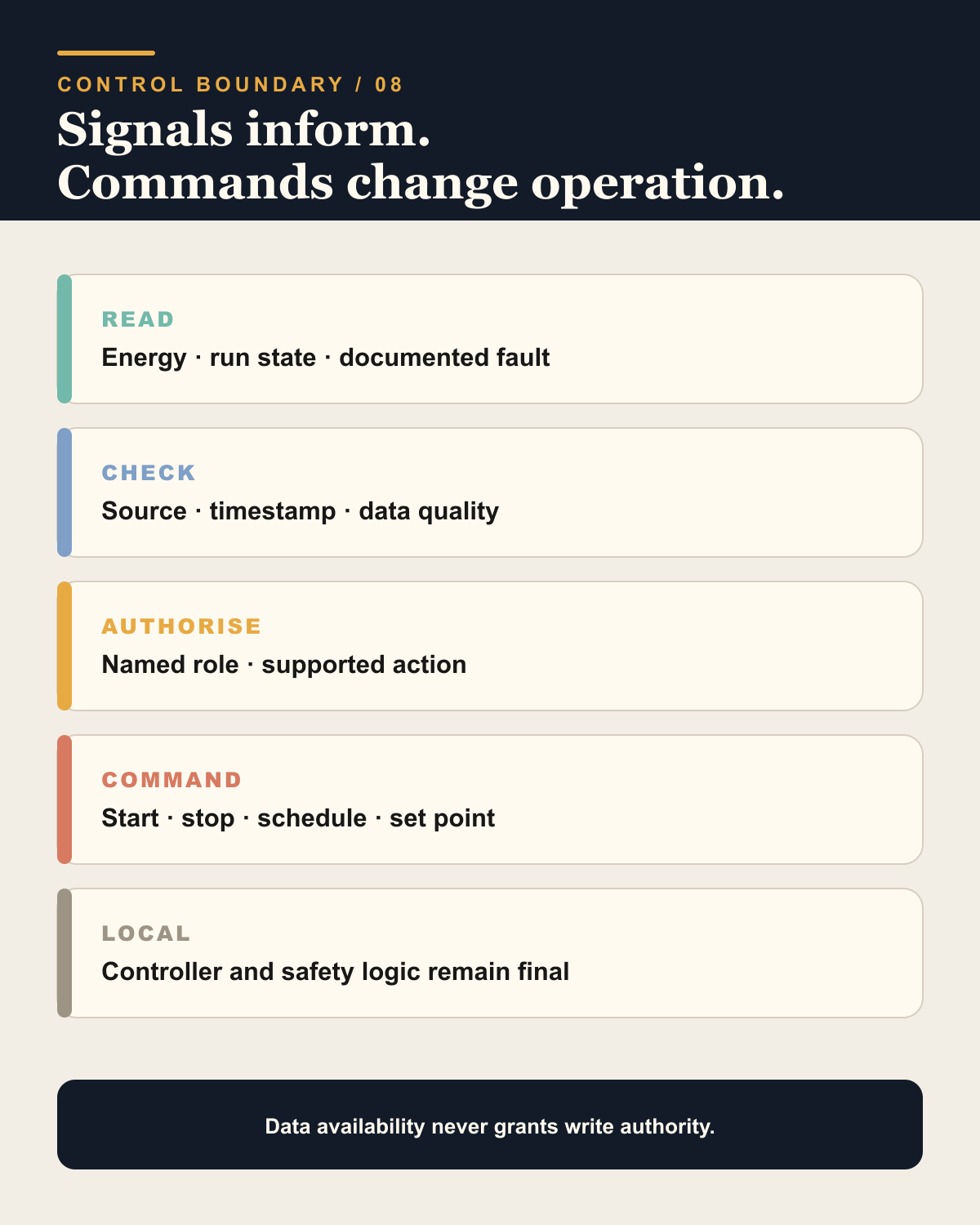
Read points create visibility. Commands change operation. The local controller and documented safety devices remain the final authority.
Product detail is decisive here. Harvia's current Xenio WiFi page describes MyHarvia functions for product CX001WIFI and says features vary with connected devices. It describes Wi-Fi and mobile control. It does not document a generic BACnet, Modbus or other BMS interface on that page.
Harvia's door-switch support page, updated on 25 August 2026, says that door-switch arrangement is not suitable for public saunas and recommends its SFE safety device for professional use. The separate SFE instructions apply to named Xenio, Fenix and VKK products. Those are product-specific limits, not a universal remote-start recipe.
The public abstract for IEC 60335-2-53:2011 covers electric sauna heating appliances and notes requirements for electronic interlocks. The public material does not expose enough detail to design a remote command sequence. Use the applicable full standard, local rules and exact equipment instructions in the project file.
How should the hotel commission the connection?
Commission in two stages. First, prove the read path. Compare BMS status against the local controller and compare imported energy with the dedicated meter. Log timestamps, missing values, stale values and communication loss. A point that looks plausible but cannot be reconciled is not ready for an alert.
Second, test each authorised command under witnessed conditions. Record who issued it, what the local controller displayed, whether safety inputs stayed effective, how the system rejected an invalid state and what happened after network loss. Don't infer any step from another controller model.
Keep the operating brief beside the technical one. How Should a Hotel Control Light Spill From a Panoramic Sauna? shows how one hotel requirement becomes a defined control boundary. A BMS gateway cannot repair an unclear responsibility, command path or acceptance test.
STOP: don't enable BMS commands when the exact controller documentation, point list, safety arrangement or tested failure state is missing. Keep the connection read-only until every write has an owner and a witnessed result.
You don't need to integrate everything in the first phase. Print the five-gate canvas and approve one useful read point with its source document. The empty command column is a safer decision than a write nobody can defend.
Frequently asked questions
Does the EPBD require a hotel sauna to connect to the BMS?
No blanket sauna connection duty appears in the cited EPBD provisions. The directive sets capabilities and thresholds for building automation in specified buildings and systems. A hotel must assess its national implementation and project scope. Don't convert a building-level requirement into an unsupported appliance-level mandate.
Can a Wi-Fi sauna controller connect directly to a BMS?
Only if the exact controller documentation identifies a supported interface or an approved gateway and defines the exchanged points. Wi-Fi or app control proves neither BMS compatibility nor safe command behaviour. Record the controller model, revision, interface document and every read or write point before procurement.
Should the BMS be allowed to start the sauna remotely?
Not by default. Remote start should remain blocked until the exact heater and controller instructions, professional-use safety arrangement, local electrical design and commissioned failure tests support it. A read-only status connection can still deliver operating value without turning the BMS into a remote-start authority.
Which sauna data should a hotel send to the BMS?
Send only data that serves a named decision and has a defined source, unit, timestamp and quality state. Useful candidates may include independently metered energy, run status and documented faults. Final point selection depends on the installed equipment. A generic list must never replace its point documentation.
Who should own a hotel sauna BMS integration?
Give one person operational ownership, then name the technical contributors. The hotel operator defines the service, the controls integrator maps points, the electrical designer checks the installation and the equipment supplier confirms product limits. The commissioning record should show who accepted every command and failure test.
1reading
Written by
 Giedrius PatlabaCEO & co-founder, Wood Architects163 pieces · 30 followers
Follow Giedrius to see new posts in your feed, on your phone or by email.