What Determines Whether Your Fertiliser Subsidy Pays Off?
A fertiliser subsidy pays off when two numbers are high enough: how much each subsidised tonne adds to the fertiliser farmers would have used anyway, and how much grain each kilo of nutrient produces on farmers' own fields.
The tonnes you ship are not the tonnes you add.
If you run or fund an input subsidy programme, your finance ministry will ask this. The best summary of the evidence is the review by Jayne, Mason, Burke and Ariga, Taking stock of Africa's second-generation agricultural input subsidy programs, published in Food Policy in 2018. It synthesised nearly 80 studies from Ghana, Nigeria, Kenya, Tanzania, Malawi, Zambia and Ethiopia. The ten countries it covers spent roughly 600 million to 1 billion US dollars a year on these programmes, about 14 to 26% of their combined public spending on agriculture.
The first number: how much fertiliser the subsidy really adds
Some subsidised fertiliser replaces fertiliser farmers would have bought at market price. Economists call this crowding out. The review reports that each additional 100 kg of programme fertiliser crowds out up to 50 kg of commercial fertiliser in Kenya, 35 kg in Nigeria, 18 kg in Malawi and 13 kg in Zambia. Crowding out is largest where private dealers were already strong, as in Kenya.
Then there is diversion: programme fertiliser that is resold at or near commercial prices instead of reaching the intended farmer. With diversion estimated at 33%, the review calculates that one tonne of programme fertiliser raised total fertiliser use by only 0.38 tonnes in Kenya, 0.55 in Malawi and 0.58 in Zambia.
Only two cases showed the opposite, where subsidies pulled in extra commercial demand: a voucher pilot in Kano State, Nigeria, and parts of Zambia with little private retailing.
The second number: how much grain each kilo of nutrient produces
Programme appraisals often borrow response rates from researcher-managed trials. In east and southern Africa those trials typically show 18 to 40 kg of maize per kg of nitrogen. Surveys of farmer-managed fields, summarised in the same review, show 5 to 26 kg, with most estimates below 15.
The soil explains much of the gap. In Zambia, the review cites average responses of 2.1 kg of maize per kg of basal fertiliser on highly acidic soils (pH 4.3 and below, 51% of maize plots in the sample), 3.7 kg on moderately acidic soils and 7.8 kg on less acidic soils. Low pH, low soil organic matter and sandy texture are all linked to lower response.
As I wrote in Why Africa's Fertiliser Crisis Is Really an Allocation Crisis, fertiliser that reaches a soil which cannot use it is money spent twice: once on the import, once on the lost harvest.
Why the two numbers multiply
The arithmetic is simple. Extra grain equals the fertiliser the programme really adds multiplied by the response on farmers' fields. A programme that ships 100,000 tonnes with a net addition of 0.38 and a response of 10 kg per kg delivers a fraction of what a plan assuming full addition and trial-plot response promises. Profitability for the farmer follows the same logic: the review notes that a value-cost ratio of two is the usual benchmark for reliably profitable fertiliser use, and that most survey-based estimates fall between one and two.
So target areas where private markets are weak, track where the fertiliser goes, and treat the response rate as something the programme can raise: lime where acidity blocks it, organic matter where soils are depleted, inputs that improve nutrient uptake.
Where a nutrient-efficiency input fits
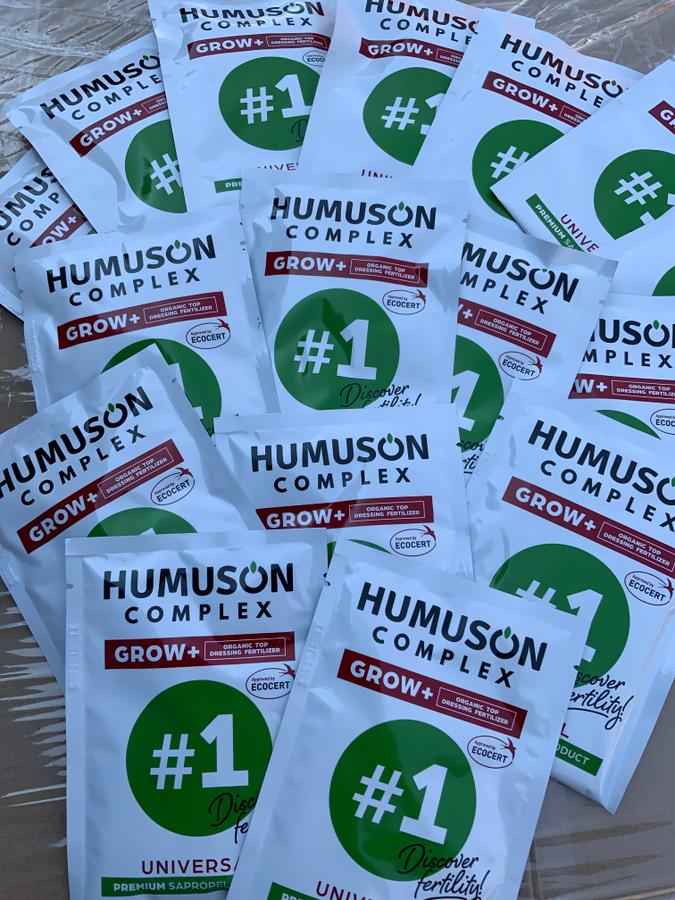
At Sapropel Organics we make HUMUSON, a plant biostimulant from freshwater lake sapropel, manufactured in the EU under Regulation (EU) 2019/1009. In tested conditions it has enabled a 25 to 50% reduction of the standard mineral NPK programme while maintaining productivity. In three seasons of tobacco trials with the Tobacco Research Board in Zimbabwe, 75% and 50% fertiliser plus HUMUSON stayed within the trial's least significant difference of the full programme. As arithmetic, not a yield promise: a 25% cut lets the same fertiliser stock cover about 30 to 33% more hectares.
To be precise about scope: it does not replace the N, P and K a crop needs, and it is not a substitute for lime on a strongly acidic soil. HUMUSON alone, without mineral fertiliser, yielded clearly less in the trials.
The takeaway
A subsidy budget buys tonnes, but the ministry is paying for grain. Measure what each tonne adds and what each kilo yields on farmers' own fields, and fund the soil conditions that raise the response. That is where the return on the next subsidy round will come from.
If you design or implement a fertiliser subsidy or soil-health programme and want to see the Zimbabwe tobacco and Kenya tea trial reports before your next procurement round, let's talk.
Related questions
What is crowding out in a fertiliser subsidy? It is when subsidised fertiliser replaces fertiliser farmers would have bought anyway, so total use rises by less than the tonnes distributed.
Why do farmers get lower fertiliser response than trial plots? Acidic, low-organic-matter and sandy soils, plus real farm constraints, cut the grain each kilo of nutrient produces.
What value-cost ratio makes fertiliser worth using? A ratio of two is the usual benchmark for reliably profitable use; a ratio of one is only break-even.
Sources
1reading
Written by
 AurimasSoil regeneration / organic fertilizer (Agronomy)32 pieces · 19 followers
Follow Aurimas to see new posts in your feed, on your phone or by email.