Why Africa's Fertiliser Crisis Is Really an Allocation Crisis
The global fertiliser crisis is no longer a forecast. It is already underway. Cargoes have been physically blocked, prices have spiked, phosphate plants have cut or stopped production, and the world's largest importers are making emergency purchases. And beneath the headline of "expensive fertiliser" sits a harder problem: this has become a crisis of allocation. Fertiliser may exist somewhere in the world, but the real question is whether a given importer can secure it, at an affordable price, before the planting window closes.
The cargoes that never arrived
The disruption is measurable. By the end of April 2026, the International Fertilizer Association reported roughly 800,000 tonnes of urea loaded on 17 vessels but blocked west of the Strait of Hormuz, alongside about 400,000 tonnes of stranded sulphur and 150,000 tonnes of stranded phosphate fertiliser. Only two urea vessels, carrying around 85,000 tonnes, escaped the Gulf during that period. The World Bank reports fertiliser prices at their highest since 2022, with urea near $725/t — up roughly 55% in a single month — and forecasts a rise of more than 30% across 2026.
Why the supply can't simply be replaced this cycle
Natural gas is 80–90% of ammonia production cost, and ammonia is the foundation of urea and most nitrogen fertiliser; the Strait of Hormuz alone normally carries about 34% of internationally traded urea. New gas, ammonia and urea capacity takes years to build, not one farming season. Phosphate is no easier: with sulphur scarce, its share of DAP/MAP cash production cost jumped from roughly 10–20% to around 65%, so even countries with phosphate rock cannot make fertiliser without it. And the usual fallbacks are unreliable — Russia is increasingly constrained by war damage and export controls, and China now manages exports around its own food-security priorities.
The big buyers are taking what remains
This is where allocation bites. India, the world's largest urea importer, tendered for 2.5 million tonnes and paid roughly $935–959/t — nearly double the price of two months earlier — and has secured around 3.8 million tonnes through global tenders. Australia created a $7.5 billion Fuel and Fertiliser Security Facility to back 340,000 tonnes of urea for its farmers. The EU has moved to suspend duties on nitrogen imports to compete. Smaller, less-financed buyers — much of Africa — are left to secure what remains after the wealthy and the large have been satisfied.
Africa's shortfall is already reaching the field
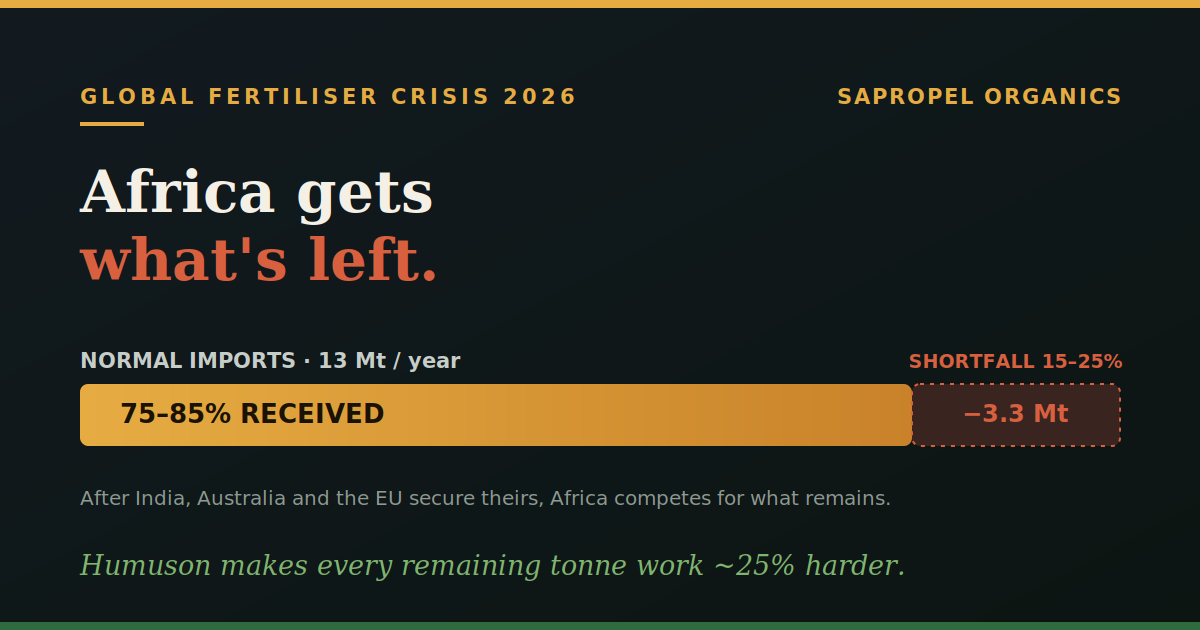
Africa normally imports roughly 13 million tonnes of fertiliser a year. Our central scenario for the 2026/27 cycle is that it receives only 75–85% of that — a 15–25% shortfall of roughly 2.0–3.3 million tonnes, with a severe-case risk of 25–35%. This is not abstract: in Tanzania and Kenya, farmers are already reducing fertiliser application, cutting cultivated area, or skipping basal applications because of price and availability. A shortage becomes demand destruction — farmers do not stop needing fertiliser; they simply become unable to obtain or afford it, and the smaller harvest arrives months later.
The question has changed
For governments and farmers, the question is no longer only "how do we get more fertiliser?" It is becoming "how do we produce the required harvest with less mineral fertiliser?" That single shift moves fertiliser-efficiency technologies out of the category of optional optimisation and into the category of strategic food-security tools.
Humuson as a risk-mitigation strategy
This is precisely where Humuson Complex fits — not as a replacement for NPK, but as a way to make every available tonne of mineral fertiliser work harder. Made from sapropel, it improves nutrient-use efficiency by around 25% and helps the crop absorb nutrients already in the soil. If a country needs 100 units of mineral fertiliser but can obtain only 75–85, an input that lifts efficiency helps close part of that gap. That protects harvests, farmer income and food affordability — it cannot undo the geopolitics, but it can soften the economic and food-security consequences. This connects directly to our earlier piece on the 2026 fertiliser market.
If you work in agricultural policy, food security or fertiliser distribution across Africa and beyond, this is the conversation to have now — before the next procurement cycle closes.
1reading now
Written by
 AurimasSoil regeneration / organic fertilizer (Agronomy)28 pieces · 17 followers
Follow Aurimas to see new posts in your feed, on your phone or by email.
- views