Who Should Control a Hotel Sauna: Guests or Staff?
Key Takeaways
Guests use only the actions deliberately exposed to them.
Staff control the operating limits and the room-release decision.
Technicians verify every permission against the selected product manual.
A lit control panel doesn't prove that the operating model works.
Undocumented permissions stay locked until the supplier confirms them.
Accept the whole request, release, door-state and record path.
Consider this operating scene. A guest sees a control beside the sauna and assumes every visible setting is theirs to change. Reception expects the controller to prevent the wrong action. Facilities expects reception to reset any fault. The technician supplied working hardware, yet nobody wrote down where one role ends and the next begins.
Who Should Control a Hotel Sauna: Guests or Staff?
Guests can control only the simple actions that the hotel, supplier and selected controller deliberately expose. Staff need authority over operating limits, room release, fault handling and the record of each check. A technician or administrator protects configuration that requires product knowledge. The right split is therefore not “guest or staff” in the abstract. It is an action-by-action permissions sheet, tested with the exact controller before the first bookable session.
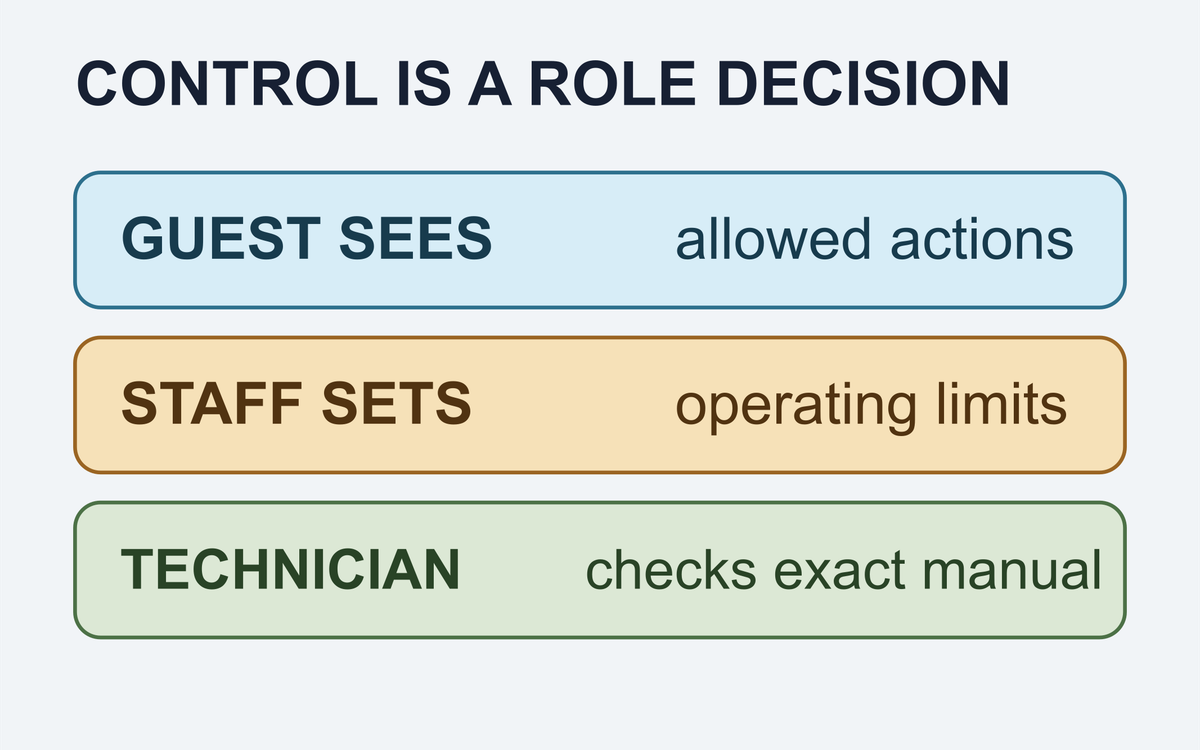
This editorial card shows a role boundary, not an installed controller, hotel system, permission set or approved operating model.
What belongs on the permissions sheet?
Start with actions, not job titles. List what a guest can request, what duty staff can release or reset, and which settings remain behind an administrator or technician boundary. Add the exact screen, physical control or documented procedure used for each action. If the manual is silent, write “unknown”. Don't invent a permission from an attractive interface.
As checked on 22 August 2026, the UK Health and Safety Executive's training and competence guidance says people who use work equipment need adequate information, instruction and training, with supervision proportionate to the risk. That is GB workplace guidance. It supports training hotel employees for their equipment role. It does not allocate permissions to guests or approve remote operation.
At Wood Architects, we fit quality heaters from Harvia and HUUM, but a heater brand still doesn't decide the hotel's permission model. The chosen controller, its options, the property operating plan and local requirements all matter. Brand familiarity is useful. It isn't a permissions sheet.
We assemble and check each sauna at our Klaipėda facility before shipment. That checks the supplied product, not the hotel's guest and staff workflow. We cannot simulate reception staffing, booking rules, local incident escalation or a room reset from inside the factory.
Product-ready isn't role-ready.
What does the selected controller actually allow?
Read the current manual for the exact controller and software version. Record the functions that are available, the functions that can be restricted and the functions that remain outside the hotel's chosen use. A glossy panel can make a control look universal. The manual is the harder boundary.
Harvia's current Fenix 2026 guidance documents a Guest mode that can hide or restrict settings behind a PIN. It gives one hotel-room example where a guest can adjust between 60 and 80 °C while the operating time is locked to two hours. Those figures describe that Fenix example. They are not our recommendation for another controller, property or jurisdiction.
The official HUUM UKU 4.1 User Manual v8 EU 2025 documents capabilities, commissioning steps and safety-device boundaries for that named product. It doesn't create a general hotel guest mode. Use a model-specific manual to confirm behaviour, then let the hotel's competent project and operating teams decide what is exposed.
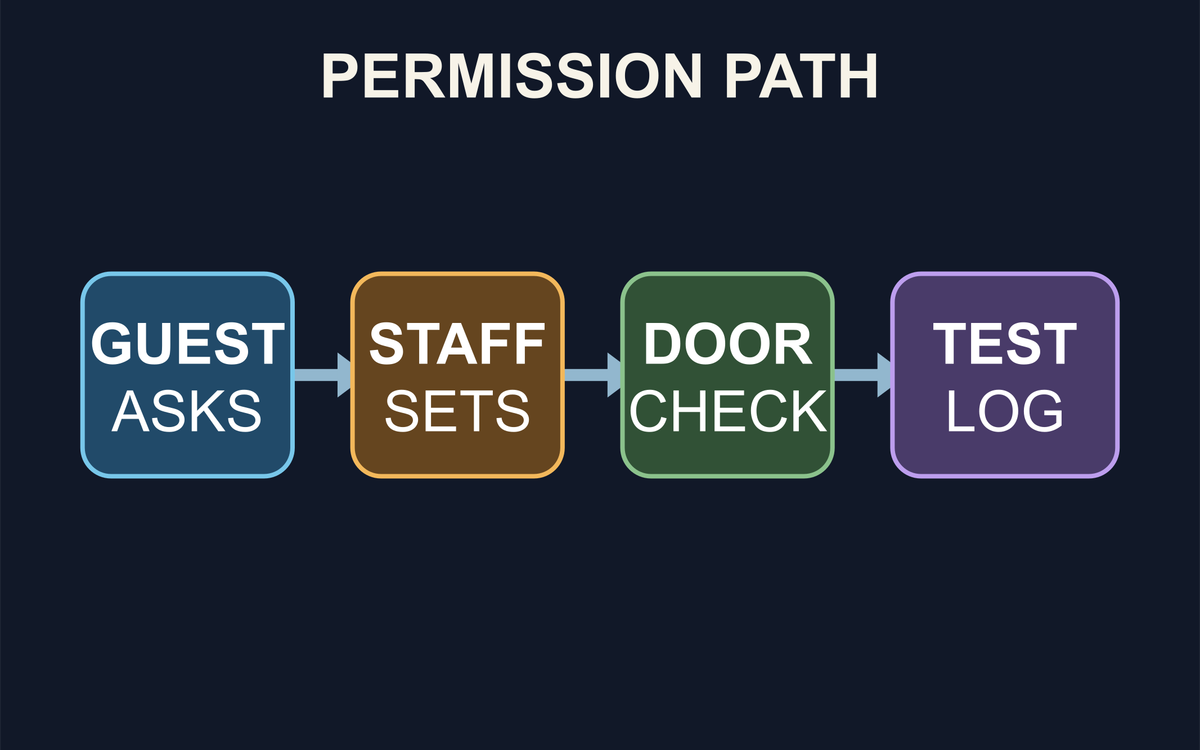
The four-node path is a meeting prompt. It supplies no product function, temperature, timing, staffing rule or permission.
The trade-off is real. More guest choice can reduce calls to reception, yet it increases the number of actions that need plain instructions and reliable limits. More staff control can simplify the guest interface, yet it creates a response and training duty for every staffed shift. Choose the burden the property can actually carry.
What fails when roles remain implicit?
Picture a newly opened room. The guest-facing panel starts the sauna, but a fault later appears. The guest presses the same control again. Reception assumes facilities will clear it. Facilities assumes the supplier enabled an automatic reset. Nobody checks the room state before the next booking. Nothing here proves a product defect. The role design has failed.
That scenario is why the acceptance test needs a complete chain. A button response is one step. The hotel also needs to know who confirms the room condition, who reads the fault information, who may reset the system and what keeps the next guest outside while the state remains uncertain.
Write the uncertain cases first. They expose the dangerous assumptions faster than the normal start sequence. Use four copyable lines:
“Guest-visible actions are limited to ___.”
“Duty staff release the room after ___.”
“A fault may be reset only by ___.”
“Any undocumented permission remains locked until ___ confirms it.”
These lines force names, screens and records into the same conversation. They don't assign legal duty. The local operator and appointed specialists still do that.
How do you accept the control model before opening?
Run the acceptance test in the real room with the real controller, selected settings and the staff who will operate it. Test the guest view, locked settings, door-state check, fault path and record. Use the product manual as the source of available functions. Use the hotel's operating plan to assign actions.
Action | Role boundary | Acceptance check | Hold trigger |
|---|---|---|---|
Normal start | Guest or staff, as specified | Only intended actions are visible | An extra setting appears |
Operating limits | Staff or administrator | Protected settings stay locked | Guest can alter a locked value |
Fault response | Named trained role | Escalation and room hold work | Reset authority is unclear |
Return to use | Hotel operating role | Door, room and record are checked | Any required check is missing |
For the separate electrical hand-off, see How Should Your Electrician Wire an Outdoor Sauna Heater? by Giedrius Patlaba. That article covers the electrical question. It doesn't select the guest and staff control split.
This is the practical answer to “Who Should Control a Hotel Sauna: Guests or Staff?”
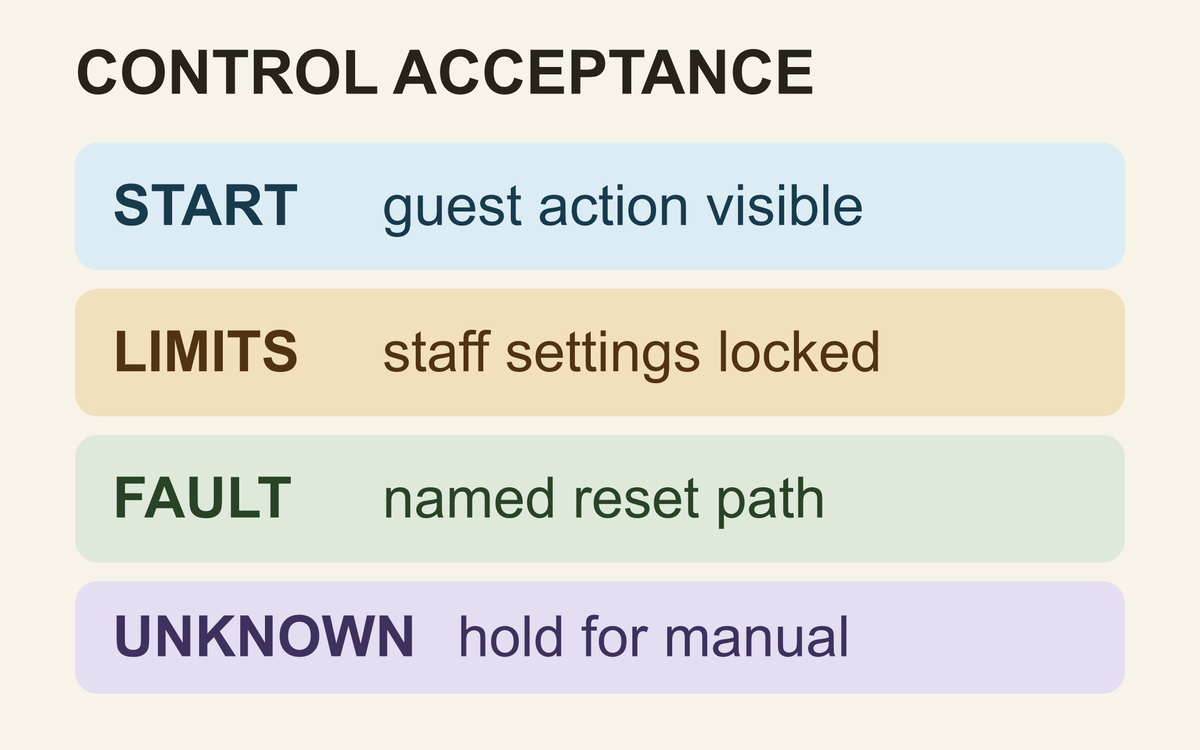
The card names four test areas. It does not define the correct role, reset method, product capability or permission for a real hotel.
STOP: don't open the sauna to guests while any visible action, protected setting, fault reset, room-release check or record remains unassigned or unverified against the exact manual. Keep that action locked and let the locally responsible team resolve it.
Lock the unknown.
Bring the controller manual and the one-page permissions sheet to the opening review. If the same action has two assumed roles, the room isn't ready.
Frequently asked questions
Can hotel guests start a sauna themselves?
They can when the selected controller supports the intended action and the hotel has deliberately accepted that operating model. The guest view needs clear limits and instructions. Staff still need a defined room-release and fault path. A visible start button alone doesn't prove that self-start is appropriate.
Does a PIN make a hotel sauna control safe?
A PIN can protect settings on products that document that function, but it is only one control boundary. The hotel still needs trained staff, a room check, fault escalation and a tested permission sheet. Don't transfer Harvia's Fenix example to another controller without its current manual and supplier confirmation.
Who can reset a sauna controller after a fault?
The exact product documentation, the fault type and the hotel's operating plan determine the permitted response. Some conditions need a trained staff action, while others need a competent technician. Keep the sauna unavailable whenever reset authority or the required post-reset check is unclear.
Can the sauna manufacturer choose the hotel control model?
The manufacturer can explain the supplied sauna and the documented capabilities of selected equipment. The hotel team knows staffing, booking, supervision and local duties. The final model needs those inputs together. A factory check cannot approve a guest workflow that exists only at the property.
What record proves the guest and staff split was tested?
Keep the controller and software identification, intended guest actions, protected settings, named staff actions, fault scenario, door-state check, result, tester and date. Attach the accepted permissions sheet to the operating file. The record proves what was tested, not that every future condition will remain unchanged.
1reading
Written by
 Giedrius PatlabaCEO & co-founder, Wood Architects163 pieces · 30 followers
Follow Giedrius to see new posts in your feed, on your phone or by email.