When Does Your Sauna Change Need a New Technical Review?
Key Takeaways
A new technical review starts when a change invalidates an accepted assumption.
Product, safety, service and physical-interface changes deserve explicit trigger tests.
The reviewer should match the affected discipline, not the loudest job title.
The manufacturer re-checks product configuration and factory information, not local project compliance.
Trivial changes stay quick when the team records why no technical trigger was met.
No affected work should continue while a triggered re-review remains incomplete.
Consider a hypothetical hotel team that changes the heater control after the sauna order is placed. The footprint remains identical, so the email calls it a commercial option. Then the electrician finds a different control arrangement, the door contact reappears in the discussion, and the issued drawing still names the earlier selection. One small change has reopened several assumptions.
When Does Your Sauna Change Need a New Technical Review?
Your sauna change needs a new technical review when it alters an accepted product, safety, service, interface or design assumption. The review should return only to the competent parties affected by that change, and a manufacturer can re-check product configuration and factory information. The appointed designers and installers retain project-specific design, connection and compliance decisions. Record the trigger, reviewers, revised evidence and release status before the controlled change reaches site again.
What changes should trigger the review?
Use triggers based on consequences, not the price or size of the change. A different heater, control, glazing arrangement, opening, orientation or service position may alter previously issued information. The unchanged footprint proves only that the footprint is unchanged. It says nothing about connected requirements.
As checked on 25 August 2026, Harvia's current Fenix 2026 support page distinguishes home and professional configurations, safety-device arrangements and compatibility for named control products. This is manufacturer guidance for those named products. It isn't a general rule for another heater, another control or every sauna project.
That example matters because a model name can carry a chain of connected instructions. Changing the selection may change which product information the designer and installer must use. It doesn't mean every option change is technical. It means the team should test whether the accepted evidence still belongs to the selected configuration.
My manufacturer judgement is simple: re-review the product when a change can make our previous product answer untrue. We can confirm the selected factory configuration, openings and supplied information. We can't approve the project's electrical design, local fire strategy or completed connection.
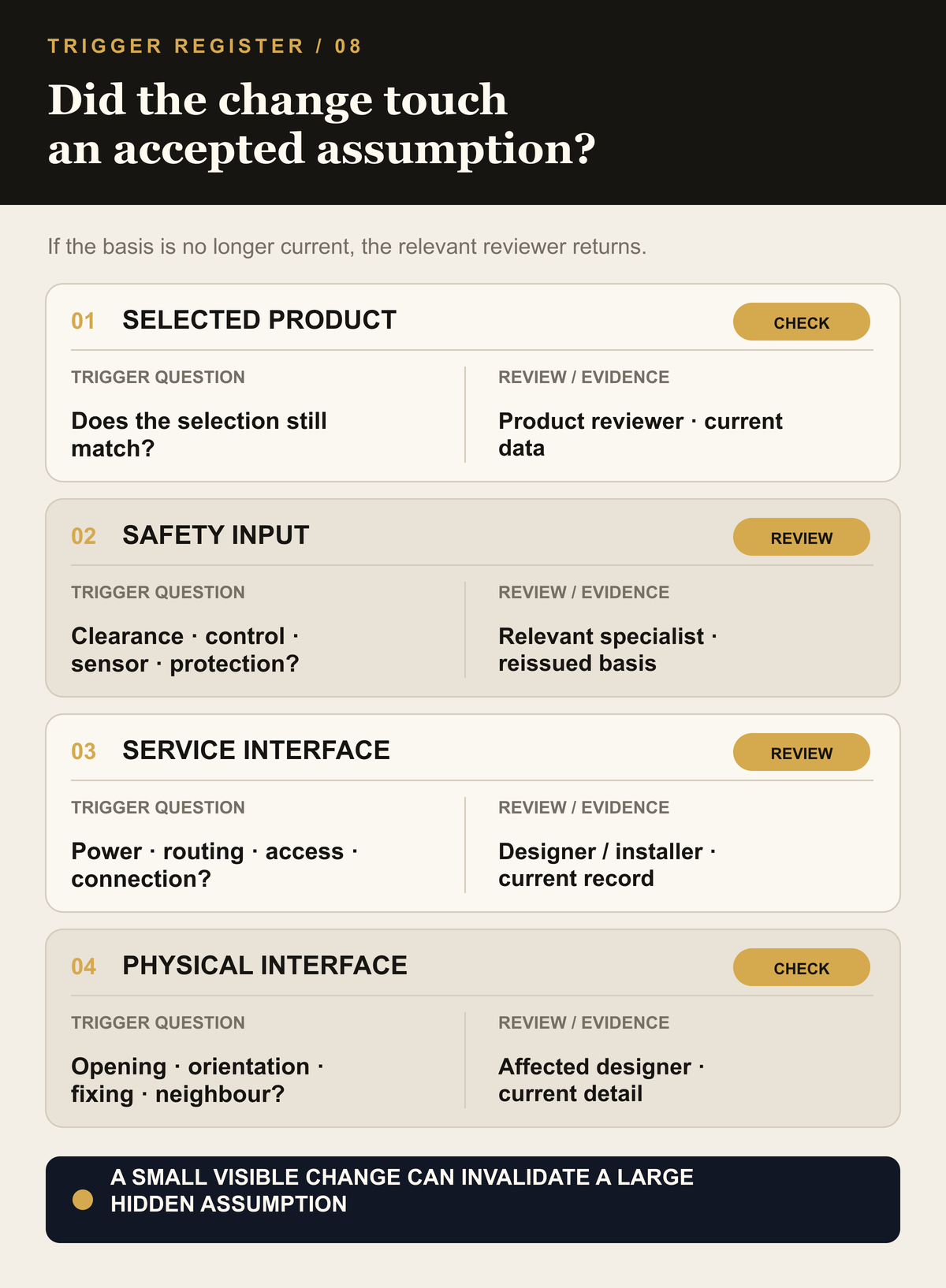
The register asks whether a change invalidated a previously accepted assumption and names the evidence to reissue. It does not assert that every change needs every discipline.
How should your team triage a proposed change?
Start with the changed field. Then compare it against the assumptions behind the current product information, project design and release. The named decision is whether the change stays on the existing release path or returns to technical reviewers.
Trigger test | Question to ask | Reviewer to name |
|---|---|---|
Selected product | Does the accepted evidence still match the exact selection? | Manufacturer plus the affected product specifier |
Safety input | Could a clearance, control, sensor or protective assumption change? | The competent appointed technical party |
Service interface | Does the change affect power, routing, access or connection information? | The relevant designer and installer |
Physical interface | Does an opening, orientation, fixing or adjacent package change? | The relevant project designer and manufacturer |
Copy these lines into the change note:
“Changed field: [field], from: [current value], to: [proposed value].”
“Accepted assumption affected: [assumption], evidence reference: [revision].”
“Required reviewers: [names and disciplines], response due: [project date].”
“Release status: [held or active], superseded information: [references].”
The explicit trade-off is speed against coverage. Sending every minor edit to every consultant wastes time and hides the important reviews. A narrow trigger list keeps harmless wording changes moving. It also sends configuration, safety and interface changes back to the people who can test them.
Consider a hypothetical order where the control option changes after procurement. The buyer approves the cost, the factory updates one selection, and the project drawing stays unchanged. The installer then works from an earlier control note. No single approval was obviously careless because the failure was treating one commercial answer as a complete technical review.
Who should take part in the new review?
Name reviewers by the assumption that may have changed, and let the manufacturer review product selection, supplied components and factory information. The architect or relevant designer reviews design intent and co-ordinated geometry. The engineer or specialist reviews their technical scope. The installer reviews connection and buildability inside their competence.
For an adjacent electrical boundary, see How Should Your Electrician Wire an Outdoor Sauna Heater? by Giedrius Patlaba. That article keeps product information separate from competent electrical work. A technical re-review should preserve the same boundary rather than asking the factory to approve the site design.
At Wood Architects, one clear question is easier to answer than an email chain containing several hidden changes. We can check whether the proposed selection still matches our current factory information. We should also say plainly when the question belongs to the appointed project team.
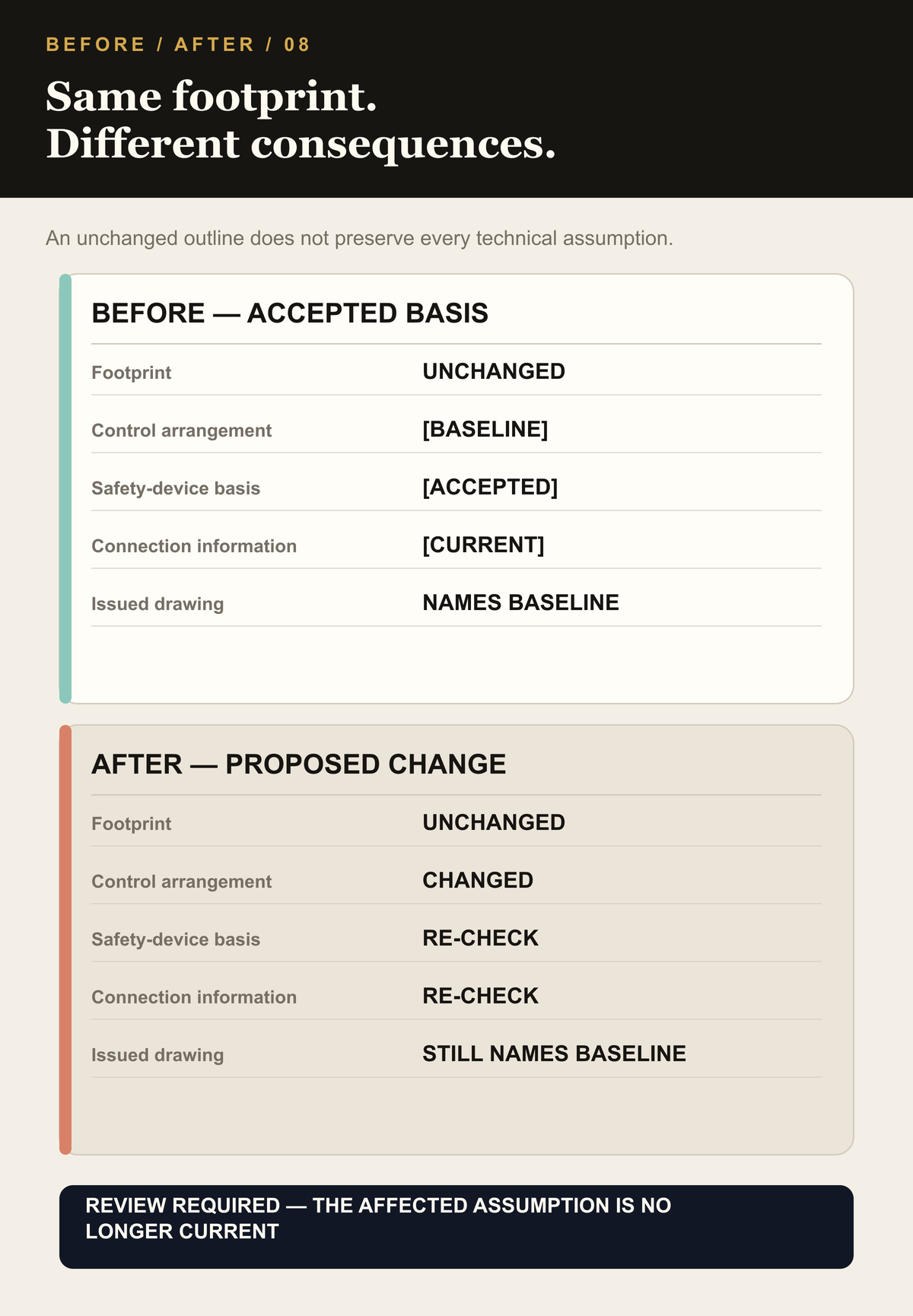
The comparison demonstrates why an unchanged outline can still require technical re-review. The overall release remains REVIEW REQUIRED until the affected basis is current again.
What belongs in the re-review record?
Keep one current record with the original selection, proposed change, affected assumptions, reviewers, evidence received and resulting revision. Record who made the project decision under the relevant appointment. Also name the information that the decision supersedes. A buried email isn't a controlled answer.
Decision: “Change [reference] requires a new technical review by [named parties] because it affects [accepted assumptions]. The current release is held until revision [reference] records the accepted outcome.”
The question “When Does Your Sauna Change Need a New Technical Review?” becomes useful when the answer points to one invalidated assumption and one named reviewer.
STOP: don't implement the changed sauna selection, issue affected drawings or release related factory work when a technical trigger has been met and the named review remains incomplete. Close the review with current evidence and a recorded release status first.
You don't need a large change board. Put the four trigger tests beside the current order. If one answer is yes, open the re-review record and hold the affected release.
Frequently asked questions
Does every sauna change need a technical review?
No. A wording correction or administrative update may leave every accepted product, safety, service and interface assumption unchanged. Record why no trigger was met. If the team can't explain that boundary, the change should be screened by the relevant technical lead before implementation.
Who decides whether a sauna change is technical?
The project's agreed change route should name the person who screens changes and calls the appropriate reviewers. That screening role doesn't create expertise across every discipline. Product consequences go to the manufacturer, while project design, connection and compliance consequences stay with the competent appointed parties.
Can the manufacturer approve the whole change?
The manufacturer can accept a manufacturable product configuration and update the supplied product information. That answer is limited to the manufacturer's scope. It can't replace the architect's design decision, an engineer's calculation, an installer's connection work, the client's commercial approval or an authority's decision.
What if the change keeps the sauna footprint identical?
An unchanged footprint removes only one possible geometric difference. The change may still affect a heater, control, opening, service route, sensor assumption or adjacent detail. Test the exact changed field against the current evidence. Don't use one unchanged dimension as proof that every connected requirement stayed valid.
When can the project release the change?
Release it after the required reviewers have answered, the decision owner has accepted the outcome and the current documents name the new selection. The record should also identify superseded information. A commercial acceptance alone isn't enough when technical triggers remain open.
1reading
Written by
 Giedrius PatlabaCEO & co-founder, Wood Architects163 pieces · 30 followers
Follow Giedrius to see new posts in your feed, on your phone or by email.