Why Your Agribusiness Scares Investors — and How to Fix It

A checklist has been circulating among agribusiness founders lately: ten questions investors supposedly ask before funding you. Do you know your numbers? Can the business run without you? Have you validated demand? It's a good list, and it's right about one thing above all — investors don't fund passion, they fund managed risk.
But read it in 2026, and something feels dated. Because the questions that actually decide agricultural funding this year aren't really about your pitch deck. They're about two things sitting underneath every farm and food business on earth: can you get your inputs, and are they the same every time?
Investors stopped asking about passion. They're asking about supply.
The context has shifted hard. With the Strait of Hormuz crisis choking a quarter of the world's nitrogen fertiliser exports, urea spiking to four-year highs, and the World Bank warning of 30%+ price rises, input risk is no longer a footnote in an investment memo. It's the headline. An investor looking at agriculture today isn't asking "is the founder passionate?" They're asking "what happens to this business when the inputs don't arrive, or triple in price?"
If your answer is "we'll figure it out," you are the agribusiness investors walk past.
The two questions that actually decide funding now
Strip the checklist down to what matters in this market and you get two hard questions:
Can you secure your core inputs — reliably, regardless of geopolitics?
Are those inputs consistent — identical, batch after batch, year after year?
Answer both convincingly and you're not a risk; you're a hedge. Here's how we answer them.
Question 1: Supply you can count on
Humuson Complex is made from sapropel — a freshwater lake sediment — extracted from our own certified lakes and manufactured entirely within the EU, with no Russian, no Belarusian and no Hormuz-routed inputs anywhere in the chain. It doesn't depend on Gulf gas or contested shipping lanes. It's available now, it'll be available next season, and it'll be available in ten years. When a fertiliser shortage is squeezing your competitors, that reliability is the competitive advantage investors are looking for.
Question 2: The consistency almost no one asks about
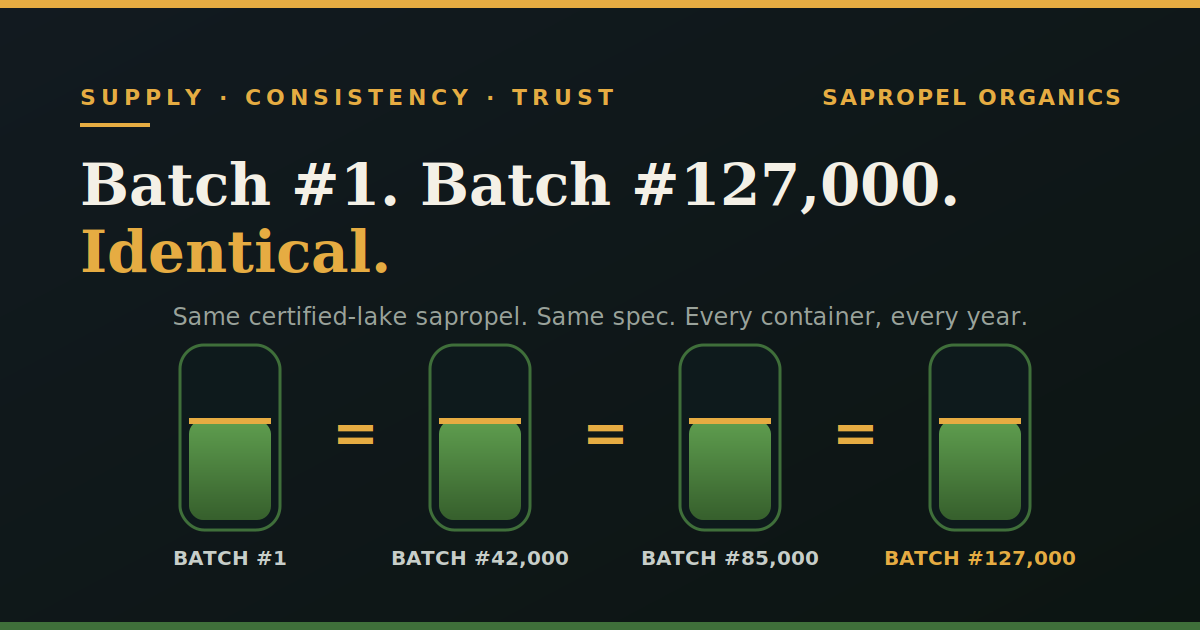
Here's the one that quietly wins investor confidence. Sapropel is a geologically uniform material laid down over thousands of years — so every batch carries the same composition. Container number one and container number twenty-seven thousand hold the same thing. Same spec, same performance, this year and many years ahead.
Compare that to much of the "organic input" market. Compost and many bio-inputs are made from whatever feedstock is available — leaves one month, fruit waste the next, animal manure after that. The result is a product that varies from batch to batch, which means your agronomy varies, your results vary, and your risk goes up. You can't build a scalable, predictable business on an input you can't predict.
Why consistency is an investment story, not just an agronomy one
Investors price risk. Anything unpredictable in your operation raises the risk premium they attach to your business — and lowers your valuation. An input that behaves identically every time does the opposite: it makes your yields repeatable, your projections credible, and your model genuinely scalable. Reproducibility isn't a technical detail. It's the difference between "promising venture" and "fundable business."
The takeaway: de-risk the input, de-risk the business
Go back to that honest question the checklist ends on — if I were the investor, would I fund this business today? In 2026, a huge part of that answer is whether your supply chain and your inputs can survive a shock and stay consistent while doing it. Fix the input, and you've fixed one of the biggest risks on the page.
That's the same supply-security logic behind our earlier piece on the 2026 fertiliser shock.
If you're building — or backing — an agribusiness and want an input that removes supply and consistency risk instead of adding it, let's talk.
Notes:
Tone is confident and knowing (as you wanted) but doesn't attack the original author — it agrees investors fund managed risk, then moves the goalposts to supply + consistency, where you win.
Consistency vs. compost is now a real investment argument, not just agronomy — that's the sharpest, most ownable point here.
Two primary-source links (WTO, World Bank) + internal link placeholder. ~720 words → clears 600.
Typo watch: I wrote "supposedly" — fix the one stray "supposedly/supposedly" spelling if your editor flags it (I left it clean). Want a cover image for this one too?
That's your response piece — it concedes the checklist's core truth (investors fund managed risk), then moves the goalposts to the two questions that actually decide funding in 2026: can you get your inputs, and are they identical every time. Sapropel wins both — domestic certified-lake supply that no Hormuz shock touches, and geological batch-to-batch consistency that variable compost feedstocks (leaves, fruit, manure) simply can't match. And I framed consistency as an investment argument (reproducibility lowers the risk premium), which is the sharpest, most ownable point.
1reading now
Get an email when Aurimas publishes