How to Bring the World's 'Dead' Farmland Back to Life

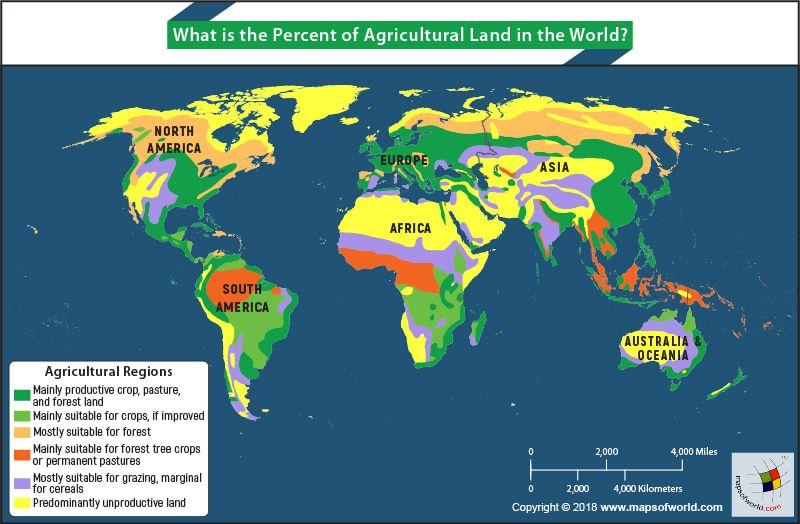
Look at any map of the world's agricultural land and one colour dominates the poorer regions: yellow. "Predominantly unproductive." It stripes across North Africa, the Sahel, the Middle East, central Australia, chunks of Asia and the Americas. On the page it reads like a verdict — as if a third of the planet's surface has simply been ruled out of feeding anyone.
That verdict is wrong. Or at least, far more of it is reversible than the colour suggests.
"Unproductive" is a status, not a sentence
The maps describe land as it is today, under the management it has had. They don't describe what it could be. Most of the world's yellow zones aren't barren rock — they are soils that have lost their structure, their organic matter and their biological life to erosion, over-grazing, salinity or simple neglect. That's not death. That's degradation. And degradation, unlike geology, can be undone.
The scale of the opportunity is enormous. The UN Convention to Combat Desertification estimates that up to 40% of the world's land is already degraded — but also that restoring it is one of the highest-return investments available in food and climate. The FAO Global Soil Partnership frames the same land not as lost, but as the single biggest untapped reserve of future productivity on Earth.
The difference between dead and degraded
Here is what actually holds most marginal land back. It isn't a lack of sunlight or, in many cases, even a lack of rain. It's that the soil has lost the living system that makes rain and nutrients usable — the microbial life that builds structure, holds water and cycles nutrients. Pour synthetic fertiliser onto dead soil and most of it washes away or blows off. The bag treats the symptom; the soil stays lifeless.
Restore the biology, and the same land behaves completely differently. It holds water instead of shedding it. It grips nutrients instead of leaking them. It starts, slowly, to feed a crop again.
Why this is exactly what sapropel does
This is the gap Humuson Complex was built to close. Made from sapropel — a freshwater lake sediment concentrating more than 40 organic, organic-mineral and inorganic compounds over thousands of years — it doesn't just add nutrients. It reactivates the soil's microbial factories, rebuilds organic matter, and measurably improves the soil's ability to hold water — the decisive factor on marginal land.
Africa's yellow zones: degraded, not doomed
Look again at the Sahel and East Africa. Those yellow bands are among the most restorable land on the planet — and the political will has finally arrived. The African Union's Nairobi Declaration commits member states to restoring 30% of degraded soils by 2034. That is a continent actively looking for inputs that rebuild soil rather than just fertilise it. The land is there. The mandate is there. What's missing is the biology — and that ships in a container from the EU.
Even the desert edge
Be honest about the hardest cases, and the argument gets stronger, not weaker. In truly arid zones — much of Saudi Arabia, the deep Sahara — water, not soil, is the binding constraint, and no input creates rain. But that is precisely where improving water retention matters most: on the irrigated and semi-arid margins, a soil that holds moisture stretches every scarce, expensive litre of water further. Restoring biology doesn't conquer the desert. It pushes its edge back, hectare by hectare, and makes the water that is used count for more.
Turning yellow into green is a business, not charity
Every hectare reborn from "unproductive" to productive is new land value, new yield, new margin — for the farmer, the distributor and the nation. In a world short on both food and farmland, restoring what we already have is the highest-leverage move on the board.
This connects directly to the supply-security case we made earlier, in our piece on the fertiliser shock ahead.
If you work in land restoration, agricultural policy, or input distribution across Africa, the Middle East or Europe's own marginal soils, this is the conversation to start now. The yellow on the map is not the end of the story. It's the opportunity.
1reading now
Get an email when Aurimas publishes