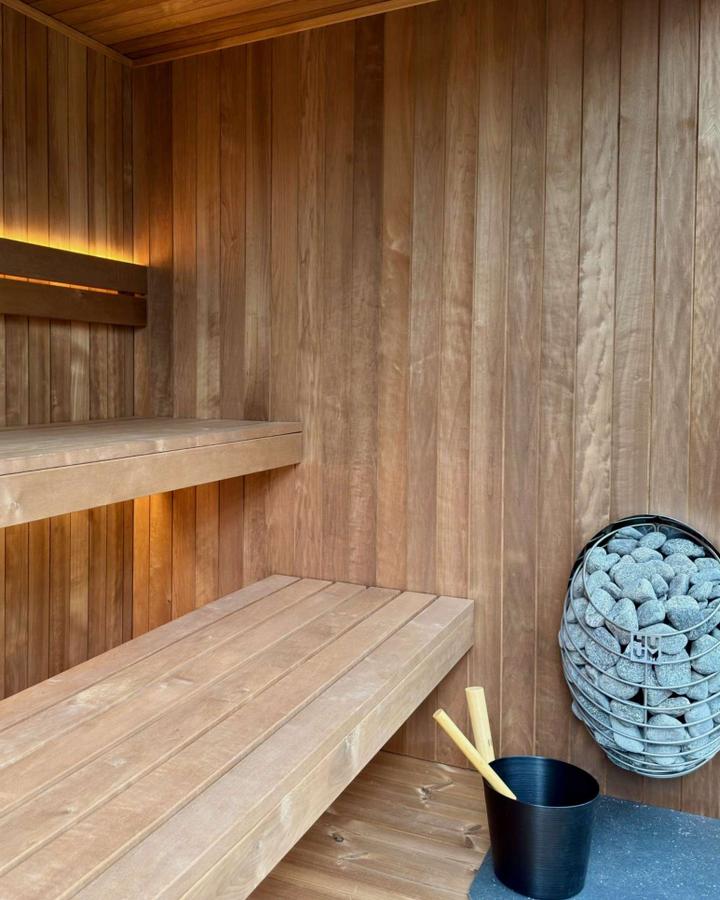
Why Lithuanian sauna makers earn shortlist spots

When an architect or an interior designer specifies an outdoor sauna into a serious residential project, the manufacturer they choose does more than fulfil an order. The maker becomes an implicit part of the design's credibility, an ongoing support relationship for the client, and a reflection of the specifier's own judgement about quality. Get the choice right and it becomes a fixture the client mentions to friends for years. Get it wrong and it becomes a source of expensive complaints.
This is a short guide on what serious specifiers should look for when evaluating sauna makers for premium residential work, and why Lithuanian workshops in particular are worth serious consideration for the shortlist.
## What to look for in a sauna maker for a premium project
Four criteria separate the sauna makers who should be on a specifier's shortlist from those who should not.
The first is timber quality and traceability. The wood used in an outdoor sauna sits at the heart of the product's ability to last through fifteen or twenty seasons of thermal cycling, humidity variation, and weather exposure. A serious sauna maker should be able to answer directly where their timber comes from, what species are used for which component, and what treatment or thermal modification each element has undergone. If the answers come slowly or through a distributor rather than from the manufacturer directly, that is a signal.
The second is engineering discipline. Outdoor saunas fail predictably in the same ways: cold bridges through poorly detailed walls, seal failure at glass joints, moisture penetration at the roof and floor interface, and hardware corrosion. Each of these is preventable with correct specification and careful assembly, but each requires a manufacturer who genuinely understands the physics rather than one who copies an approach that looks correct. A sauna wall that appears identical to a competitor's may perform completely differently through five winters, and the difference usually comes down to detail decisions made at the workshop that are invisible in a brochure.
The third is direct communication. On any serious project, the specifier will need to reach the manufacturer about custom dimensions, delivery scheduling, warranty questions, or unexpected site conditions. A maker who routes every question through a distributor chain, or takes a week to respond, will cause disproportionate friction on a design where timelines matter. Working with a manufacturer who answers directly is not a nicety. It is a project risk reduction.
The fourth is long-term stability. A sauna delivered on a project should be repairable and supportable for a decade or more. The maker chosen should have an operational structure that will still exist when parts are needed in year seven or year twelve. Small workshops with clear ownership and a stable business model often score better on this criterion than large industrial operators who have been through multiple restructures.
## Why Lithuanian sauna makers meet these criteria consistently
Lithuania is not the obvious answer for premium sauna manufacturing to specifiers outside the region. Finland has the cultural association. Germany has the industrial scale. Italy and France have design reputations. And yet a significant proportion of the premium outdoor saunas installed in Western Europe over the past decade have been built in Lithuania, quietly, in workshops that most architects have never visited. The reasons are worth understanding.
Lithuania has one of the highest forest coverage rates in Europe, at roughly 33 percent of national land. According to Interreg Europe, the country's forest-based industry is recognised across European markets specifically for quality and sustainability, and it operates as a significant contributor to European timber supply chains. The [Forest-based Sector Technology Platform](https://www.forestplatform.org/the-forest-based-sector-in-lithuania/) confirms that Lithuania's woodworking industry employs approximately thirty thousand people and is a critical part of the wider European forest-based value chain.
More specifically, the Lithuanian furniture and specialised wood-processing industry operates at a scale that is roughly three times the European average relative to national economy size. This means the depth of practical woodworking expertise available within a short radius of any Lithuanian workshop is substantially greater than in most European countries. Specialist suppliers for tempered glass, industrial fittings, thermally-modified timber, and precision joinery are all reachable within hours by road.
Export data confirms the international recognition. Lithuania exported approximately $73.86 million of wood and wood articles to France alone in 2025, according to UN Comtrade data. This is not a small country doing niche craft work. It is a serious timber-industry economy whose products are integrated into European construction and consumer supply chains at scale.
For a specifier evaluating a Lithuanian sauna maker, this ecosystem context matters practically. It means the workshop being considered is not operating in isolation. It has access to specialist suppliers, technical expertise, sustainable timber, and a well-developed export logistics network. These are the conditions under which small serious workshops can consistently deliver premium products to European clients.
## The specific advantage of workshop-scale operations
There is a further point worth naming, because it is what specifiers actually experience when they work with a Lithuanian sauna maker rather than a large industrial one.
Most Lithuanian sauna workshops operate at deliberate small scale. Ten to thirty employees is typical. The founders or owners are usually present in the workshop rather than in remote head offices. Production runs are counted in dozens of units per year rather than thousands, which means each unit receives more human attention than mass production allows.
For a specifier working on a premium residential project, this scale delivers three things that are difficult to source elsewhere. First, custom dimensions or configuration changes are treated as normal requests rather than exceptions. Second, the person specifying the sauna can speak directly with the person building it, without a sales layer or account manager in between. Third, the manufacturer has genuine interest in the finished installation because the project matters to their reputation as much as to the specifier's, and this interest translates into follow-through that industrial suppliers often cannot match.
These are not marketing claims. They are the practical operational reality of how small workshops function, and they are why Lithuanian sauna makers appear on premium project shortlists in Sweden, Norway, the UK, Belgium, the Netherlands, Switzerland, and increasingly further afield.
## What working with our workshop looks like specifically
At Wood Architects, our workshop in Klaipėda produces Signature cube saunas and traditional barrel saunas within the operational pattern described above. We source timber from suppliers within roughly 200 kilometres of the workshop. We build in small production runs. The co-owners answer emails and phone calls directly.
For specifiers considering us for a residential project, the practical process is straightforward. A first conversation covers project scope, site conditions, and any custom requirements. A written proposal follows within a week, itemising unit specification, delivery, and any custom fabrication cost. Where the project scale justifies it, we welcome a workshop visit, either before commitment or as part of the specification process. Installation coordination is handled between our team and the specifier's chosen contractor.
We do not currently claim to be the largest or the cheapest option for premium residential sauna specification. We claim to be a serious workshop that specifies, sources, and builds carefully, with direct communication and a stable structure. For projects where those things matter, we belong on the shortlist. For projects where they do not, other manufacturers will fit better and we will say so honestly.
If you are a specifier evaluating manufacturers for a current or upcoming project, reach out. We will reply promptly, from the workshop, and tell you honestly whether we are the right fit for what you are trying to build.
---
Filed under premium products and business.
1reading now
Get an email when Pijus publishes