Why the Next Big Crop Might Not Be Grown at All

Commodity analyst Kevin Van Trump recently flagged something easy to miss under the headline. A consumer-goods giant is investing in a desert plant, hesperaloe, as a potential replacement for the wood fibre in everyday products. The plant is interesting. The business model behind it is the real story. As Van Trump put it, large manufacturers are increasingly looking backward into agriculture for raw materials that reduce water use, secure domestic supply chains and replace traditional industrial inputs. The question for landowners is quietly changing from "what can my acres grow?" to "what can they manufacture?"
From cultivation to transformation
For a century, agricultural value has meant yield: more tonnes of food or feed per hectare. But a second kind of value is emerging, and it does not always require planting anything. It comes from taking a natural resource and transforming it — through processing, material science and biology — into something a modern supply chain needs. Agriculture, material science, energy and manufacturing are starting to overlap, and some of the biggest future opportunities in farming may come from customers no one currently thinks of as agricultural buyers.
The three tests a new input has to pass
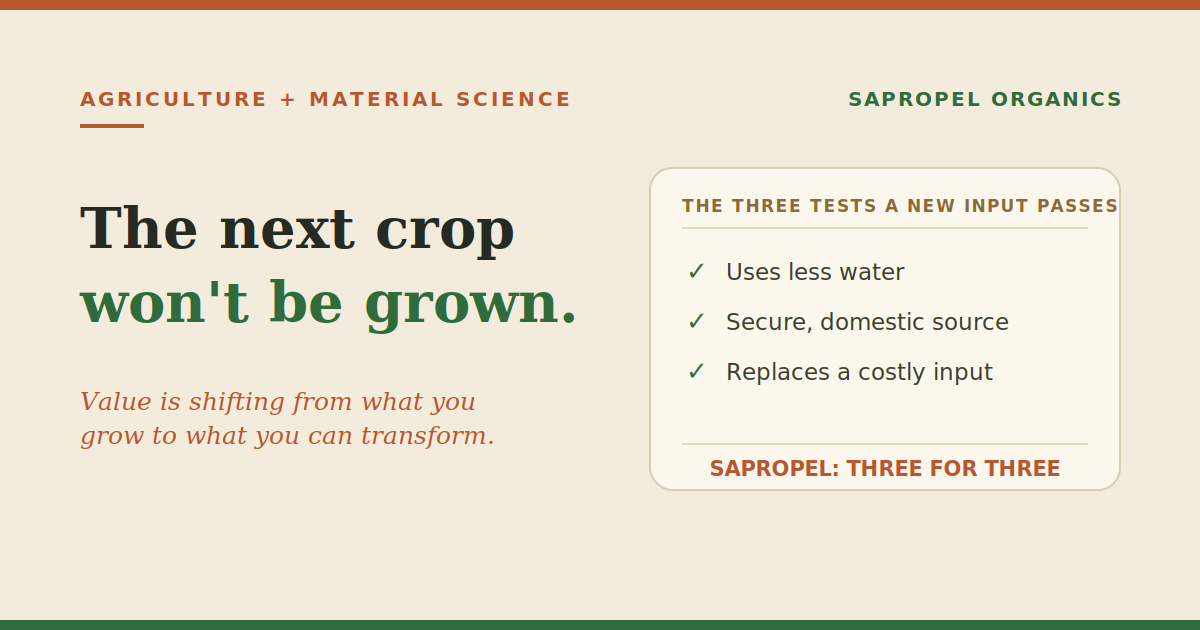
Notice the criteria driving this shift. The inputs manufacturers are hunting for have to do three things: use less water than what they replace, come from a secure and preferably domestic source, and substitute for a conventional industrial input that has become expensive, volatile or environmentally costly. Any resource that clears all three is suddenly strategic, regardless of whether it was ever a "crop."
A resource that was never planted
This is where our own work is a small case study in the trend. Sapropel is a freshwater lake sediment that has concentrated organic and mineral compounds over more than ten thousand years. Nobody grew it. It simply accumulated, dormant, at the bottom of lakes. Through cold, material-science-based processing, that overlooked resource becomes Humuson Complex — a high-value soil input. It is agriculture, but not by cultivation. It is value created by transformation, exactly the model Van Trump is pointing at.
It passes all three tests
Measured against the three criteria, it holds up. On water: by rebuilding soil organic matter and structure, it improves the soil's ability to hold moisture, reducing irrigation demand — and the FAO Global Soil Partnership treats water-holding capacity as one of the highest-value functions of healthy soil. On domestic supply: it is extracted and manufactured within the EU, from local lake reserves, with no dependence on distant exporters or contested shipping lanes. On substitution: it lets growers get more from the synthetic fertiliser they already use, lifting nutrient-use efficiency by around 25% and displacing part of the conventional input load. Reduce water, secure supply, replace a traditional input — three for three.
The opportunity hiding in plain sight
The lesson is bigger than any one product. The next wave of agricultural value will not come only from growing more of what we already grow. It will come from looking at land, water and the natural resources around them and asking a different question: what can this be transformed into that industry, farmers and the planet actually need? The answers will increasingly sit at the intersection of agronomy and material science — and the winners will be the ones who saw the resource before anyone else called it valuable. That is the same conviction behind our earlier piece on what sapropel actually is and why it works.
If you're thinking about where agriculture's next sources of value come from — including from buyers who don't yet think of themselves as agricultural — that is exactly the conversation we're built for.
1reading now
Get an email when Aurimas publishes