How Should Sauna Drawings Be Checked Against the Final Order?
Key Takeaways
Compare the final order and the current drawings line by line before production release.
Match identifiers, dimensions, orientation, openings, finishes, components and interfaces.
Give each discrepancy one owner, disposition and resulting document revision.
A drawing note should never silently replace an explicit commercial selection.
The reconciliation record should preserve both the decision and its evidence.
Stop when a conflict affects the product and no competent party has resolved it.
Imagine a hypothetical project where a client approves a left-hand door on the final order. The latest drawing carries a right-hand swing copied from an earlier option, while the electrical plan follows the left-hand arrangement. Each document is current in someone's folder. The factory can build only one version, so the mismatch needs a decision before material is cut.
How Should Sauna Drawings Be Checked Against the Final Order?
Check them through a controlled reconciliation, not a visual glance. Put the final order, current product drawing and option schedule side by side. Compare every product identifier, dimension, handedness, opening, finish, component, accessory and interface, then record each explicit match and discrepancy. Resolve conflicts through the project's named approval route and update affected revisions before final production release, while site design and technical approvals remain with the appointed competent parties.
Which identifiers must match line by line?
Begin with identity before geometry. Confirm the order reference, product model, drawing number and revision. Then compare overall dimensions, orientation, door and glazing arrangement, cladding and interior finish, heater and control family, lighting, accessories, service entry points and any project-specific options.
As checked on 25 August 2026, the current RIBA Plan of Work page includes a Design Responsibility Matrix in its professional-practice toolbox. That supports making responsibility visible during design coordination. It doesn't prescribe a universal sauna reconciliation sheet, create a project appointment or decide liability.
Treat product identity as a control line, not a descriptive note. The exact model named in the order, drawing and supporting evidence must describe the same configuration. Record any relevant declaration or technical sheet against that precise product identity and revision.
Check that the referenced document actually belongs to the item being ordered. It documents that item only and doesn't prove the complete sauna, resolve project interfaces or approve the works.
Check line | Order evidence | Drawing evidence | Disposition |
|---|---|---|---|
Product identity | Model and order reference | Drawing number and revision | Exact match required |
Geometry | Dimensions and orientation | Plans, elevations and details | Resolve every conflict |
Appearance | Finish and glazing selections | Codes, legends and elevations | Confirm named references |
Equipment | Heater, controls and accessories | Layouts and schedules | Match component families |
Interfaces | Included factory provisions | Connection locations and notes | Assign external design owners |
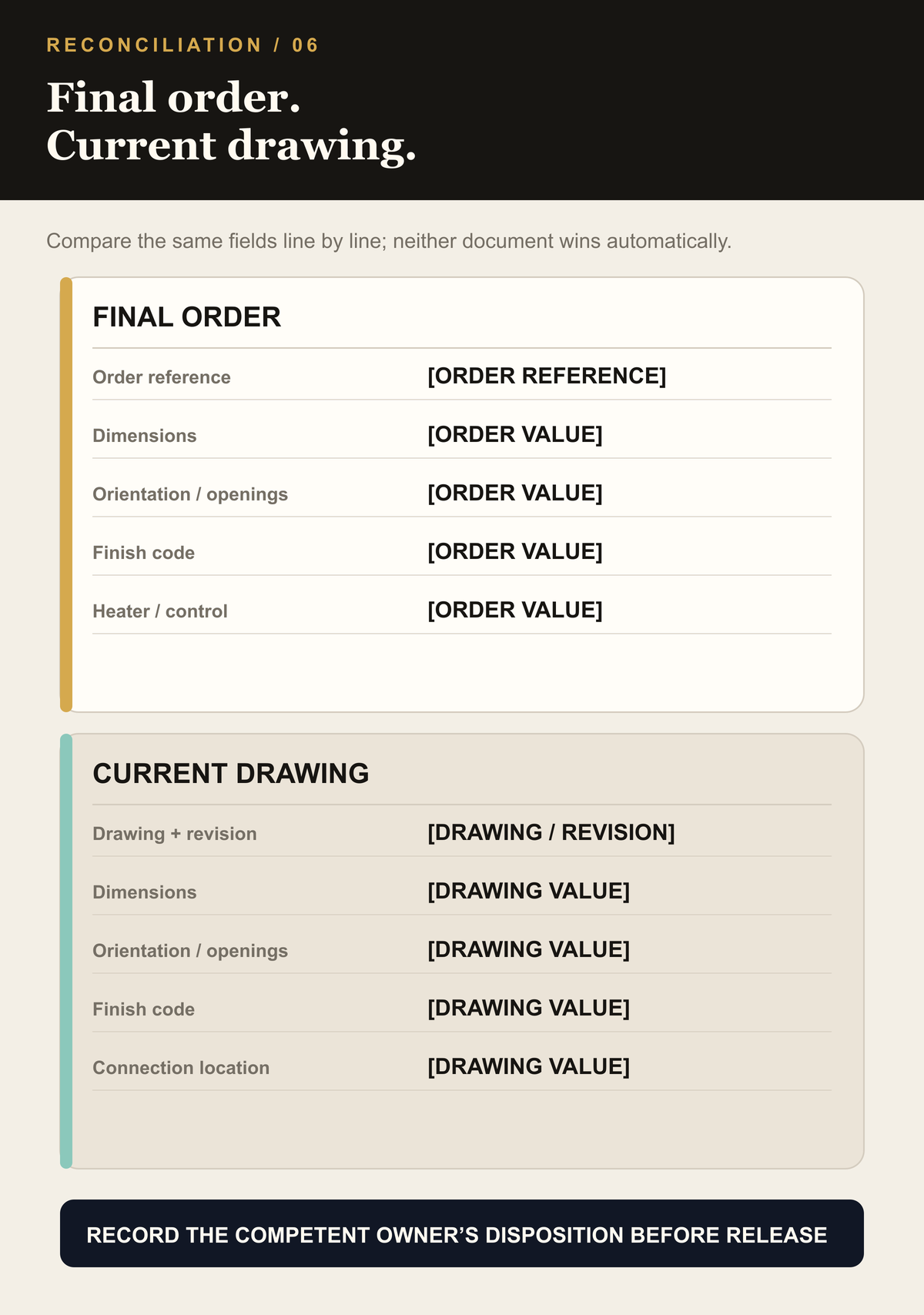
The comparison keeps both evidence sources visible and highlights where a competent owner must record the disposition. Neither document wins automatically.
How should the team handle a discrepancy?
Never fix a conflict by choosing the newest-looking document without first describing the difference in neutral language. Identify which decisions and interfaces it affects. Send it to the named owner with both sources attached. The response should state the accepted value and which documents must change.
Copy these lines into the reconciliation record:
“Check line: [item], order states: [value], drawing states: [value].”
“Affected product or interface: [description], production impact: [impact].”
“Decision owner: [name], evidence required: [document or answer].”
“Accepted disposition: [value], authorised through: [route], date: [date].”
“Documents revised: [references], superseded revisions: [references].”
The trade-off sits between speed and traceability. A quick verbal answer can unblock a meeting, but the factory and site teams need the same durable instruction. Recording the disposition adds minutes now and prevents two legitimate-looking versions from surviving into production or installation.
Consider a hypothetical resort order that lists an external control panel, while the current elevation still shows an earlier internal position. The factory follows the drawing and the electrician prices the order. Both teams act reasonably from different sources. The late correction then affects a finished panel, cable routing and programme.
For the separate installation-side boundary, read How Should Your Electrician Wire an Outdoor Sauna Heater? by Giedrius Patlaba. A product drawing can show manufacturer connection information, but it doesn't replace project-specific electrical design, installation, testing or certification.
What should the release record say?
The record should state the documents compared, their dates and revisions, every discrepancy found, the accepted disposition, the decision owner and the updated controlling documents. Keep rejected values visible as superseded entries. Deleting the history makes a later change look like the original instruction.
From our factory perspective, reconciliation works only when the accepted value reaches every document used to build. An answer parked in an email isn't production control. It is another source the next colleague must interpret.
My manufacturer judgement is that a discrepancy closes only after the competent project owner chooses the accepted value. The factory's next duty is to remove the superseded instruction from its production set, not reinterpret the decision.
The question “How Should Sauna Drawings Be Checked Against the Final Order?” is answered by one row for every selection, one disposition for every mismatch and one current set after revision.
Decision: “Order [reference] and drawing [reference, revision] have been reconciled. Discrepancies [list] are resolved by dispositions [list]. Revised documents [list] now control product manufacture from [date].”
STOP: don't release production when the order and drawing disagree on product identity, critical geometry, orientation, openings, finish, selected equipment or a factory interface. Obtain the competent owner's decision, revise every affected controlling document and repeat the relevant comparison first.
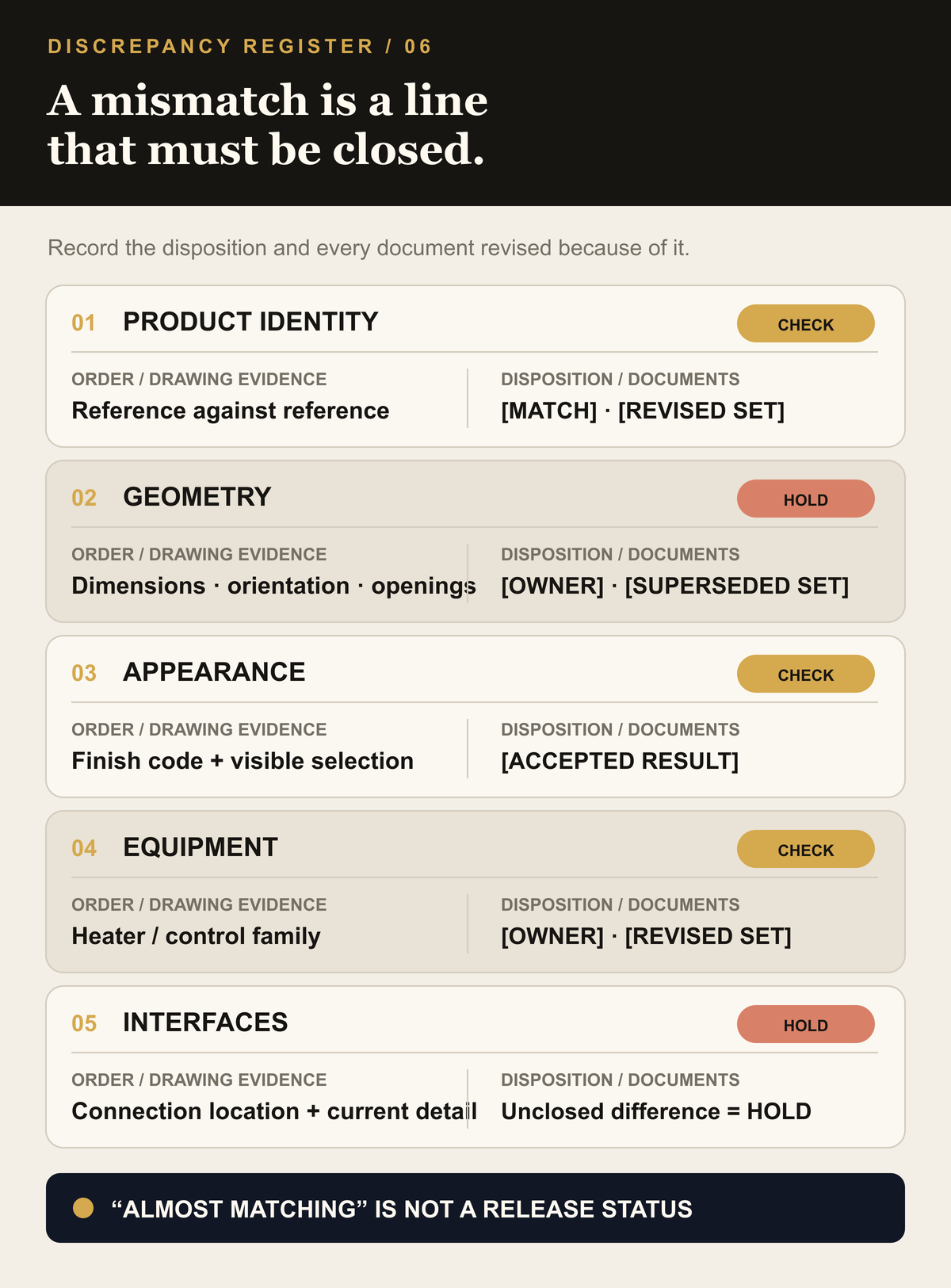
The register records the order evidence, drawing evidence, decision owner, accepted disposition and revised document set. An unresolved mismatch remains on HOLD.
Use a second reader for the final pass. Give them only the order, current drawing set and completed reconciliation record. If they can repeat the selected configuration without opening the email archive, the comparison has produced a usable control.
Frequently asked questions
Which document wins when the sauna order and drawing disagree?
Neither should win automatically unless the contract and agreed document hierarchy clearly say so. Record the conflict and route it to the named competent decision owner. Once resolved, revise every controlling document so the factory, project designers and installers work from the same accepted value.
Should every sauna drawing carry a revision?
Yes, every controlled production drawing should have an identifiable revision or issue status and date. The reconciliation record should name it exactly. A revision label doesn't prove technical correctness, but it lets the team distinguish the reviewed instruction from an earlier or superseded version.
Do rendered images count as final-order evidence?
Only for decisions they explicitly and reliably identify. A rendering may communicate appearance while omitting dimensions, component codes or interfaces. Use it as supporting context, not as a silent replacement for the order and controlled drawings. Record any appearance decision in the relevant schedule or drawing note.
Who should check electrical details on sauna drawings?
The manufacturer checks product information within the supplied scope. The appointed electrical designer and installer check project-specific supply, protection, routing, connection, testing and certification under applicable requirements. Reconciliation should expose the interface between those scopes without implying that one party has approved the other's work.
Must the client sign every reconciliation row?
Not necessarily. The project's agreed approval route should identify who can decide each category. Some rows may be confirmed by the manufacturer, architect, engineer, contractor or client representative. The important control is a named competent decision owner, recorded evidence and an updated set that everyone can identify.
1reading now
Written by
 Giedrius PatlabaCEO & co-founder, Wood Architects163 pieces · 31 followers
Follow Giedrius to see new posts in your feed, on your phone or by email.
- views