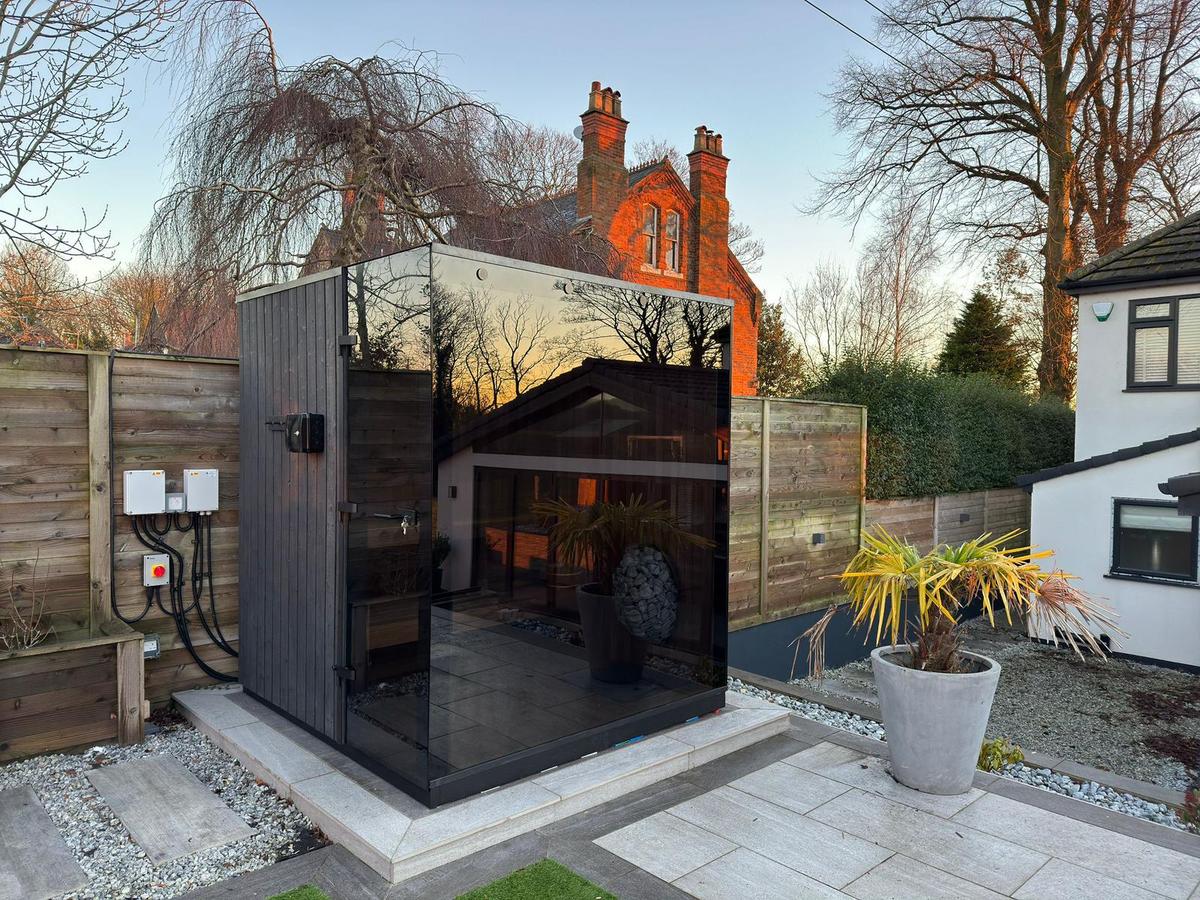
Does Your Outdoor Sauna Need a Changing Room or Terrace?

An outdoor sauna does not need a changing room if it stands a few steps from a door of your house, because the house already does that job. It does need one, or at least a sheltered spot, if the sauna sits further down the garden, if you bathe through winter, or if friends and guests will use it. A small covered terrace is worth having on almost any garden sauna, because it gives you somewhere to cool down between rounds.
What a changing room actually does
A changing room, also called an anteroom or vestibule, is an unheated space between the outside door and the hot room. It does three practical things.
It keeps your things dry and warm. Towels, robes, slippers, phones and glasses need to be somewhere out of the rain and out of the heat. Without an anteroom they end up on a garden chair or back in the house.
It buffers the hot room from the weather. When the hot room opens straight to the garden, every time someone goes in or out, cold air and sometimes rain or snow come in with them. With an anteroom, the outside door is closed before the inner one opens.
It gives privacy. Changing behind a closed door matters more when the sauna is overlooked, or when you share it with people who are not family.
What a terrace does
A terrace or porch is the covered, open part at the front of the sauna. Its job is the cool-down. A traditional sauna session is a cycle of heat, cooling and rest, repeated two or three times, and the cooling part needs a place to sit or stand in fresh air. Harvard Health Publishing's sauna guidance includes the advice to "cool down gradually afterward". A roof over a bench makes that possible in drizzle as well as sunshine.
A terrace also keeps the doorway dry, gives you a place for a hook and a pair of shoes, and makes the building look settled in the garden rather than dropped on it.
The trade-off: every metre comes out of something
Extra rooms are not free space. For a given overall length, a changing room takes length away from the hot room, so you seat fewer people on the benches. Add the length instead and the building needs a longer base, a bigger delivery and usually a higher price.
So decide the hot room first. Work out how many people will bathe together and whether anyone wants to lie down, then see what length is left. A cramped hot room with a generous anteroom is the wrong way round.
Four questions that decide it
1. How far is the sauna from the house? If you can walk there in a robe in a few seconds on a dry path, the house is your changing room. If it is at the far end of a long garden, by a lake or at a holiday cabin, plan for one.
2. Will you use it in winter? Cold-weather bathing is where an anteroom earns its place. Dressing in warm, dry clothes before you step outside is far more pleasant than doing it in the open.
3. Who uses it? A couple at home can manage without. Families with children, regular guests or a rental property generally need somewhere to change and leave belongings.
4. What else is nearby? If you already have a covered deck, a pergola or a pool house beside the sauna, they can do the terrace's and the changing room's work for nothing. My business partner Giedrius Patlaba describes planning the whole route, changing, walking, entering, cooling down and returning, before fixing where the cabin goes.
How this looks in real sauna sizes
Our own barrel range at Wood Architects shows how the choice tends to follow length. The 2 m barrel is hot room only. The 2.5 m and 3 m barrels add a 0.6 m terrace. The 4 m barrel has a 1 m changing room and a 0.6 m terrace, and the 6 m barrel has a 2 m changing room and a 0.6 m terrace. Our cube saunas run from 2.5 m to around 4 to 5 m, and the longer ones can include an anteroom or relaxation area.
The logic applies to any small sauna: at around 3 m and below, a changing room would squeeze the hot room too much, so a terrace is the sensible extra. From about 4 m, there is room for both.
Related questions
Can you add a changing room later? Not easily to a finished, factory-assembled sauna. A separate shelter or pergola beside it is the usual answer.
Is a terrace enough on its own? For a sauna close to the house, yes. It covers the cool-down and keeps the doorway dry.
Does a changing room need heating? No. It is normally left unheated; it only has to be dry and out of the wind.
Sources
Harvard Health Publishing, "Sauna Health Benefits: Are saunas healthy or harmful?"
1reading now
- views
Get an email when Pijus publishes