Why Your 2027 Fertiliser Plan Starts Today

Most conversations about fertiliser stop at the price on the invoice. But the real risk in 2026 is not that fertiliser is expensive. It is that the whole system has become unpredictable, deep into the supply chain, and the next two years look more turbulent still. If you buy inputs, that has one practical consequence: the decisions that protect next season need to be made now, not when the bill arrives.
Even the producers are losing money
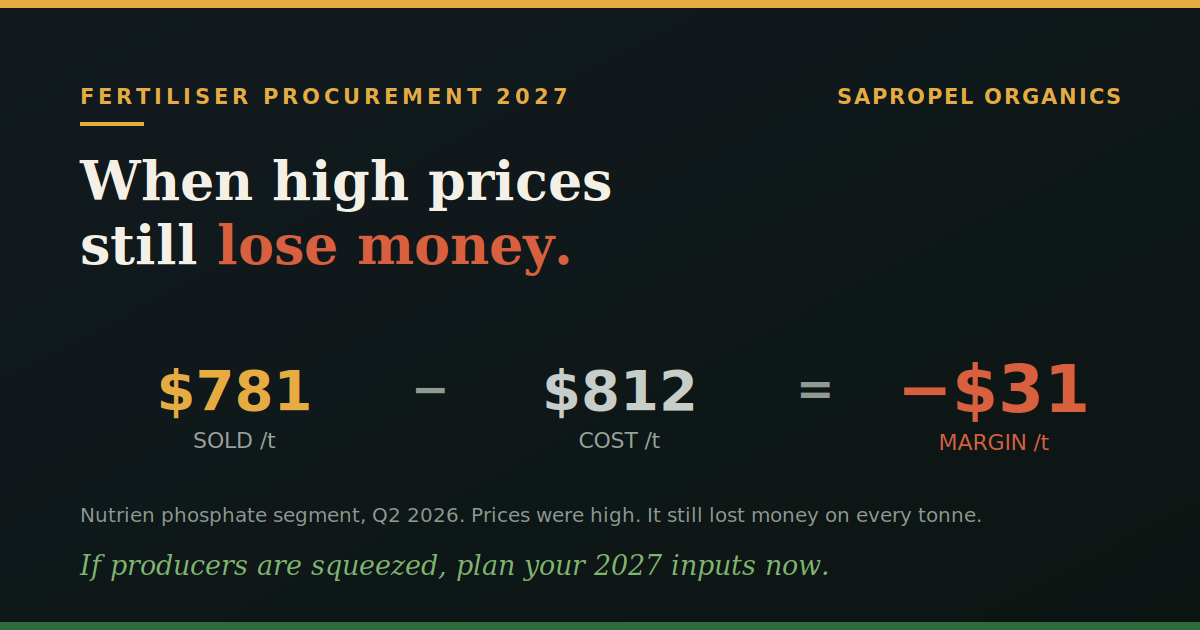
Here is how deep the instability runs. In the second quarter of 2026, industry analysis highlights that Nutrien's phosphate segment sold product at an average of about US$781 per tonne while its cost of sales reached roughly US$812 per tonne, a gross margin of around minus US$31 per tonne. Prices were high, and the producer still lost money on every tonne, largely because of the soaring cost of sulphur used to process phosphate. When even the largest producers are squeezed like this, buyers further down the chain should not expect calm pricing.
The forecast is turbulence, not relief
The near-term outlook offers no easy landing. The World Bank expects fertiliser prices to rise around 31% in 2026, while sulphur supply is expected to stay tight through 2026 and into 2027 before new capacity eases it. DAP prices are then forecast to fall roughly 10% in 2027 as fresh supply arrives. In other words: high and rising now, potentially softer later, but with the timing uncertain and dependent on volatile inputs no farmer controls. That is precisely the kind of market in which buying reactively, at spot, in the middle of a season, is the most expensive way to operate.
The worst position is reactive
When prices swing this hard, the buyer who waits until planting to secure inputs takes whatever the market offers on that day. The buyer who planned months ahead has options: timing, contracts, and a lower dependence on the single most volatile inputs. The difference between those two positions is often the difference between a profitable season and a squeezed one.
Two moves to make before next year
The first is obvious but frequently skipped: plan procurement for 2027 now. Map how much you will need, watch the sulphur-driven cost signals the producers are watching, and secure what you can while you have the choice.
The second is more strategic: reduce how much of your yield depends on the volatile part of the market in the first place. Every unit of conventional, sulphur- and gas-linked fertiliser you can use more efficiently is a unit less exposed to this rollercoaster.
An input that doesn't ride the same rollercoaster
This is where Humuson Complex fits into a procurement plan. Made from sapropel, extracted from certified lakes and manufactured in the EU, its cost base is not tied to sulphur, natural gas or Gulf shipping lanes, and its composition is identical batch after batch, year after year. It is the stable line in a volatile portfolio.
More importantly, it improves nutrient-use efficiency by at least 25%, so the conventional fertiliser you do buy stretches further, and it helps the crop draw on nutrients already locked in the soil. Planned into next season, that means a smaller, more predictable exposure to exactly the inputs whose prices no one can forecast.
The takeaway: decide now
The producers watching the sulphur-to-phosphate spread are already planning their 2027 exposure. Buyers should be doing the same. Next year's fertiliser cost is not set next year. It is shaped by the decisions you make in the months before. This is the same supply-resilience logic behind our earlier piece on the 2026 fertiliser market.
If you're a farmer, distributor or buyer planning next season's inputs, now is the moment to build in a hedge against the volatility, not react to it.
1reading now
Get an email when Aurimas publishes