What Should Your Dedicated Sauna Energy Meter Record?
Key Takeaways
A dedicated sauna meter must identify one fixed electrical boundary.
Keep cumulative active energy and time-stamped interval records.
Record meter identity, circuit description, clock basis and data-quality flags.
Voltage, current, power and power factor are useful only when the chosen meter supports them.
Assign ownership for installation, export, review and correction before commissioning.
A submeter creates evidence, not automatic savings.
A meter can be perfectly accurate and still answer the wrong question. We see the same risk when a complete sauna leaves our Klaipėda workshop and meets the hotel's final electrical scope. The meter record card below fixes the circuit, fields, clock and owner before the first interval is stored.
What Should Your Dedicated Sauna Energy Meter Record?
A dedicated sauna energy meter should record cumulative active energy, time-stamped interval energy or readings, meter identity, the exact circuit boundary, timestamp and time zone, and data-quality events such as gaps, resets or configuration changes. Where the selected meter supports them, voltage, current, active power and power factor can help diagnose operation. The hotel should also keep controller state, schedule and service context in a linked log. A number without its boundary and clock isn't an auditable sauna record.
Why does the circuit boundary come before the meter model?
The hotel isn't buying a display. It's buying an answer to a defined question. Does the meter cover the heater alone, or the heater plus controls, lighting, ventilation and other auxiliaries? Both boundaries can be useful. Mixing them destroys comparability.
Start at the distribution board. Trace the outgoing circuit, protective devices and any branches. Give the measurement point a plain-language description that a future electrician can verify. Photograph the labelled circuit and place that reference beside the meter schedule.
The U.S. Department of Energy's Building Energy Data programme, checked on 25 August 2026, stresses that energy use becomes useful when correlated with building assets and activities. It also highlights common data dictionaries and schemas as tools for interoperability. That is exactly why “sauna kWh” needs a named asset, boundary and timestamp.
A whole-building utility bill cannot isolate a sauna reliably when many loads move together. DOE's performance metrics guidance notes that basic facility-level analysis may not describe building energy performance because of other energy uses at the site. A dedicated meter narrows the question to the installed circuit.
Which measurements belong in the record?
Separate required evidence from optional diagnostics. Required fields make the record traceable. Optional fields depend on the meter, communications design and the fault questions the hotel wants to answer.
Field group | Record | Purpose |
|---|---|---|
Energy | Cumulative active energy and interval change | Creates the primary consumption record |
Time | Timestamp, time zone and clock status | Aligns energy with schedules and events |
Identity | Meter ID, model, serial reference and circuit label | Shows which device and boundary produced the data |
Quality | Gaps, resets, estimated values and configuration changes | Stops uncertain data becoming a confident report |
Diagnostics | Supported voltage, current, active power and power factor | Helps investigate operation without replacing energy totals |
One current manufacturer's manual shows the boundary of that last row. The Schneider Electric iEM2250 display documentation lists active energy in kWh, voltage, current, active power and power factor for that model. It doesn't prove that every meter exposes those parameters or that the model suits this installation. The project spec must name the selected device and required outputs.
Where should the meter sit in the system?
Place it where the physical circuit matches the reporting boundary. The drawing should show the upstream supply, protective device, meter, downstream sauna loads and any excluded branch. If lighting or ventilation sits elsewhere, label it as excluded rather than implying the meter covers the full service.
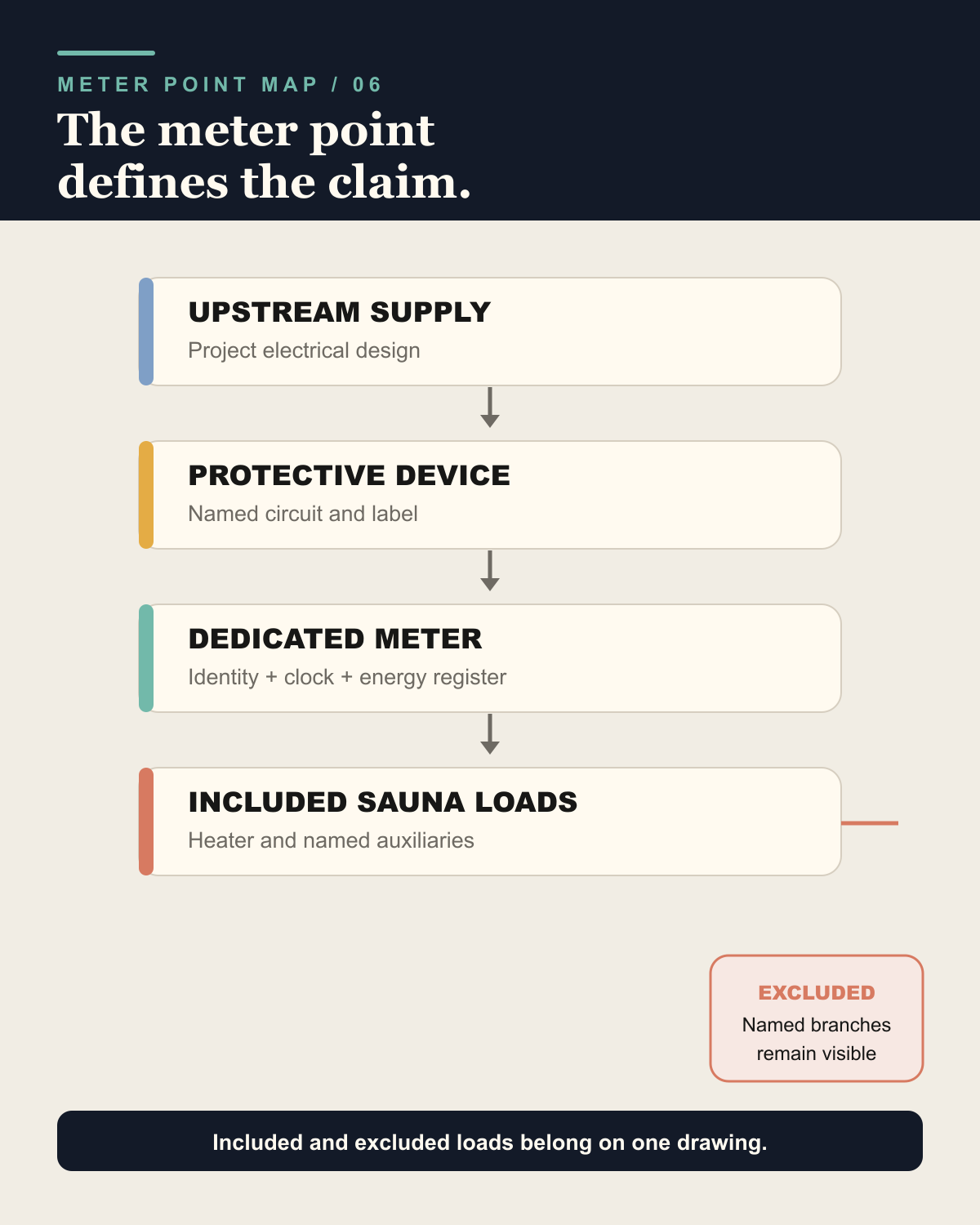
The meter point defines the claim. Every included and excluded load should remain visible on the same one-line map.
The meter's enclosure, access, electrical rating, installation and verification belong to the qualified project team. This article doesn't select a meter class or wiring method. Those choices depend on the local electrical design, billing purpose, supply and applicable rules.
Keep the independent meter read-only from the sauna controls unless the engineered design explicitly requires another relationship. Measurement and control are different responsibilities. A logging failure should not become a sauna-control failure.
How should the hotel structure each data record?
Use a stable field name and unit for every export. Keep the cumulative register even when the dashboard calculates intervals. That source reading lets the hotel rebuild a disputed total and see whether a reset occurred.
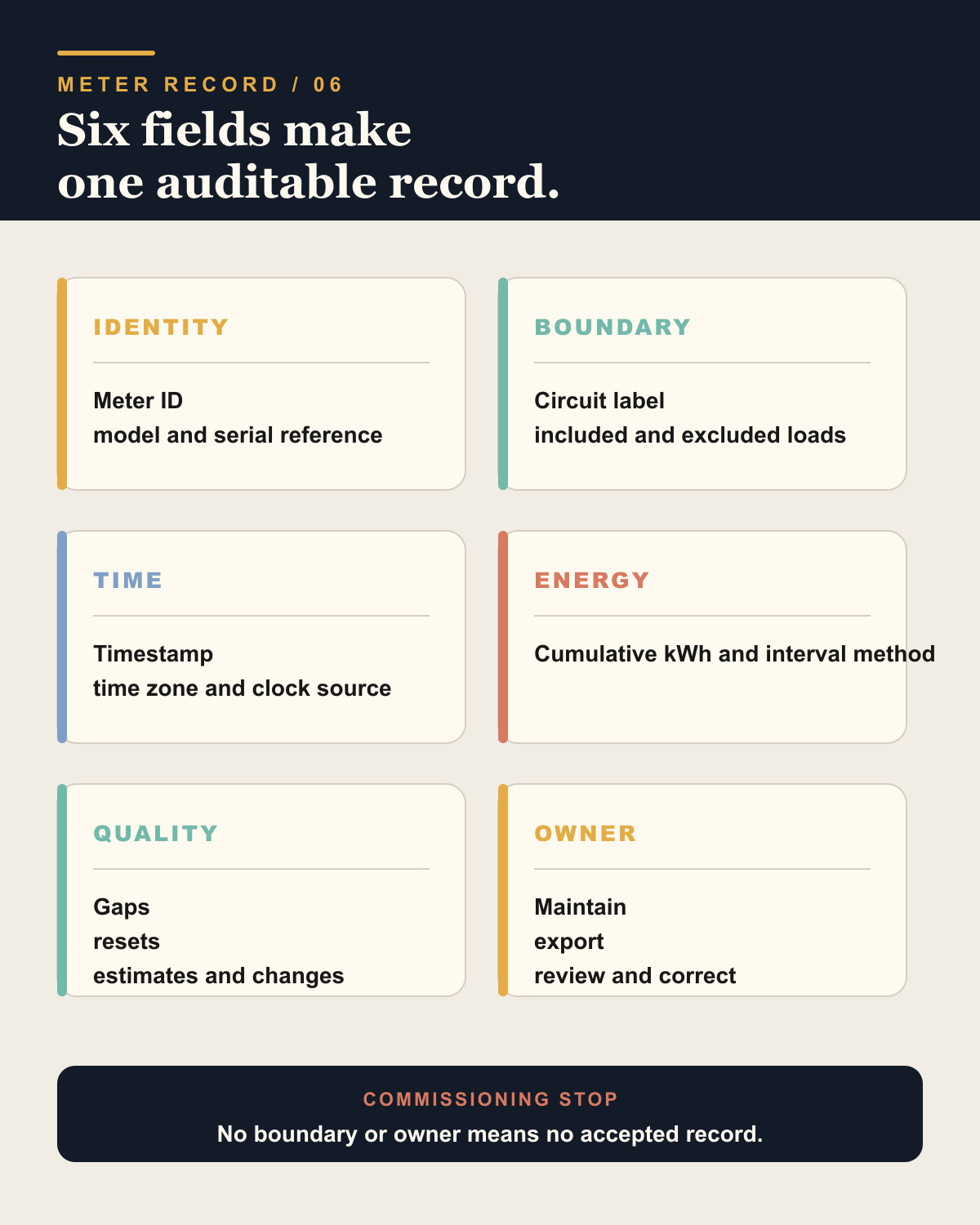
The record card keeps technical data and responsibility together. A blank owner or boundary is a commissioning defect.
“Meter ID and serial reference: [verified at enclosure].”
“Measured circuit and included loads: [single-line drawing reference].”
“Excluded branches and auxiliary loads: [named explicitly].”
“Timestamp, time zone and clock source: [documented].”
“Cumulative active energy register: [unit and export field].”
“Interval calculation or interval register: [method and field].”
“Missing, reset or estimated data flag: [rule and owner].”
“Controller schedule and service context link: [log reference].”
For data granularity, DOE's EMIS capabilities guidance describes interval meter analytics at one hour or less and links meter profiles with schedules, occupancy and system trends. That is an example of useful granularity, not a universal logging interval for every sauna. Choose the interval around the decisions the hotel needs to make.
Who should own the data and the correction process?
Name four responsibilities before handover: who maintains the meter, who can export data, who reviews anomalies and who corrects labels or clock errors. Keep configuration changes in the record. Otherwise the dashboard survives while the meaning of its columns drifts.
For the upstream project boundary, use What Should Your Architect Specify for an Outdoor Sauna?. A dedicated meter becomes useful only when its circuit boundary, access and handover responsibility are defined before installation. This article stays with the evidence produced after commissioning.
STOP: don't describe a meter as billing-grade, compliant for tenant charging or suitable for the installation unless the exact device, wiring, verification and local requirement prove it. A useful operations submeter is not automatically a legal billing instrument.
You don't need a larger dashboard. Print the meter record card and walk it from the distribution board to the data export with the electrician and facilities lead. The useful handover object is one labelled circuit, one clock and one owner for every blank field.
Frequently asked questions
Should a sauna meter record kW or kWh?
Keep active energy in kWh as the main cumulative consumption record. Active power in kW can add operating detail when the selected meter supports it. Don't substitute one for the other. The handover should state the unit, field name and whether each value is cumulative, instantaneous or interval-based.
Does a dedicated sauna meter need interval data?
Interval data helps align energy with heat-up, holding, sessions and schedule changes. The useful interval depends on the decision, communications design and storage limits. There is no universal interval in this article. Record the chosen interval and keep cumulative readings so disputed totals can be reconstructed.
Should lighting and ventilation sit inside the sauna meter boundary?
Include them when the hotel wants total sauna-service energy and the electrical design allows one clear boundary. Exclude them when the decision concerns the heater circuit alone. Either choice can work. The drawing and data label must say which loads are included so later comparisons remain honest.
Can the hotel use the sauna submeter for guest billing?
Not without separate proof. Operational submetering and legal billing can have different requirements for device class, verification, installation and local regulation. Treat the meter as an operations record unless the exact project documents establish its billing purpose. Never infer billing status from a dashboard or product photograph.
What happens when the sauna meter loses data?
Flag the gap, preserve the last valid cumulative reading and document the cause and correction. Don't silently interpolate values into an audit record. If management needs an estimate, label the method and uncertainty separately. The data-quality event should remain visible beside any report that crosses the missing period.
1reading
Written by
 Giedrius PatlabaCEO & co-founder, Wood Architects163 pieces · 30 followers
Follow Giedrius to see new posts in your feed, on your phone or by email.