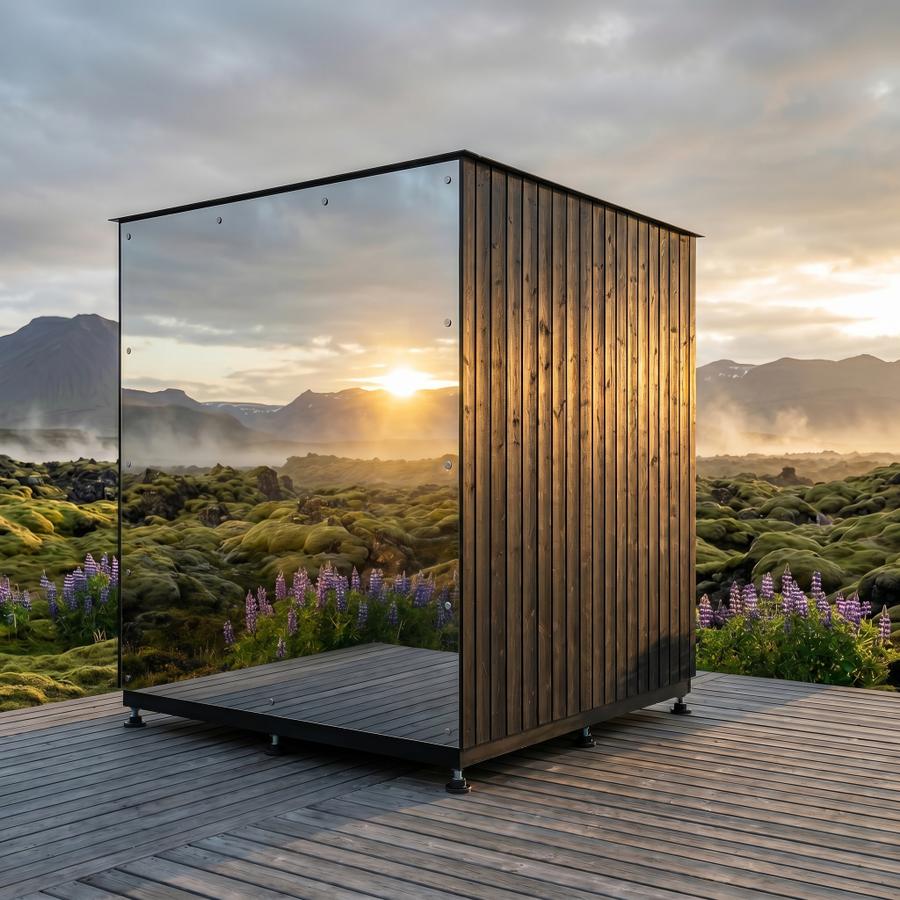
Cube or Barrel Outdoor Sauna: Which Is Right for Your Garden?

Choose a barrel sauna if you want a lower purchase price, a quick-heating compact room and a traditional look. Choose a cube sauna if you want more headroom, flexible bench layouts, large glazing and a modern form that sits well beside contemporary architecture. Neither shape is better in absolute terms. The quality of the build, the insulation, glass, roof, timber and how the sauna is finished at the factory, matters more than the shape itself.
How the two shapes differ
Air volume and heat-up. A barrel's round cross-section has no unused corners, so there is less air to heat for a given length, and the curved ceiling helps heat circulate. Barrels therefore tend to come up to temperature a little faster. A cube encloses more air, but that air is usable space rather than waste.
Headroom and benches. The barrel's curve limits standing height near the walls and usually means one bench level. A cube's flat ceiling allows full standing height and, where the design includes it, two bench heights, hotter on the upper level and gentler below. That matters if your household has different heat preferences.
Glass and view. Both shapes can be glazed, but a cube's flat end wall can take a full-height pane, which turns the sauna into a viewing room. A barrel uses a round or half-moon end window. If the garden view is the point, the cube usually wins.
Look and siting. Barrels read as traditional and rustic; cubes read as architecture. Think about what the sauna will stand next to, a timber cabin or a glass-fronted modern house, and how visible it is from your windows.
Price. For comparable size and quality, barrels generally cost less because the shape uses less material and is simpler to build. Cubes carry more structure, a flat roof that must be fully waterproofed, and usually larger glass.
What matters more than the shape
Whichever shape you pick, check these before ordering:
Insulation. A traditional barrel relies largely on the thickness of its solid timber staves. A cube is typically built with insulated wall panels. Ask what the wall is made of and how thick it is.
- Glass. Ask for the glass thickness and whether it is tempered safety glass.
- Roof. A flat cube roof needs a proper waterproof membrane; a barrel needs a roof covering that protects the staves from standing water and sun.
- Timber. Thermally modified wood resists rot and moves less than untreated softwood, which is relevant outdoors in a wet climate.
- Heater and power. Electric heaters for larger saunas often need a three-phase supply, so confirm what your house has before choosing a model. Wood-burning is an option for many barrels and some cubes.
- How it arrives. A sauna assembled and checked at the factory removes most on-site risk; a flat-pack kit shifts the build quality onto whoever assembles it.
How one manufacturer approaches both
Wood Architects, an outdoor sauna manufacturer in Klaipeda, Lithuania, builds both shapes, which makes the trade-off concrete. Its cube saunas use 128 mm insulated walls with PIR insulation, 8 mm tempered safety glass, an EPDM membrane roof, a charred thermowood exterior and a Grade-A thermo-aspen interior, with HUUM electric heaters as the usual choice. Its barrel saunas run from 2 m to 6 m in Nordic spruce or thermowood, with half-moon or full panoramic end glass, and use Harvia electric heaters, typically on a 400 V three-phase supply, or wood-burning stoves; the longer barrels add a terrace and changing room. Both are assembled at the factory before shipment, and because they arrive as finished units, you will need a crane or forklift on delivery day.
A simple way to decide
Budget-led, small garden, traditional style, one or two users: choose a barrel.
- View-led, modern house, family with mixed heat preferences, wants standing room: choose a cube.
- Wants a changing room under the same roof: a longer barrel with an integrated room, or a cube with an anteroom.
Specifications for both ranges are listed at woodarchitects.eu.
Related questions
Does a barrel sauna heat up faster than a cube sauna? Usually slightly, because its round shape encloses less air with no dead corners.
Can a cube sauna have a wood-burning stove? Some can; it depends on the interior layout and clearances, so confirm with the manufacturer before ordering.
Is thermowood worth it for an outdoor sauna? For a sauna left outside year-round, its better rot resistance and lower movement than untreated softwood usually justify the extra cost.
Source
https://www.fieldmag.com/articles/barrel-vs-cube-sauna
Related reading on PUBlish: Giedrius Patlaba
1reading now
Get an email when Pijus publishes