I created an AI team. What's next?
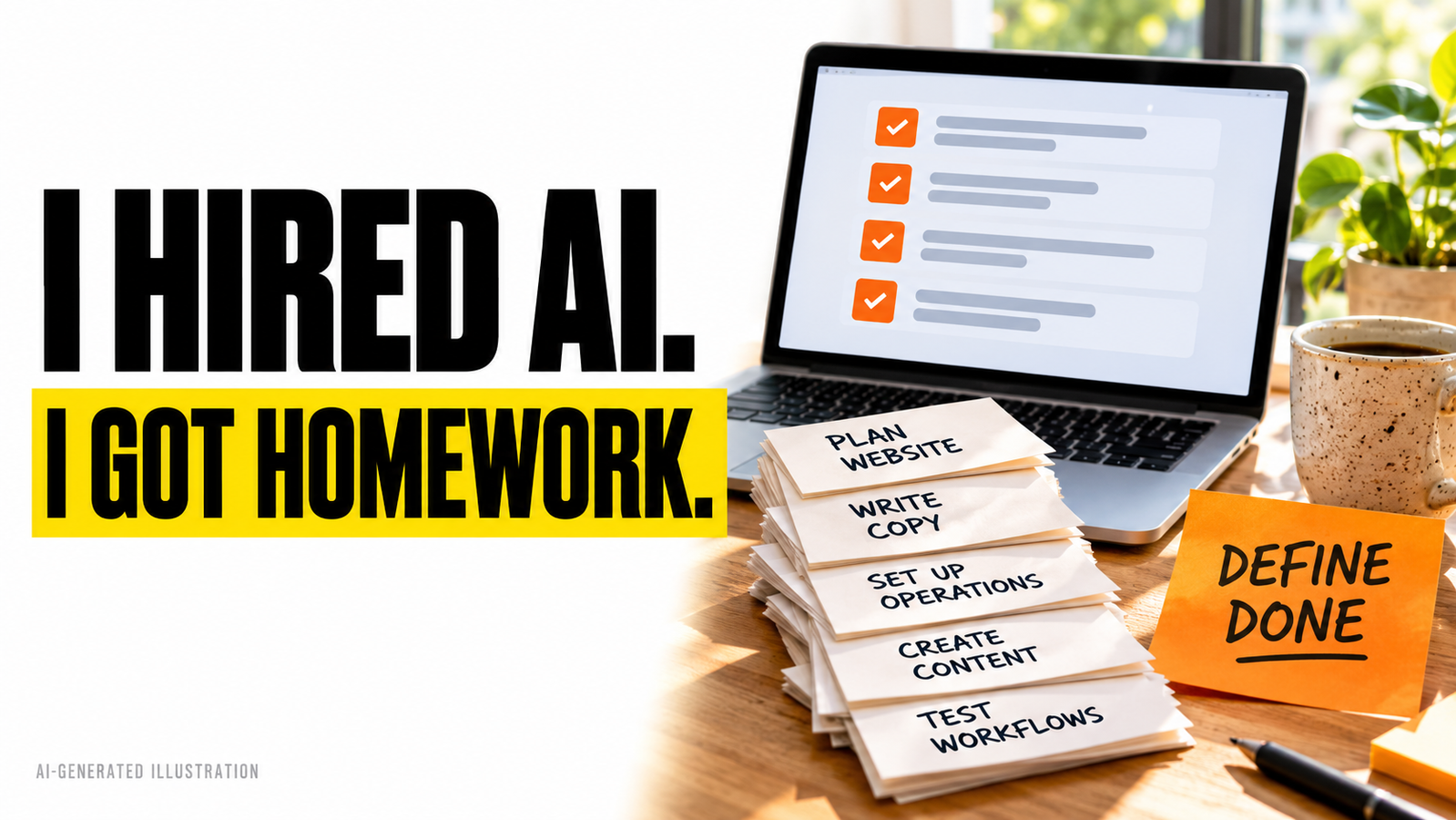
I wanted an AI team. Apparently, I still have homework.
The dream is fairly simple. Give an AI agent a job, make a coffee, come back to finished work.
The less exciting bit is deciding what “finished” actually means.
I’m building a business using AI agents, and this is the part I keep coming back to. You can have a very capable tool and still give it a brief that would confuse a reasonably intelligent human.
“Help me grow the business” is a lovely ambition :D. As a task, it leaves quite a lot open. Last week’s OpenAI update made that question more interesting. Its 26 to 30 October release introduced 6.1 Terra with a focus on understanding images and using computers. One example OpenAI gives is matching product photos to catalogue entries, which is very cool!
For a store owner, that suggests a useful experiment: give an agent a small batch of product photos and an approved catalogue, ask it to suggest matches, and see which ones still need a human eye. Still needs you, but helps in parts where you need another people oppinion.
There’s also a business example worth looking at.
Postiz, founded by Nevo David, offers social media scheduling that can be operated by AI agents. Its TrustMRR listing showed $352,049 in monthly recurring revenue when checked on 2 November 2026, with verification through a connected Stripe account. That’s reported subscription revenue, before costs, rather than the founder’s take-home pay. The product helps with planning, creating and scheduling posts across social platforms.
The part I’d take away is the recognisable job underneath it. Businesses already need to keep their social channels running. You can explain the product without delivering a small lecture on the future of intelligence.
It doesn’t prove that adding an agent to a product creates a successful business BUT - It does give me a more useful starting question: what recurring job would somebody be relieved to hand over?
For anyone starting with agents in their own business, I’d try something small enough to check properly.
Take customer enquiries, for example.
Give the agent ten anonymised enquiries and your approved product information. Ask for draft replies, the source behind each answer, and a list of anything it couldn’t establish. Keep the drafts for review.
The brief could be this simple:
Draft replies to these ten anonymised enquiries using only the attached product information. Flag missing details. Do not invent prices or delivery dates. Return each draft with its supporting source and any questions for me. Save drafts for review. Do not send them.
Then count the time honestly. Include preparing the information, checking the replies and fixing mistakes. A fast first draft is useful when it reduces the whole job.
If the same correction comes up repeatedly, put it in the instructions. If the information is missing, improve the source material. If the task is still too broad, make it smaller.
There’s a slightly funny possibility here: trying to delegate to AI might force us to explain our own businesses more clearly.
What information matters? Who decides? When is something ready for a customer?
I’m still interested in how much these tools can do. But I’d happily start with one routine job that comes back consistently useful.
Preferably before the coffee goes cold.
What’s the first job you’d like to hand over in your business?
1reading
Written by
Kristjan SaarikTech entrepreneur building AI agents21 pieces · 9 followersFollow Kristjan to see new posts in your feed, on your phone or by email.