Anatomy of a Connected Health App: What It Actually Takes to Link Body, Mind and Diet

Ask someone how their health is and they'll answer with one number — steps, weight, a ring closed. Ask them why it's that number and the answer is somewhere else entirely: what they ate this week, how work went, whether they slept.
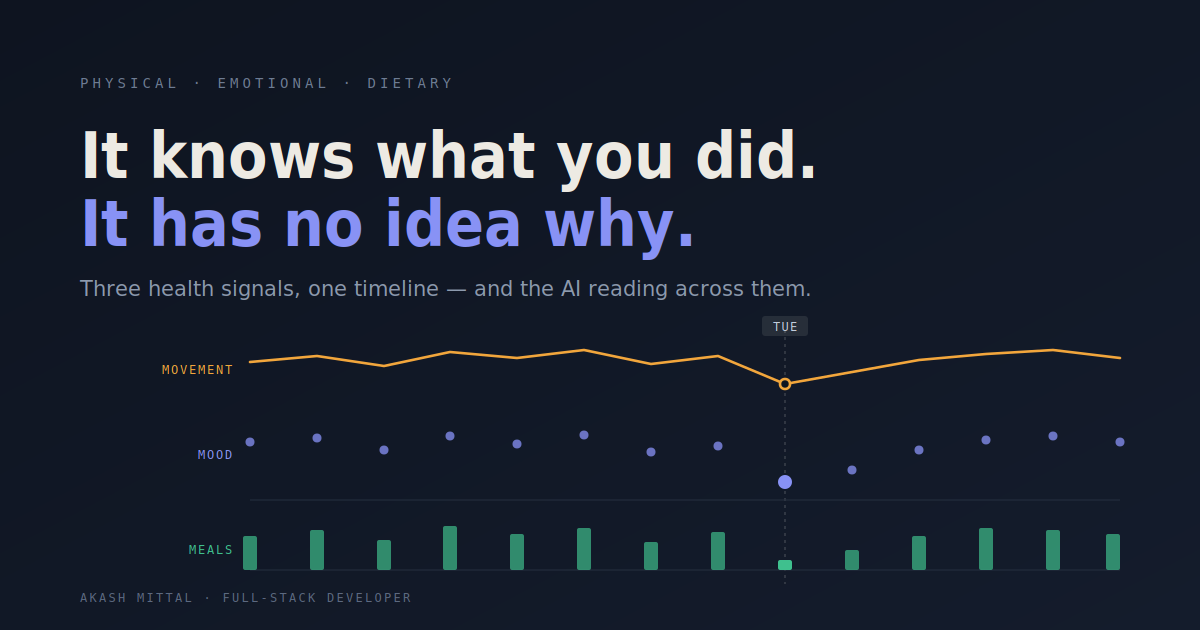
I've been scoping and building an ecosystem that tries to hold all three at once. Not a fitness tracker with a mood widget bolted on — a system where physical, emotional and dietary data are peers, recorded against the same calendar, and read together.
Here's what that actually consists of, module by module. If you're planning something in this space, this is the shape of the work.
Module 1 — Physical: two paths in, one view out
The mistake is building only for people who own a wearable. The scope has to support both: pull metrics automatically from Apple Health and Google Health for users with a device, and offer clean manual entry for everyone else — height, weight, and per-workout logging after the fact.
Both paths land in the same place: a calendar the user can open on any past day of any month and see exactly what their training looked like. They can attach photos, video or notes to a session, so the record isn't just numbers.
Module 2 — Emotional: the part almost nobody builds
This is the module that makes the whole thing work, and it's the hardest to design.
You can't ship a fixed list of emotions. One user tracks happy, anxious, low, upset; another tracks angry, agitated, irritable, nervous. So the user configures their own triggers first — building a personal set of quick-access buttons — and logging becomes a single tap on a button that means something to them.
After the tap: an optional line of context, typed or spoken and transcribed, because nobody types a paragraph at the moment they feel something. Those entries plot onto a chart over days and weeks, and the same calendar view lets the user open any date and see what they were carrying that day.
There's also a journal layer for the days that mattered in either direction — pictures, video, voice notes, milestones. Over a year, that becomes something no metric captures.
Module 3 — Nutrition: designed around the fact that logging is tedious
Nutrition tracking dies from friction, so the scope attacks friction directly. Users predefine their typical breakfast, lunch and dinner once, then quick-add on ordinary days instead of re-entering items. A food library with calorie values covers the rest, and anything off-plan can be added as an exception.
Meals can go in as text or as an image — which brings us to the AI.
The AI layer: two jobs, not one
Photo-to-meal. Point the camera at the plate. A vision model identifies the items, estimates the portions, computes the meal, and adds it to the day's tally. No form, no searching a database. This single feature is the difference between a nutrition module people use in month three and one they abandon in week two.
A coach that has all three streams. This is the part that isn't possible in a single-purpose app. An assistant with access to the user's physical output, their logged emotional triggers and their intake — available any hour — can answer questions in plain language and point at patterns across the three: the training days that follow the days they logged as anxious, the intake pattern that keeps preceding a bad week.
Those correlations are also what feed the two scores in the scope: a Health Score summarising where the user is, and a Benchmark Score giving them something concrete to move toward. Scores are what turn a logging app into something people open daily.
The half nobody sees
Around all of that sits the work that determines whether the product survives contact with real users.
Accounts — email, social and mobile-number sign-in, welcome flows, password recovery, and a real account-deletion path.
An admin console — user management and approvals, subscription visibility, revenue reporting, and order handling for the in-app store.
Commerce — an in-app mini-store for accessories and apparel, with cart, secure checkout and online payment, because subscriptions alone are a thin revenue model.
Monetisation — a free tier with the three modules available in restricted form, and a paid tier that unlocks them. Users who've logged months of their own data don't experience the upgrade as an expense.
Security and compliance — and this one isn't a checkbox. The moment you're storing workout data, mental-health entries and card transactions in one system, you need hardened servers, a properly integrated payment gateway, and HIPAA-grade thinking about health data from day one. Retrofitting that is far more expensive than designing for it.
Two things I'd tell anyone building this
Correlation is a prompt, not a diagnosis. The interface must never imply the app has diagnosed anything. That's a UI constraint throughout, not a disclaimer at the bottom of a screen.
A log should lower anxiety, not add to it. Anything that scores a person and tracks their eating and mood needs deliberate restraint in how it nudges. Get that wrong and the app harms the users it was built to help.
The rest — three modules, one calendar, two AI models, and a serious security layer — is just execution.
I'm Akash Mittal, a full-stack developer with 8+ years building web and mobile products in React Native, Flutter and modern web stacks. If you're scoping something like this and want a candid read on the architecture before anyone commits, I take on freelance projects and I'm reachable here.
1reading now
Get an email when Akash publishes