How to choose the right size outdoor sauna for your garden

Sauna size is one of the two or three decisions that most buyers get wrong on their first outdoor sauna purchase. Some buy too small because the price gap between sizes felt significant at the point of purchase and they underestimated how often they would actually use it. Others buy too large because they envisioned entertaining and hosting sessions that in practice happen once or twice a year. Both mistakes are avoidable, but only if the buyer thinks about the decision correctly before ordering.
This is a practical guide to picking the right size outdoor sauna for your household and your garden, based on how these decisions actually play out in the years after installation. It applies whether you are buying from us, from a competitor, or from a budget importer.
## Start with how you will actually use it
The single most useful question before picking a size is not how many people you might theoretically fit inside. It is how many people will actually be in the sauna during a typical session over the first two years of ownership.
For most European households, the honest answer to that question is one or two. Even in homes with three, four, or five occupants, the sauna is typically used by one or two people at a time, on a rotating basis, several times per week, which is the usage frequency most closely linked to cardiovascular and wellness benefits in the research compiled by the Global Wellness Institute. Group sessions with more people happen occasionally, but they are the exception rather than the norm. Buyers who size their sauna for the exception often regret it, because they end up heating a larger volume of air, running higher electricity or fuel costs, and waiting longer for the sauna to reach temperature, all for a use pattern that never actually materialises.
The correct sizing logic runs the other way. Size the sauna for your typical use pattern, and accept that on the rare occasion when a larger group is present, sessions can be rotated rather than shared. This produces a sauna that gets used more often, heats faster, costs less to operate, and delivers better bathing experience per session.
## Practical sizing by household use pattern
For solo or couple use, three to four times per week, an outdoor sauna of roughly two to two and a half metres in length or diameter is genuinely sufficient. In our barrel range this corresponds to the XS 200cm or S 250cm configurations. In our cube range it corresponds to the SIG-170, with internal dimensions of roughly one and a half metres by one and a half metres. Either format seats two adults comfortably with room for lying down on the top bench, heats to usable temperature in twenty to thirty minutes with a standard Harvia M9 or HUUM DROP electric heater, and remains manageable in terms of running cost for regular use.
For family use with regular sessions of three or four people, a sauna in the two and a half to three metre range makes more sense. Our barrel M 300cm and our Signature SIG-200 specified with a HUUM DROPheater both fit this pattern, with internal dimensions that comfortably accommodate three adults or a mix of adults and children. This is the size range where most European family installations land, and it typically represents the best compromise between capacity, heat-up time, and running cost for households where the sauna is used several times a week.
For extended families, occasional group use, or households where the sauna doubles as an entertaining space, a larger configuration is worth considering. Our barrel L 400cm, XL 600cm, and Signature SIG-240 all fit this use case. But it is worth thinking carefully about whether the group use pattern is genuinely regular or aspirational. Larger saunas cost more to install, more to heat, and more to maintain. If the group sessions happen twice a year, the smaller configuration serves the household better through the other three hundred and sixty-three days.
The pattern that produces satisfied buyers is not the biggest sauna the buyer can afford. It is the smallest sauna that comfortably accommodates the typical use pattern with a little room to spare.
## What the garden imposes on the choice
The second half of the sizing decision is not about the household. It is about the garden.
Every outdoor sauna occupies a physical footprint, requires access for delivery, needs a stable foundation, and sits within a wider outdoor space that has to remain functional after the sauna is installed. Getting these constraints right before ordering avoids the frustration of a sauna arriving and not fitting the site correctly.
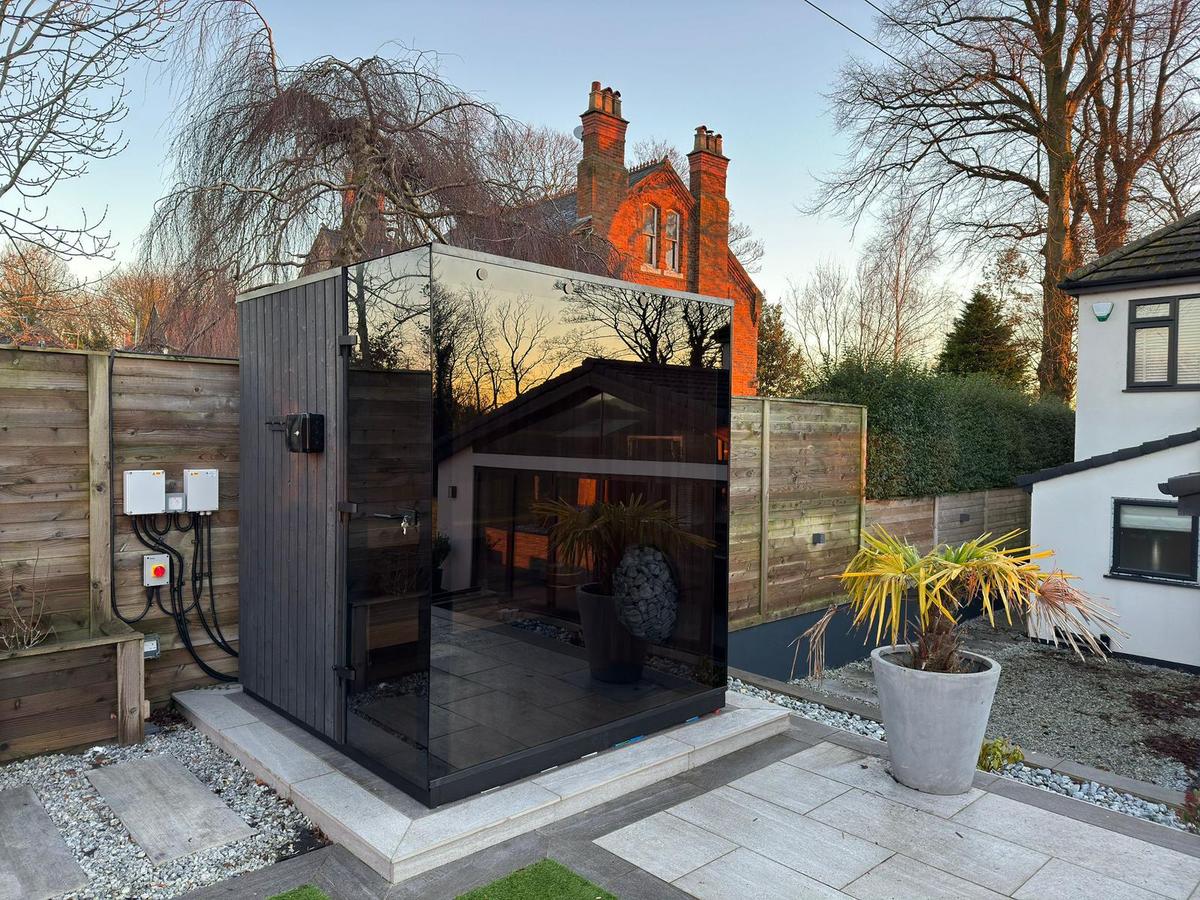
Footprint is the first consideration. A 3-metre barrel sauna occupies roughly three metres by two and a half metres of ground area including the base rings, plus recommended clearance around the structure for ventilation and access. A Signature SIG-200 cube occupies roughly two metres by two and a half metres externally including the deck platform. A larger XL barrel or SIG-240 cube requires proportionally more ground area. The rule of thumb is to plan for a total site footprint of roughly one and a half times the sauna's own dimensions, which allows for the required clearances and for reasonable access.
Delivery access is the next constraint. An outdoor sauna arrives either flat-packed on a pallet, in the case of barrels and smaller cubes, or as a partially or fully pre-assembled unit for larger cubes. Delivery vehicles need to be able to reach a point close enough to the installation site that the components can be moved manually the remaining distance. Sites with narrow side access, gated pathways, or steep grades may require additional planning. This is worth checking before ordering, particularly for larger units.
Foundation requirements scale with sauna weight. A 3-metre barrel built to International ThermoWood Association standards with 45mm staves weighs several hundred kilograms fully assembled. A Signature SIG-200 cube weighs approximately 1,095 kilograms empty, before the heater, benches, and stones are added. These weights require a proper foundation, typically a compacted gravel pad or concrete slab appropriate for the load, sized to the sauna's footprint. For our Signature cube line specifically, we provide detailed foundation guidance including recommended slab thicknesses and dimensions before delivery.
Finally, the sauna needs to sit within a garden that continues to function around it. A sauna dominating the entire outdoor space can feel imposing rather than restorative. A sauna sized appropriately for the garden becomes a natural feature that adds to the overall experience of the outdoor area rather than replacing it.
## When bigger genuinely is better
The reverse decision, sizing up rather than down, makes sense in a specific set of circumstances that are worth naming honestly.
Households that regularly host groups for wellness or entertainment purposes, particularly those in remote or rural settings where extended visits are common, benefit from a larger sauna because the group use pattern is genuinely typical rather than aspirational. Commercial or semi-commercial installations, such as a sauna serving a guest house, a small hotel, or a wellness retreat, should be sized for peak occupancy rather than typical use. And households where the sauna will be shared across multiple family units, such as an extended family compound or a residence hosting adult children and their families regularly, may benefit from the larger configuration.
For these cases, our L 400cm and XL 600cm barrel configurations and our SIG-240 cube specification provide the additional capacity while maintaining the same manufacturing standards as our smaller units. The trade-offs are higher purchase price, longer heat-up time, higher running cost, and larger site requirements. All of these are acceptable when the use pattern justifies them, and none are when it does not.
## What we recommend, and how we help buyers get this right
At Wood Architects we spend a significant amount of pre-order conversation on sizing decisions specifically, because we have seen how much the choice affects long-term satisfaction. Buyers who arrive certain they need the largest available configuration are often best served by the size below. Buyers who arrive planning to buy the smallest available configuration are occasionally best served by sizing up, but more often the smaller unit is the right answer for their actual life.
The way we handle this is straightforward. During the pre-order conversation, we ask specifically about the number of people expected in typical sessions, the frequency of intended use, the garden dimensions and access constraints, and the household context around how the sauna will fit into weekly life. Based on these answers, we recommend a specific configuration and explain the reasoning. Buyers are free to overrule the recommendation, but our starting point is what produces the best long-term outcome rather than the highest immediate order value.
If you would like help sizing a sauna for your household and garden, reach out with a short description of what you are working with. We will reply from the workshop, honestly, usually within a working day.
---
Filed under outdoor sauna and premium products.
1reading now
Get an email when Pijus publishes