Should Your Hotel Keep Its Sauna Hot or Reheat Between Sessions?
Key Takeaways
Keep-hot and reheat schedules are comparable only when they deliver the same guest service.
Test both schedules through one meter boundary and the same operating conditions.
Separate heat-up energy, ready-state holding and occupied use.
Record bookings, door events, ambient conditions and staff interventions beside every result.
Judge energy beside availability, failed sessions and operational effort.
Choose a property-specific schedule, not a universal rule from a controller screen.
A schedule decision looks simple until the first guest arrives early. We build and check complete saunas in Klaipėda, but the hotel decides when that installed room must be ready. The A/B plan below keeps the guest promise fixed while changing only the operating schedule.
Should Your Hotel Keep Its Sauna Hot or Reheat Between Sessions?
A hotel should keep its sauna hot only when measured guest demand and the required availability justify the holding energy. It should reheat between sessions only when the room can return to the agreed ready condition before the next booking. Compare both schedules through the same meter boundary, set point, service window and guest-use pattern. Record energy, readiness, missed service and staff interventions. The better schedule is the one that delivers the hotel's actual promise with the lower measured operational burden.
Why is the default schedule the wrong starting point?
The controller offers times and temperatures. It doesn't know the hotel's guest promise. A spa advertising walk-in access is selling a different service from a property running fixed private sessions. One may need long ready periods. The other may have clean gaps between bookings.
That difference matters more than a slogan about switching off. Reheating can reduce holding periods and still fail commercially if guests wait. Holding can preserve availability and still waste energy when the room sits unused. Neither mode wins without a measured service boundary.
For a schedule comparison, ISO 50015:2014 supplies current guidance for energy performance measurement and verification. It establishes general principles rather than a hotel-sauna schedule. That boundary is useful. The standard supports a defensible method, not a universal keep-hot or reheat verdict.
The U.S. Department of Energy's measurement and verification guidance says baseline conditions can include occupancy, control strategies, loads and operating hours. In a hotel sauna, those are not side notes. They explain what the meter saw.
What must stay fixed during the A/B test?
Start with the service promise. Write the ready condition, the bookable windows and the response expected after an unplanned door opening. Then hold that promise constant across both schedules.
Test field | Keep fixed | Record every run |
|---|---|---|
Electrical boundary | The same included heater, controls, lighting and auxiliaries | Meter ID and start and end readings |
Ready condition | The same sensor, set point and acceptance rule | Time ready and any failed ready check |
Service window | The same advertised or booked availability | Occupied, unoccupied and unavailable periods |
Use pattern | A matched booking and door-event script | Actual deviations and staff interventions |
Context | Comparable operating days where practical | Ambient conditions and unusual events |
Don't hide a changed guest promise inside the energy result. If the reheat schedule makes the sauna unavailable for part of an advertised open period, that is a service change. If the keep-hot schedule covers an empty period that operations could close, that is a scheduling choice.
How should the hotel run the two schedules?
Use matched operating blocks. Label one schedule A and the other B before collecting data. Alternate them across comparable days or booking patterns where the property can do so without confusing guests. Keep the raw record. A weekly total without its daily context is too blunt.
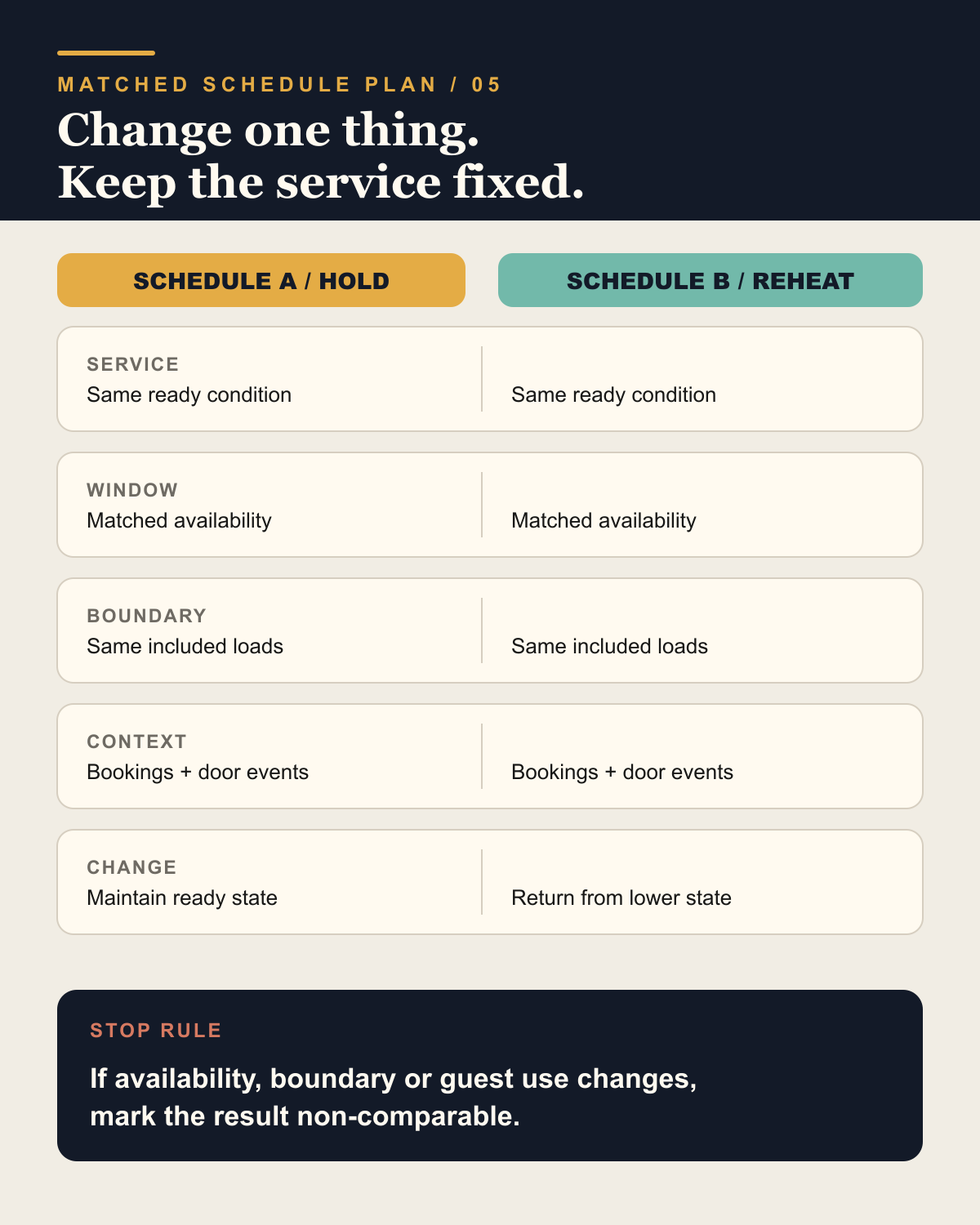
Change only the schedule. Keep the guest promise and measurement boundary fixed, then mark every deviation before comparing the totals.
Schedule A: maintain the agreed ready condition
Run the sauna through the defined service window using the approved ready-state mode. Record the meter at each boundary. Mark booked sessions, walk-ins, door events, cleaning windows and any staff adjustment. Separate initial heat-up from the energy used while the room remains ready.
Schedule B: return from a defined lower state
Use the same service window and the same ready rule. Record when reheating starts, when the ready condition is achieved and whether any booking or walk-in request arrived before that moment. Keep the lower state and controller sequence documented. Don't assume every controller behaves alike.
The DOE's Option B guidance describes system-level measurement of relevant performance and operational factors. A hotel schedule test isn't a federal retrofit contract. The principle still fits: measure enough of the installed system and its operation to explain the result.
What belongs on the service-energy scorecard?
Energy is the first line, not the whole score. Put operational outcomes beside it so the winning schedule cannot hide a colder room, a missed booking or more staff work.
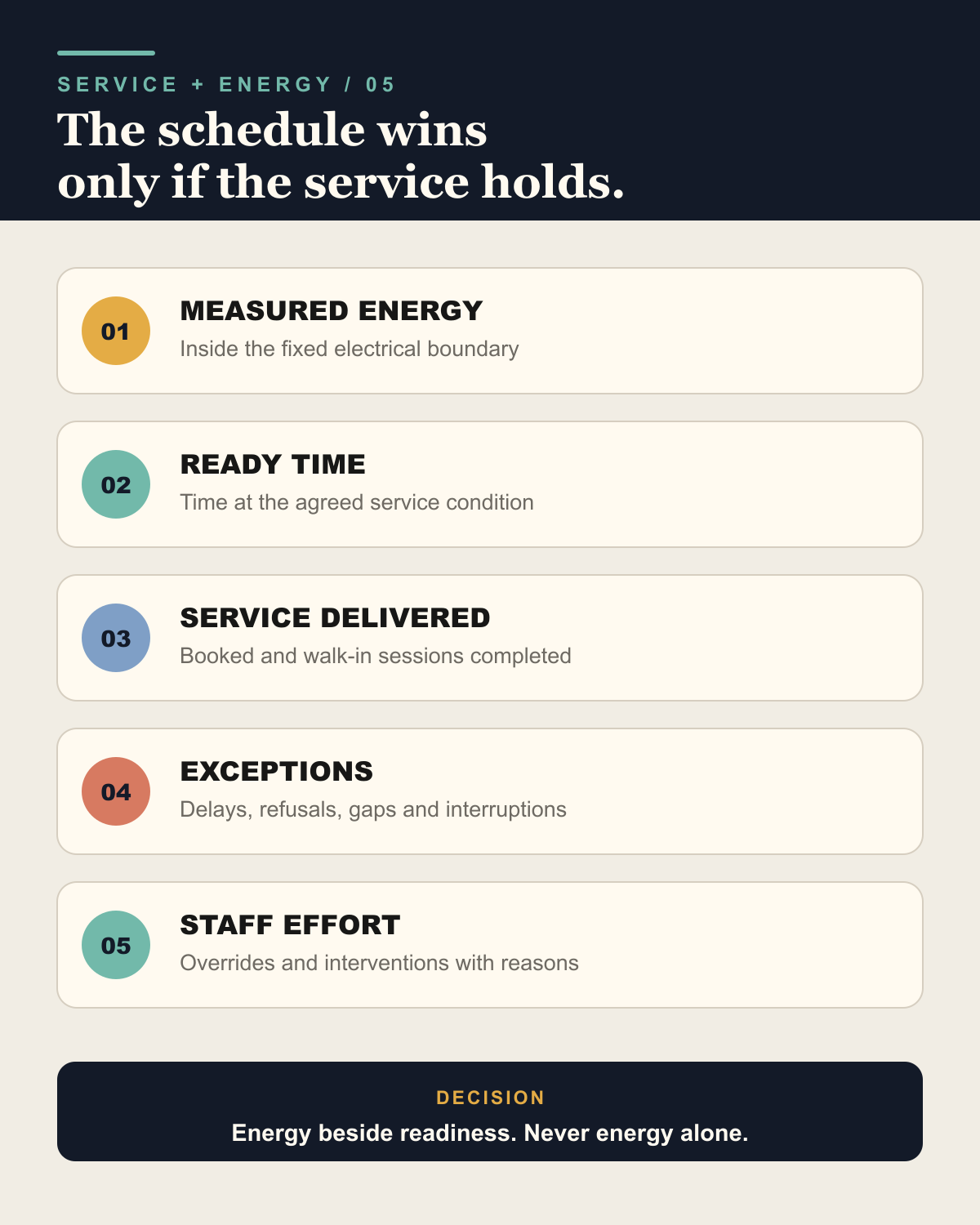
A schedule earns a decision only when measured energy, guest readiness and operational exceptions appear on the same card.
“Measured energy inside the agreed boundary: [meter record].”
“Time at the agreed ready condition: [time-stamped record].”
“Booked and walk-in sessions delivered: [operations log].”
“Requests delayed or refused: [exception log].”
“Door events, cleaning and maintenance interruptions: [context record].”
“Manual overrides and staff interventions: [named reason].”
“Weather or ambient differences affecting comparability: [daily note].”
Write the decision rule before reviewing the totals:
“Choose the schedule that meets the agreed sauna availability and ready condition with the lower measured energy, provided it creates no unacceptable guest failure or operational burden.”
How should management choose the final schedule?
Choose by operating pattern, then keep watching. A fixed-session spa may find a reheat pattern easier to plan. A walk-in facility may need longer ready periods. Those are hypotheses for the meter and operations log, not universal truths.
For the physical context behind changing heat demand, read Will Your Panoramic Glass Sauna Work in Winter?. That article explains why glazing, climate and installed conditions belong in the brief. This decision stays narrow: one installed sauna, two schedules and one unchanged guest promise.
Review the result again when opening hours, booking rules, controls or guest traffic change. The original comparison belongs to its recorded conditions. It doesn't become a permanent law for the property.
STOP: don't claim a saving when the schedules delivered different availability, used different boundaries or lack raw meter readings. A shorter operating window can reduce energy while quietly reducing the service.
You don't need to redesign the whole spa timetable. Print the A/B plan and test one recurring operating block with the facilities and spa teams together. The useful result is a signed schedule beside its meter record, ready for the next manager to repeat.
Frequently asked questions
Does reheating a sauna always use less energy than keeping it hot?
No. The result depends on the sauna, controls, starting state, gap between sessions and required readiness. Measure both schedules under matched conditions. Include failed or delayed service beside the energy total, because a lower reading doesn't win if the hotel no longer delivers the same guest promise.
Can a hotel test keep-hot and reheat schedules in different weeks?
Yes, when the hotel records the conditions that may differ and matches the operating pattern as closely as practical. Keep bookings, service windows, set point and measurement boundary visible. If weather, occupancy or interruptions differ materially, report that limitation rather than treating the weekly totals as directly comparable.
Should cleaning time be included in the sauna schedule test?
Yes, when cleaning changes readiness, doors, ventilation or controller state. Record it as an operating event rather than folding it invisibly into unoccupied time. The hotel needs to know whether a schedule survives the real service routine, including the handover between guests and the staff actions around it.
What if guests arrive outside the planned sauna sessions?
Record the request and the service outcome. An early arrival is valuable evidence about the booking promise, not noise to delete from the test. Management can then decide whether walk-in availability belongs in the brief or whether staff should communicate a fixed ready time more clearly.
How often should a hotel review its sauna operating schedule?
Review it when opening hours, demand, booking rules, controls or the installed system changes. There is no universal calendar interval. Keep the accepted schedule, meter boundary and operating assumptions together so facilities staff can see when the original evidence no longer describes the current service.
1reading
Written by
 Giedrius PatlabaCEO & co-founder, Wood Architects163 pieces · 30 followers
Follow Giedrius to see new posts in your feed, on your phone or by email.