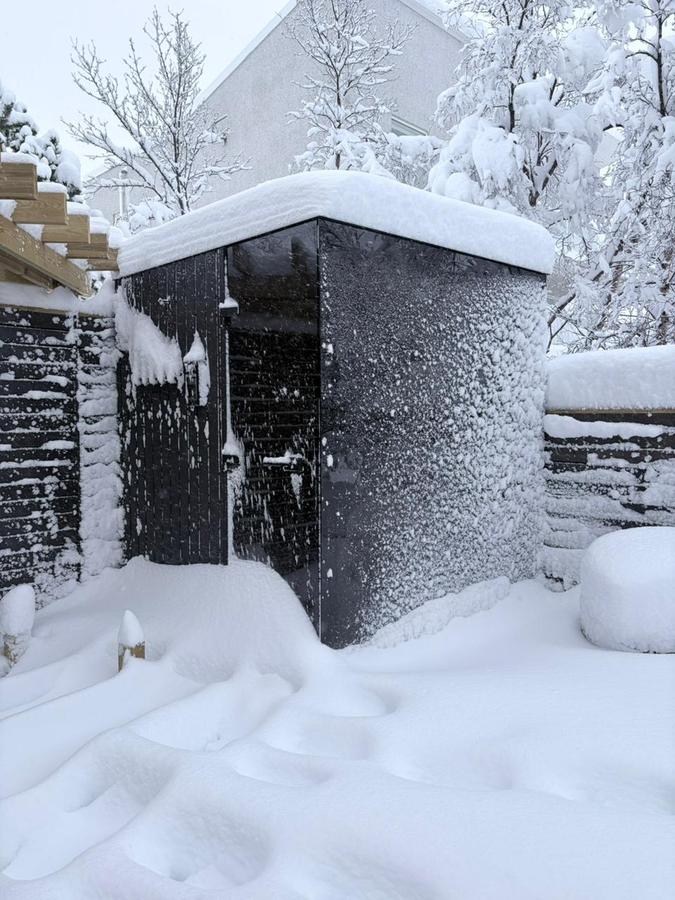
How Much Does It Cost to Run Your Outdoor Sauna?

A typical electric outdoor sauna for four people uses roughly 7 to 10 kWh per session, including the heat-up. At average European household electricity prices that is about €2 to €3 per session, or roughly €130 to €400 a year if you use it one to three times a week. Your real figure depends on three things: your heater's power, how long you heat and bathe, and what you pay per kWh.
That is the short answer. The rest of this piece shows how to work out your own number, and which choices make it go up or down.
How to calculate your own running cost
An electric sauna heater only draws its full rated power while it is heating. Once the room reaches temperature, the thermostat cycles the elements on and off to hold it, so the average draw falls well below the rated figure.
A practical way to estimate one session:
Heat-up energy = heater power (kW) × heat-up time (hours). A home heater in the 6 to 9 kW range that runs flat out for 45 minutes uses roughly 4.5 to 7 kWh.
Holding energy = for an hour of bathing, allow roughly 30 to 50% of the heater's rated power, so about 2.5 to 4 kWh for the same heater.
Cost = total kWh × your tariff.
Example: an 8 kW heater, 45 minutes to heat, one hour of use. That is about 6 kWh plus about 3 kWh, so roughly 9 kWh. Eurostat put the EU average household electricity price at about €0.29 per kWh in the first half of 2025 (https://ec.europa.eu/eurostat/statistics-explained/index.php/Electricity_price_statistics), so that session costs around €2.60. Prices vary a lot between countries and tariffs, so plug in the rate from your own bill.
Over a year, one session a week comes to roughly €130, two a week roughly €260, and three a week roughly €390 at that average price.
What pushes the cost up or down
Winter and outside temperature. Heat-up time is the biggest variable. On a freezing January evening the timber, stones and air all start colder, so expect a longer heat-up than in summer. Your winter sessions will cost noticeably more than your summer ones.
Insulation. A sauna with properly insulated walls, roof and floor reaches temperature faster and holds it with less cycling. Traditional solid-log or uninsulated board saunas lose more heat through the walls, which is one reason modern cube saunas use insulated panel walls.
Glass. Large glazed areas give you the view, but glass insulates less well than an insulated wall. A panoramic front is worth it for most owners; just expect slightly more energy use than a fully solid cabin of the same size, and choose quality tempered glazing with good seals.
Heater sizing. An undersized heater runs at full power for longer and may struggle to reach temperature in winter; an oversized one heats quickly but is unnecessary. Follow the heater maker's sizing guidance for your room volume, allowing extra for glass.
Habits. Leaving the sauna heating for an hour before anyone is ready is the most common waste. Many modern controllers, including Wi-Fi models from heater makers such as HUUM, let you start heating from your phone so the room is ready when you are, not long before.
What about wood-burning heaters?
A wood-burning stove avoids electricity costs entirely and is a good choice where firewood is cheap or the sauna is far from a power supply. The cost becomes firewood plus your time lighting and tending the fire. Electric is usually more convenient for frequent short sessions; wood suits slower, weekend-style bathing. Some barrel saunas are offered with either option, so you can choose based on how you will actually use it.
Other ownership costs to budget for
Electricity is the main running cost, but not the only one. Budget for occasional sauna stones replacement, a wood treatment or cleaning routine for the interior benches, and an electrician's inspection if your local rules require one. The installation itself (a dedicated circuit and cable run from the house) is a one-off cost that is worth getting quoted before you buy.
At Wood Architects we build our saunas in Klaipėda, Lithuania, with insulated panel walls, and every unit is assembled and checked in the workshop before shipping. That matters for running costs too: a well-sealed, factory-checked cabin is a cabin that holds its heat.
For the commercial side of this question, my business partner Giedrius Patlaba, Wood Architects' CEO and co-founder, has written about how hotels should measure sauna energy use per guest session: https://www.pub-lish.com/en/read/69a4bba7-3591-401e-bee8-a1093026afa9
Related questions
Is it cheaper to leave a sauna on all day? No. Heating from cold for each session uses far less energy than holding temperature for hours.
Does a bigger sauna cost more to run? Generally yes, because a larger room needs a more powerful heater and longer to heat.
Can I run an outdoor sauna on solar power? Partly. Solar can offset daytime use, but most sessions happen in the evening, so battery storage or grid power usually covers the rest.
Sources
Eurostat, Electricity price statistics: https://ec.europa.eu/eurostat/statistics-explained/index.php/Electricity_price_statistics
1reading now
Get an email when Pijus publishes