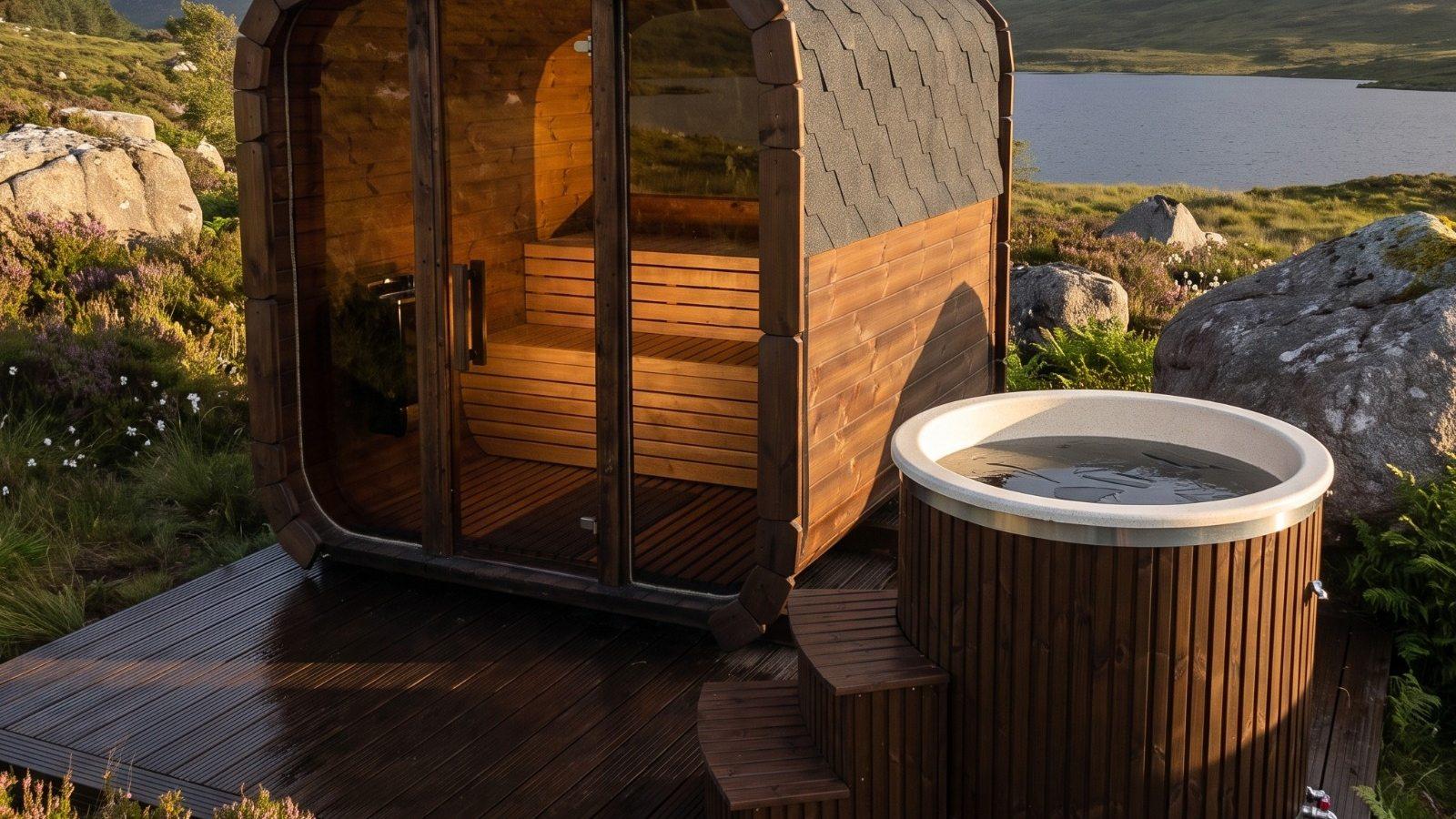
How Do You Install Your Outdoor Sauna on a Sloping Garden?
You can put an outdoor sauna on a sloping garden, but the sauna itself must sit dead level, so all of the work goes into the base. Measure how much the ground falls across the footprint, then choose between digging a level platform, building up on stepped pads or piers, or using adjustable ground screws with a level frame.
Why a level base matters more than the slope
A finished sauna is a rigid box or barrel with a glass front and a door that has to close cleanly. If it stands out of level, the door can bind, water on the floor runs to one corner, and the frame takes uneven loads it was not designed for.
Adjustable feet do not fix a slope. Wood Architects' cube saunas, for example, are listed as "approx. 242 cm high (adjustable feet)". Feet like these take out small differences on a base that is already flat and firm. They are not meant to bridge a real slope.
Step one: measure the fall across your footprint
Mark out the footprint plus a working margin, then measure the height difference between the highest and lowest corner with a laser level or a string line and spirit level. Use the full outside size of the model you are considering. A 6 m barrel with a changing room and terrace covers far more ground, and so more fall, than a compact cube that is 202 or 241 cm wide.
That one number shapes everything else. A gentle fall can often be taken out in the base itself. A steep fall usually means a raised structure and steps to the door.
Three ways to build a level base on a slope
Cut and fill with a slab or gravel pad. You dig into the high side, build up the low side and form a level, compacted platform. It suits gentle slopes. On a steeper fall the cut side may need a retaining edge so the bank does not slump towards the sauna, and the fill must be compacted properly or it will settle.
Stepped pads or piers. Concrete pads at the load points, each set at its own depth, carry a level frame or bearers. The UK guide to garden room foundations from Homebuilding & Renovating describes block pads typically 300 to 750 mm deep, dug with a post-hole auger, with air able to move underneath.
Ground screws with a level frame. The same guide singles out ground screws for "sloping sites with difficult ground conditions": galvanised screws driven 1 to 1.5 m into the ground, with brackets on top forming a level base. They need little digging but do need specialist installation.
Whichever route you take, the base must reach firm, frost-safe ground for your climate. Giedrius Patlaba covers that depth question in detail in How Deep Must Your Sauna Foundation Go Below Frost?. For a large or heavy unit, or a very steep site, ask a structural engineer or an experienced groundworker to size the base. Always get the sauna's weight and footprint from the manufacturer rather than guessing them.
Drainage, access and delivery on a sloping site
On a slope, water runs towards whatever you build. Keep surface water flowing around the base, not under it: a shallow channel or gravel strip on the uphill side helps. Leave a clear gap under any timber frame so it can dry out.
Then think about delivery day. Cube saunas from Wood Architects leave the factory fully assembled, and barrels are typically shipped assembled, with a flat-pack option where access is restricted. The buyer arranges the crane or forklift. A forklift struggles on a slope, so check where a crane can stand on firm, level ground and whether its reach covers the base. Get the electrician's cable route in before the sauna goes on.
A sensible order of work
Measure the fall, pick the base type, have it built and checked for level, lay the drainage and the power supply, and only then book the lift.
Related questions
Can I just pack shims under the sauna on a slope? No. Shims and adjustable feet are for fine levelling on a firm base, not for taking up a real slope.
Do I need planning permission for a raised sauna base? It depends on your country and the platform height, so check your local rules before you build up a low side.
Is a barrel or a cube easier on a slope? A shorter footprint is easier, because it spans less fall. Compare the outside length of the models you are considering.
Sources
Homebuilding & Renovating: Garden room foundations and how to choose the best system Wood Architects: Cube saunas Wood Architects: Barrel saunas
1reading now
Written by
 Pijus KazlauskasCo-owner of Wood Architects, Lithuanian premium sauna manufacturer35 pieces · 13 followers
Follow Pijus to see new posts in your feed, on your phone or by email.
- views