Which Sauna Documents Need Translation Before Your EU Sale?

Key Takeaways
Map languages by destination country and document type before commissioning translation.
An applicable construction-product declaration must follow the language requirements of the Member State where the product is made available.
Instructions and safety information must be understandable in the destination market under the applicable product rules.
The technical file isn't automatically a customer-facing translation pack.
Keep product identifiers, warnings, diagrams and translated terms aligned across every supplied document.
Adding another EU market can create a new translation task even when the product is unchanged.
Translation is often treated as the last formatting job before dispatch, but it should begin earlier with a document map. Because we supply European partners from Lithuania, the destination language isn't an afterthought for us. The right question is which regulated and user-facing information must be available in which language where the sauna product will be sold or used.
Which Sauna Documents Need Translation Before Your EU Sale?
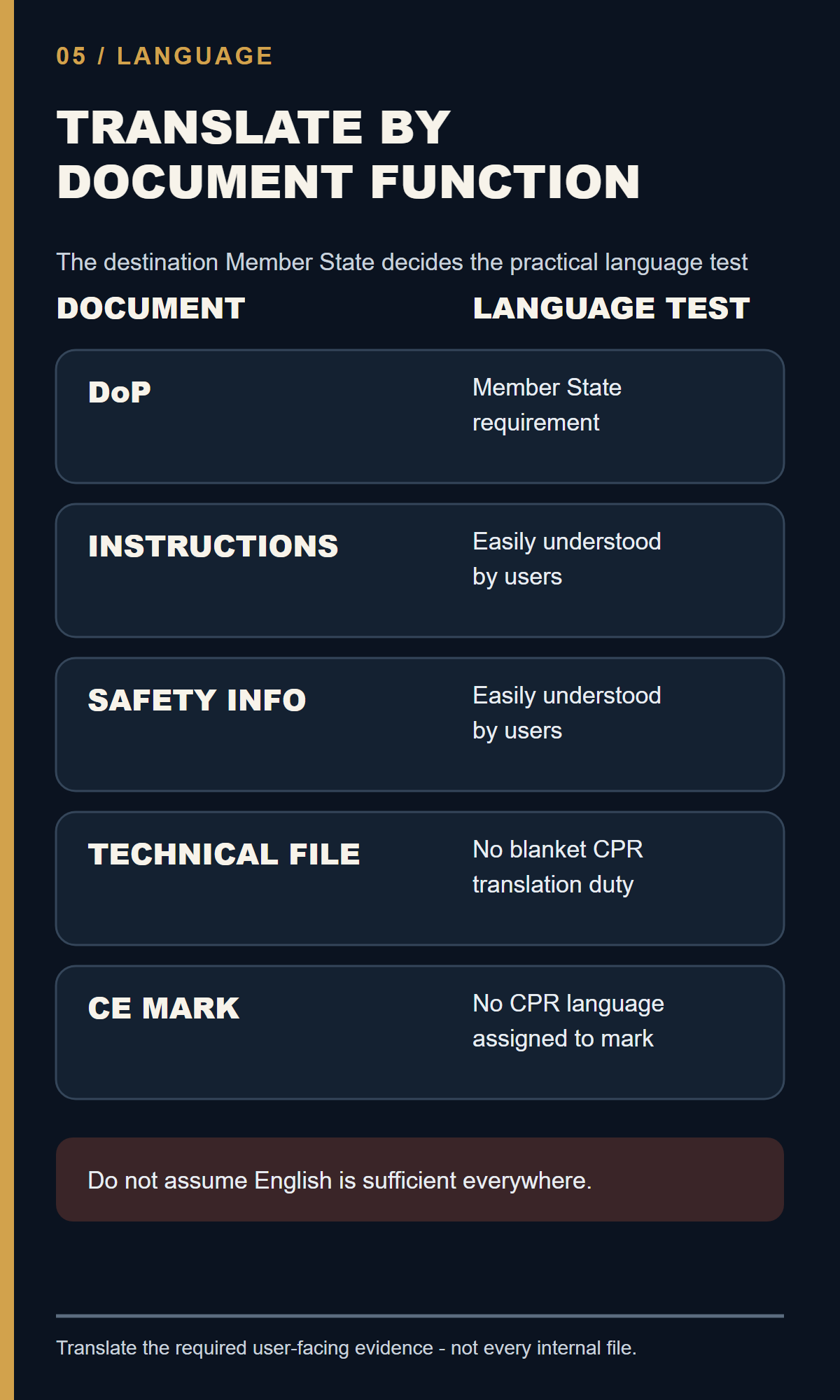
Translate the documents that the applicable EU rule and destination Member State require in an accepted or easily understood language. For a construction product, that can include the applicable Declaration of Performance and Conformity. For products supplied to users or consumers, instructions and safety information need destination-appropriate language. Do not assume that every internal test report or technical-file document must be translated. Build the list by product, legal route, destination country and recipient.
Begin with three separate document groups
First list regulated market documents, such as an applicable construction-product declaration. Second list information supplied with the product, including installation, use, maintenance and safety instructions. Third list retained technical evidence, such as calculations, test reports and supplier records held by the manufacturer for authorities or conformity work.
These groups serve different readers. The customer needs reliable instructions. The market-surveillance authority may request technical evidence. A declaration communicates assessed performance. Treating them as one translation bundle creates cost without proving that the legally required information reaches the right person.
For construction products, follow the destination rule
Regulation (EU) 2024/3110 says a manufacturer supplies the declaration in the language or languages required by each Member State where it intends to make the product available. If another economic operator makes the product available in an additional Member State, that operator provides the required translation together with the original.
The transition from Regulation (EU) No 305/2011 still matters in 2026 because older harmonised routes continue for many product families. The Commission’s current FAQ gives the same practical direction for an older Declaration of Performance. Use the language required by the Member State where the product is made available. Record which legal route and declaration version you applied.
Instructions and safety information have their own language test
The new Construction Products Regulation requires general product information, instructions for use and safety information to be supplied in the language determined by the Member State. If no language is determined, the information must be easily understood by users.
For a consumer product within Regulation (EU) 2023/988, the manufacturer must ensure that clear instructions and safety information accompany it in a language easily understood by consumers, as determined by the destination Member State. Instructions may be unnecessary only where the product can be used safely as intended without them. A sauna heater, controller or cabin installation should never receive that exception by assumption.
Document group | Language decision | Do not assume |
|---|---|---|
Applicable construction-product declaration | Use the language or languages required by the Member State where made available | English is accepted everywhere |
Installation, use and maintenance instructions | Apply the relevant product rule and destination-country language requirement | Installers can safely infer missing steps |
Warnings and safety information | Make them clear and easily understood by intended users in the destination market | A pictogram alone always communicates every hazard |
CE marking and product label | Check the applicable law for mandatory wording and destination additions | The old CPR creates a general translation rule for the CE mark itself |
Retained technical evidence | Keep the required file available and translate on a specific legal or authority need | Every report must be translated for every buyer |
Do not let translation change technical meaning
Translation quality is part of product-information quality. Keep units, temperature limits, clearances, component names and warning levels identical across the source and target versions. Diagrams should use the same identifiers as the text. If a term has no safe direct equivalent, resolve it with the technical owner before release.
Use one controlled source version. Freeze it before translation, assign a version number and link every language file to that source. A late engineering change must trigger an impact check across the declaration, installation manual, user guide, labels and online information. Otherwise a polished translation can still describe an obsolete configuration.
Check the operator responsible for a new market
A manufacturer may prepare the original language pack for planned destinations. An importer, distributor or other operator entering an additional Member State should not assume that the first pack is enough. Under the new construction-product rule, the operator making the product available in the additional country has an express role in providing the necessary declaration translation with the original.
Agree ownership before an order is accepted. Record who identifies the destination requirement, who supplies the controlled source, who translates, who reviews technical accuracy and who releases the final pack. A reseller’s improvised translation should not become the only installation instruction in circulation.
Keep a market-by-market release record
A useful release record connects the destination country, product type, document version, language, translator and technical reviewer. It should also record any destination-specific warning or contact information. This makes later updates manageable and helps the team explain which information accompanied a particular delivery.
The authoritative starting points are Regulation (EU) 2024/3110, the Commission’s Construction Products Regulation FAQ and Regulation (EU) 2023/988 on general product safety. For the broader consumer-product handover, see our GPSR compliance guide for sauna manufacturers.
Copyable translation release brief
DESTINATION-LANGUAGE RELEASE
Product type and variant:
Destination Member State:
Customer or user group:
Applicable legal route for each product:
Required or accepted language source checked:
Declaration source file, number and version:
Instructions source file and version:
Safety information source file and version:
Target languages:
Mandatory label or online information:
Translator:
Technical terminology reviewer:
Product identifiers and units cross-checked: YES / NO
Diagrams and text cross-checked: YES / NO
Original supplied with translated declaration where required: YES / NO
Final released files and date:
Change owner for future revisions:
Frequently Asked Questions
Must every technical-file document be translated?
No. Separate documents that must accompany the product or be supplied to a buyer from technical evidence retained by the manufacturer. A specific authority request or applicable law may create a translation need, but there is no sound basis for ordering every internal report in every destination language by default.
Is English enough for every EU sale?
No. Language requirements are linked to the destination Member State and the applicable document rule. Some professional recipients may work in English, but that doesn't override a statutory requirement for another language. Check the current national requirement before accepting the order and document the source used.
Who handles translation when a distributor enters another country?
Roles should be agreed contractually, but the new Construction Products Regulation specifically addresses an economic operator making a construction product available in an additional Member State. That operator must provide the declaration in the required language together with the original. Other accompanying information still needs its own legal check.
Does CE marking itself always need translation?
Do not apply a blanket rule. The Commission’s FAQ on the previous Construction Products Regulation states that it did not prescribe a language for the CE marking itself, while declarations, instructions and safety information had separate language duties. Check the current applicable framework and any other legislation governing mandatory label text.
What should be checked after a document update?
Confirm that every destination-language version reflects the new controlled source. Recheck product identifiers, technical terms, units, warnings, diagrams, links and version dates. Then withdraw obsolete customer-facing files from active use without destroying the audit trail. Record who completed the technical review and when the release occurred.
1reading now
Get an email when Giedrius publishes