Why Precision Cuts Your Fertiliser Bill, Not Your Yield

For decades, fertiliser was applied the way you water a lawn: spread it evenly, hope for the best, and accept that a large share never did any good. Precision agriculture has changed that. Drones, sensors and smart systems can now map a field metre by metre and tell a grower exactly how much nutrient each zone needs — and variable-rate equipment can place it there and nowhere else. In a market where every tonne is expensive and not guaranteed to arrive, that is not a gadget. It is a way to buy less without losing yield.
Precision means applying only what's needed
The logic is simple and powerful. Instead of blanketing a whole field at one rate, precision tools measure the real variation across it — soil, moisture, crop vigour — and match the dose to the need, zone by zone. Over-fertilised patches stop being over-fertilised. Under-served patches get what they lack. The waste that used to be invisible becomes visible, and then removable. For a farmer facing high input prices, that translates directly into fewer tonnes bought for the same or better result.
But precision optimises delivery, not uptake
Here is the part the technology alone cannot solve. Precision decides how much nutrient reaches each spot and when. It does not decide how much of that nutrient the soil can actually deliver to the roots. You can place a perfectly calculated dose on ground that is compacted, biologically depleted or chemically locked up — and much of it will still sit there unavailable, exactly as it would under blanket spreading. Precision removes the waste of over-application. It does not remove the waste of poor absorption.
The two halves of efficiency
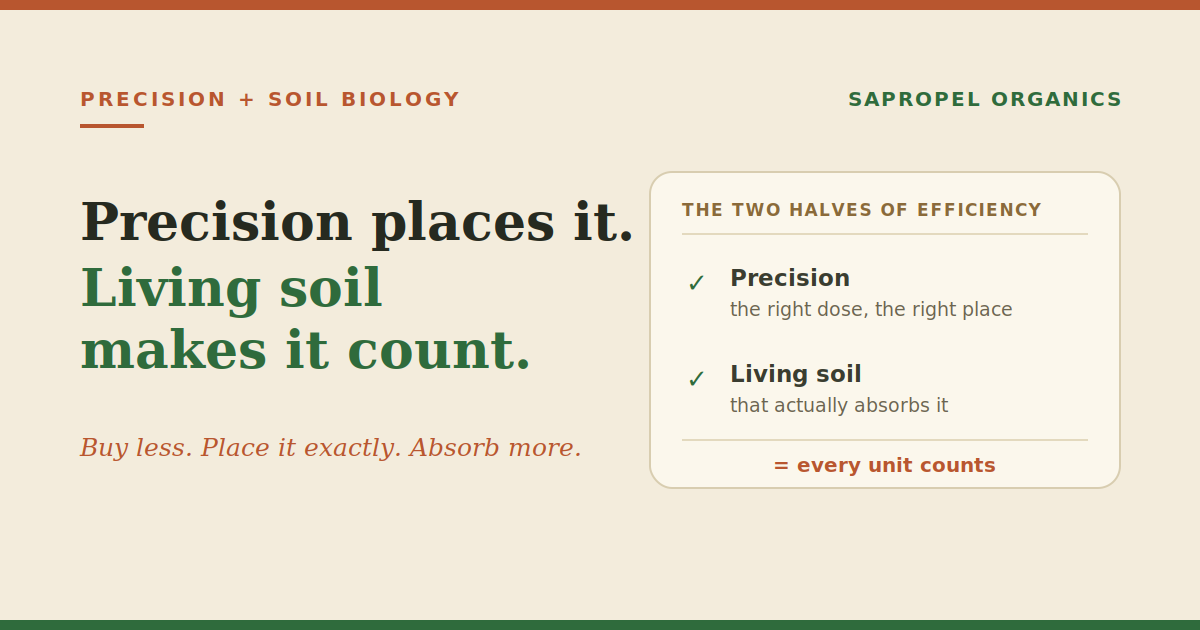
True fertiliser efficiency has two halves, and they only work together. The first is precision: the right amount, in the right place, at the right time. The second is biology: a soil that can actually take up what precision delivers. Optimise the application onto a lifeless soil and you have made a smaller mistake more accurately. Combine precise application with a soil that absorbs well, and every carefully placed unit does the job it was meant to. Miss either half and the other underdelivers: perfect placement onto dead ground, or living soil fed by guesswork, both leave yield and money on the table. The gain comes only when the two work together.
Humuson completes the equation
This is where a soil-restoration input and precision technology reinforce each other rather than compete. Humuson Complex, made from sapropel, reactivates soil biology, rebuilds organic matter and improves nutrient absorption — lifting nutrient-use efficiency by around 25% and helping the crop draw on nutrients already in the ground. Put that underneath a precision programme and the two multiply: the drone or sensor decides the exact dose, and the soil beneath it now converts far more of that dose into yield. As the FAO Global Soil Partnership notes, nutrient-use efficiency is one of the clearest levers in sustainable production — and it is won by improving both what you apply and the soil that receives it.
Buy less, place it exactly, absorb more
Stack the two and the economics are compelling in exactly the market we're in. Precision means you buy fewer tonnes. Restored soil means each of those tonnes goes further. Together they let a grower cut the fertiliser bill and protect the harvest at the same time — measuring precisely how much and where, then making sure the ground can use it. That is the same efficiency logic behind our earlier piece on getting more from every input.
If you work in precision agriculture, agronomy or input distribution and want the biological half of the efficiency equation to match the technological one, let's talk.
1reading now
Get an email when Aurimas publishes