Why the Highest Yield Isn't Your Most Profitable Crop

Agriculture has a habit of measuring success with a single number: yield per hectare. A field producing four tonnes looks like it beat a field producing three. But that number hides almost everything that decides whether the farmer actually came out ahead.
What did the four-tonne crop cost in water, fertiliser, pesticides and labour? What happened to the soil's organic carbon over the season? How exposed is it to heat, erratic rainfall, or a swing in market price? And after all of it, did the farmer earn more, or just harvest more?
Yield is a vanity metric
A more honest scorecard looks at the whole system: yield, cost of cultivation, water requirement, input-use efficiency, soil health, climate resilience, market risk, and net income. The moment you measure all of these together, "maximum yield" stops being the goal and "maximum sustainable return" takes its place. Often a 10% cut in inputs costs only 2% of yield while lifting profit substantially.
But the answer isn't always a different crop
Here is where the usual conclusion goes too far. The standard advice is to diversify or switch to lower-input crops. Sometimes that helps. But you rarely need to tear up your rotation to fix the scorecard, because most of those parameters share a single root cause — the condition of the soil underneath the crop.
Change what you grow, and you change one line. Change the health of the ground it grows in, and you move almost every line at once.
One lever moves the whole scorecard
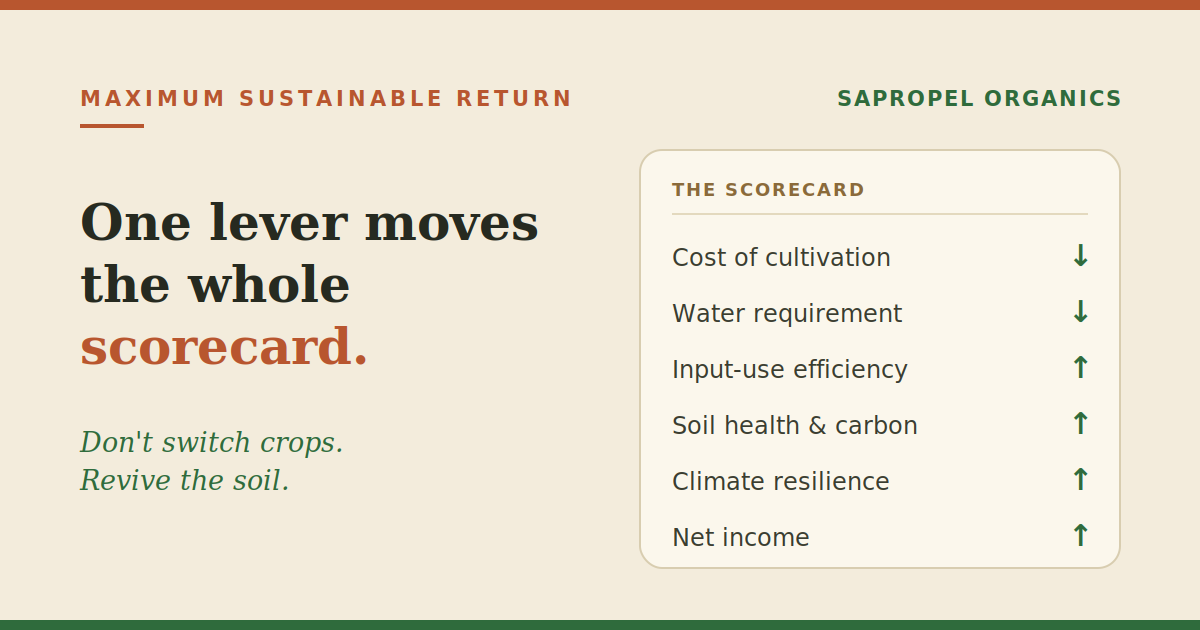
Restore the soil, and the metrics shift together. A biologically active, organic-matter-rich soil holds more water, so irrigation demand and drought risk both fall. It cycles and releases nutrients efficiently, so input costs drop without sacrificing yield. It buffers temperature and moisture extremes, so climate resilience rises. And it rebuilds soil organic carbon instead of spending it — the FAO Global Soil Partnership treats soil organic carbon as one of the clearest indicators of long-term productivity and resilience. None of this requires a new crop, new equipment or a new market. It only requires treating the soil as the asset it is, rather than a fixed backdrop the crop happens to sit on. Fix the foundation, and the numbers above it improve on their own. One intervention, the whole scorecard.
How the right input shifts the parameters
This is precisely what Humuson Complex is built to do — not by changing your crop, but by restoring the ground it stands in. Made from sapropel, it reactivates soil biology, rebuilds organic matter, and improves nutrient absorption, which pushes the sustainable-return metrics in the right direction at the same time:
Input-use efficiency rises by at least 25%, so the same yield needs less fertiliser.
Cost of cultivation falls as that efficiency reduces input volumes.
Water requirement drops as organic matter improves retention.
Soil health and organic carbon build rather than deplete.
Climate resilience improves as healthier soil withstands heat and irregular rainfall.
Net income rises as costs fall and the crop stays productive.
You keep the crop you know your market for. You change the foundation it grows in.
The real question
The better question was never "how much did the field produce?" It is "how much value did the farming system create, and at what cost?" And the fastest route to a better answer usually isn't a new crop on the spreadsheet — it is reviving the land so the crop you already grow becomes cheaper, more resilient and more profitable to produce. That is the same principle behind our earlier piece on soil biology and fertiliser efficiency.
If you're weighing sustainable return rather than raw yield, and want an input that improves the whole scorecard at once, let's talk.
1reading now
Get an email when Aurimas publishes