Why the Best Farm Tech Starts in Your Soil

The AgTech reckoning is hard to ignore. Some of the most heavily funded names in vertical farming — Plenty, AppHarvest, AeroFarms, 80 Acres — have filed for bankruptcy, restructured, or closed. Billions of dollars went into reinventing how we grow food, and much of it did not survive contact with reality.
It is tempting to conclude that innovation in agriculture failed. That is the wrong lesson. Traditional farming is under just as much pressure — rising bankruptcies, an ageing operator base, higher input costs and thinning margins. The problems these ventures were trying to solve have not gone away. What failed was not the ambition. It was the approach.
Why the flashy bets failed
The common thread in the failures is that they treated agriculture like software. You cannot ignore biology, energy, labour, climate and commodity economics and expect technology alone to overcome them. Too many projects built impressive systems and then went looking for a problem, rather than starting with the agronomy and building something that worked economically in the field.
Agriculture already has trillions invested in farms, greenhouses, equipment, irrigation and infrastructure. The winning move is not to replace all of that. It is to make it more productive.
The right approach needs the right tools
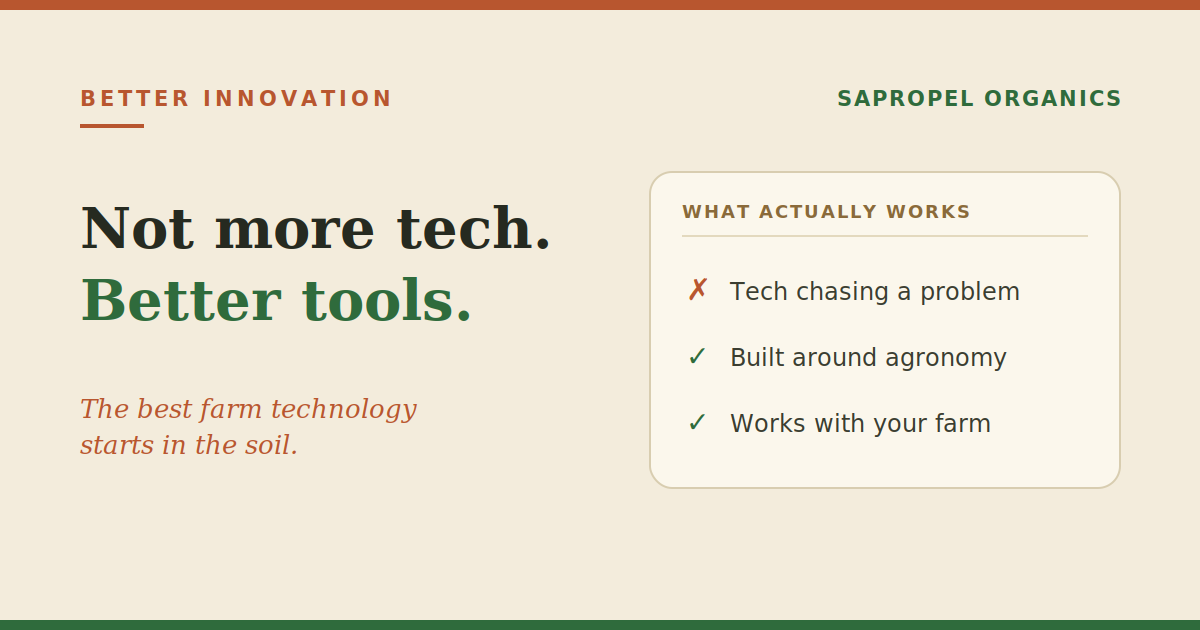
Here is the part worth sitting with: having the right approach is not enough on its own. You need the right tools to execute it. And the most valuable tools are rarely the most futuristic. They are the ones grounded in agronomy, built around the operators actually producing food, and able to make money in the real world.
That reframes what counts as innovation. A tool does not have to be an AI rig or a robot to move the needle. It has to solve a real agronomic problem, work with the infrastructure and crops a farmer already has, and pay for itself.
A tool built around agronomy, not around a pitch deck
This is exactly the category Humuson Complex sits in. It starts from the oldest agronomic problem there is — soil that has lost its biology and can no longer deliver nutrients to the crop — and it addresses that directly. Made from sapropel, it reactivates soil microbiology, rebuilds organic matter and improves nutrient absorption, so the soil the entire farm already depends on becomes more productive.
Notice what it does not require. No new crop. No new equipment. No new irrigation system. It works with the infrastructure and the rotation a farmer already runs, and the economics are grounded rather than aspirational: it improves nutrient-use efficiency by at least 25%, so existing fertiliser goes further and input costs fall. The FAO Global Soil Partnership has long argued that restoring soil biology and organic carbon is among the highest-return interventions in food production — precisely the kind of grounded, agronomy-first innovation that survives contact with reality.
It does not replace the farmer. It gives the farmer a better tool.
The takeaway
The next decade of agriculture will not be won by whoever builds the most futuristic system. It will be won by whoever gives operators tools that solve real problems, work with what they already have, and make economic sense. The lesson from the AgTech wave is not that we should innovate less. It is that we should innovate better — around agronomy, around operators, and around the soil that every other input depends on. That is the same conviction behind our earlier piece on soil biology and fertiliser efficiency.
If you're building, backing or running a food business and want innovation that starts with the agronomy rather than the hype, let's talk.
1reading now
Get an email when Aurimas publishes