How Should a Hotel Reset an Outdoor Sauna Between Guest Sessions?

How Should a Hotel Reset an Outdoor Sauna Between Guest Sessions?
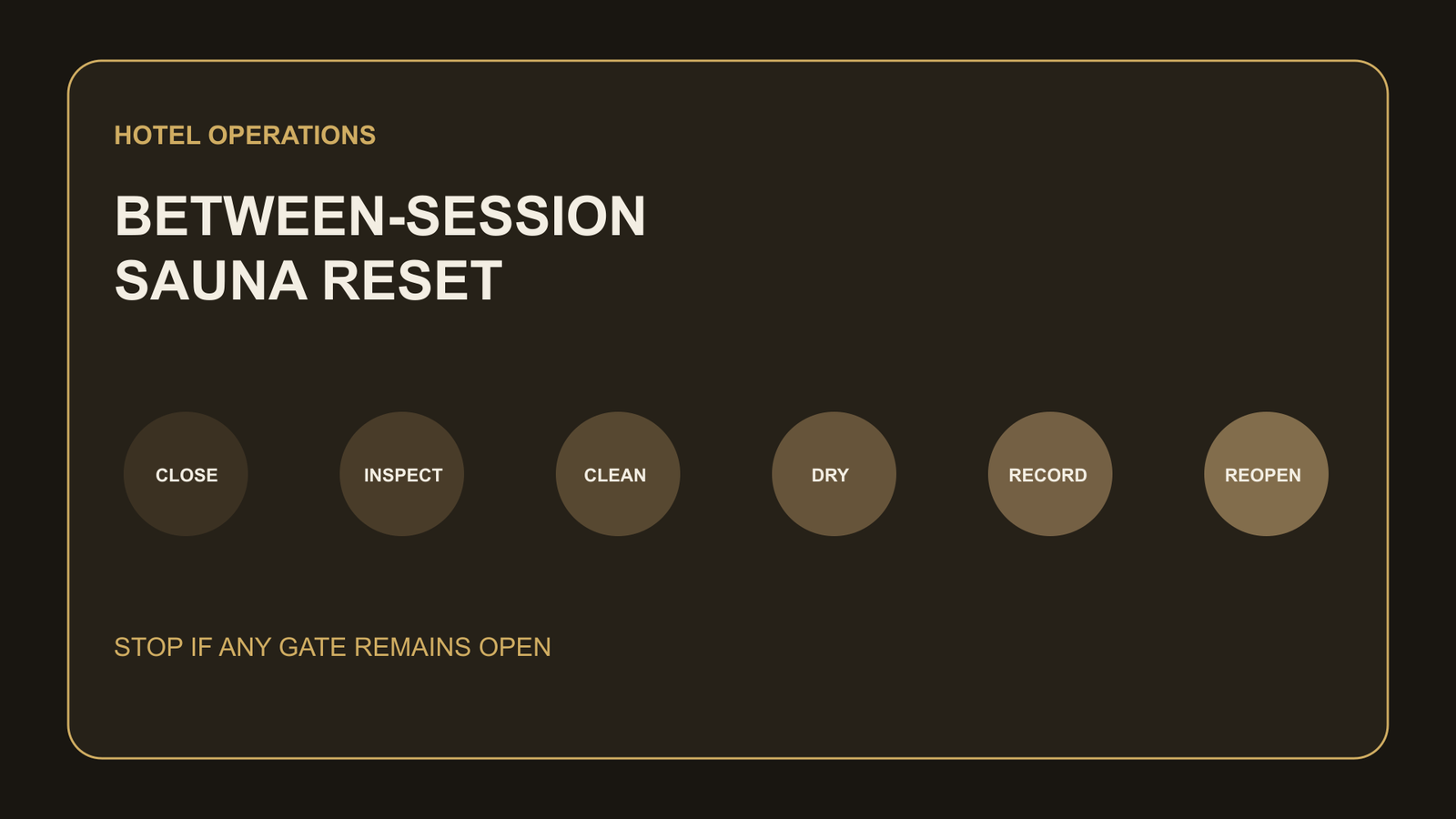
A hotel should use a short, documented reset with six gates: close the sauna, inspect the room and controls, remove loose items, clean only by the approved method, allow surfaces to dry, then record and reopen. The sequence must follow the installed manufacturer's instructions and the hotel's site-specific operating assessment. A reset is not seasonal timber maintenance, medical disinfection, ventilation design or proof of legal classification. If any stop condition remains, keep the unit closed and escalate.
Key Takeaways
Close access before staff start the reset and show that the session has ended.
Inspect first so cleaning does not hide a fault, spill or damage.
Use only the approved method for each installed surface and component.
Separate visible dryness from any claim about sanitising or air quality.
Record exceptions and escalation, not only successful reopening.
Reopen only when every local gate has a named accountable owner.
Why should the reset be a gate, not a rushed tidy?
Between-session work happens under time pressure. A loose checklist can become a race to make the room look ready. A gated sequence gives staff permission to stop when they find damage, an unexplained control state, standing water or an unresolved cleaning issue. It also gives the next shift a useful record.
I am Giedrius Patlaba, CEO of Wood Architects. From a manufacturer's viewpoint, the handover must connect the physical package to an operating routine without pretending that one routine fits every installation. Our public panoramic cube page identifies full-height glazing and a 128 mm wall build-up. These concrete product facts do not prescribe cleaning chemistry, reset frequency, drying time or a hotel's reopening decision.
The final reset should be built from the installed cabin, heater and control manuals, surface information, hotel procedures and site assessment. Manufacturer guidance can show that removing loose debris, wiping appropriate surfaces and allowing drying matter. It cannot decide a universal interval or certify that a hotel room is hygienically safe after a generic sequence.
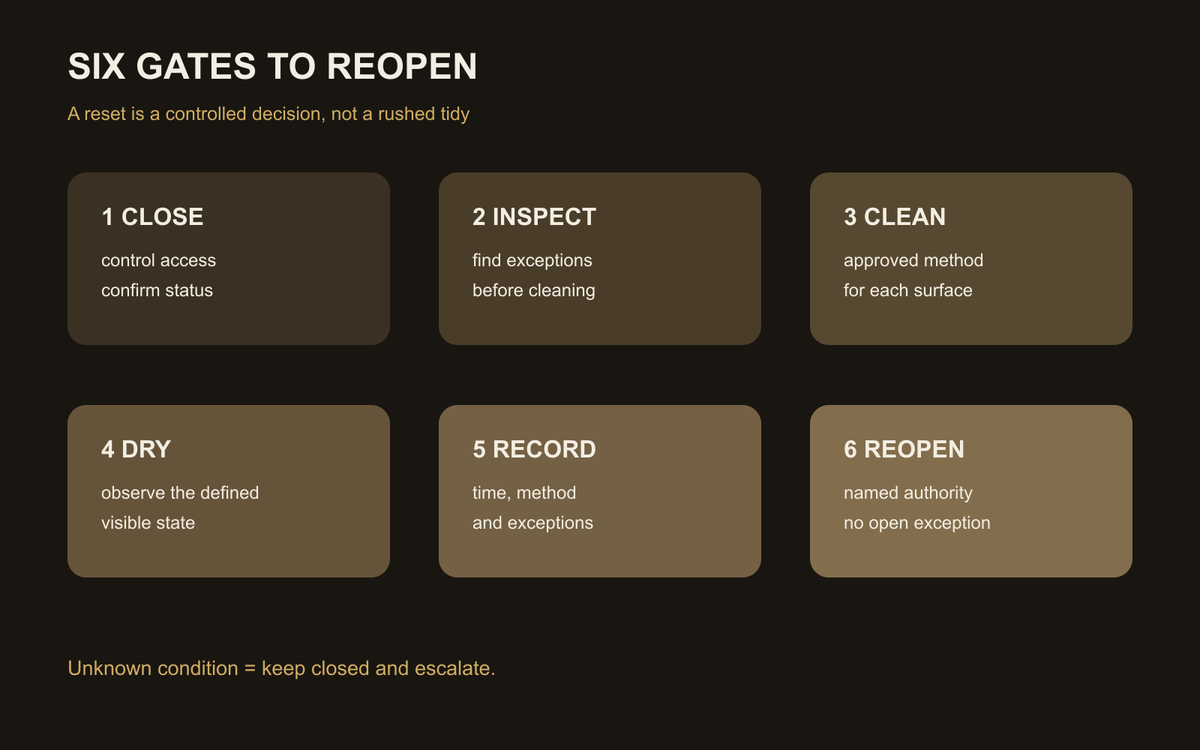
Each gate has a stop condition. Reopening is a decision, not an automatic final tick.
Gate 1: close the sauna and establish control
Mark the session as ended and prevent new entry while staff work. Confirm who controls the heater or controller under the hotel's approved procedure. Do not improvise an electrical isolation method from a generic article. If the control state is unclear, the responsible technical person should resolve it before staff touch the room or equipment.
Bring only the items authorised by the procedure. A reset cart should not block the escape route or remain inside when the sauna reopens. Record the unit, time and staff member so the later inspection and reopening belong to the same event.
Gate 2: inspect before cleaning
Look at the door and handle, glazing, visible bench surfaces, floor path, guard where fitted, visible heater exterior and controller display. The operator is not performing a technical service. The aim is to find anything that differs from the accepted operating condition, including loose debris, standing water, a damaged visible surface, an unusual smell, an unexplained warning or an item left too close to equipment.
Write specific stop conditions for the site. “Looks fine” is not enough. If staff see damage, cannot identify a control state or find a condition outside their training, the sauna remains closed and the issue goes to the named technical or duty manager. Photographs can support an exception record, subject to the hotel's privacy rules, but they do not replace competent inspection.
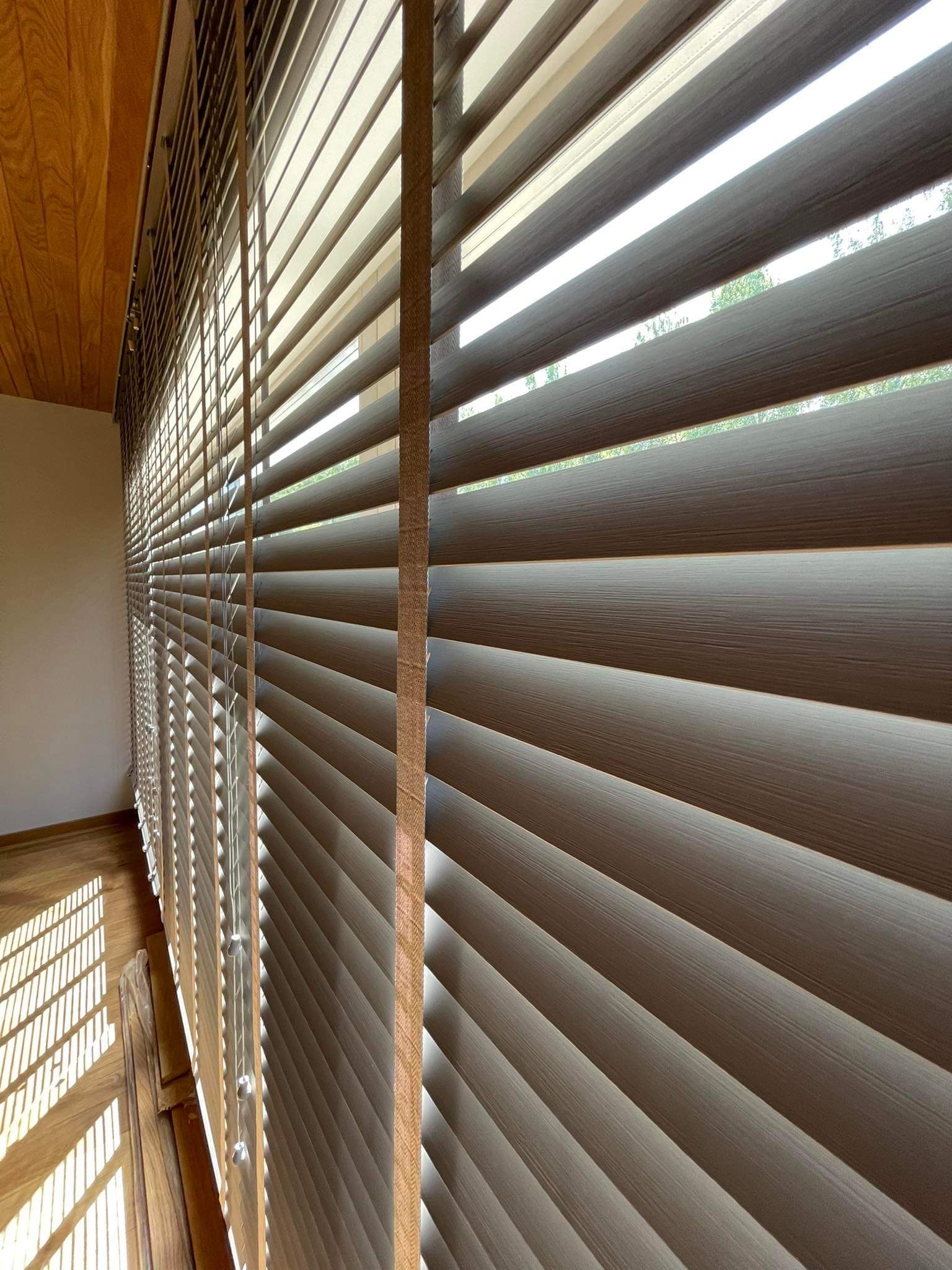
A real photograph of timber surfaces is useful for teaching staff what is visible. It does not prove that those surfaces are clean, sanitised, dry or ready for a guest.
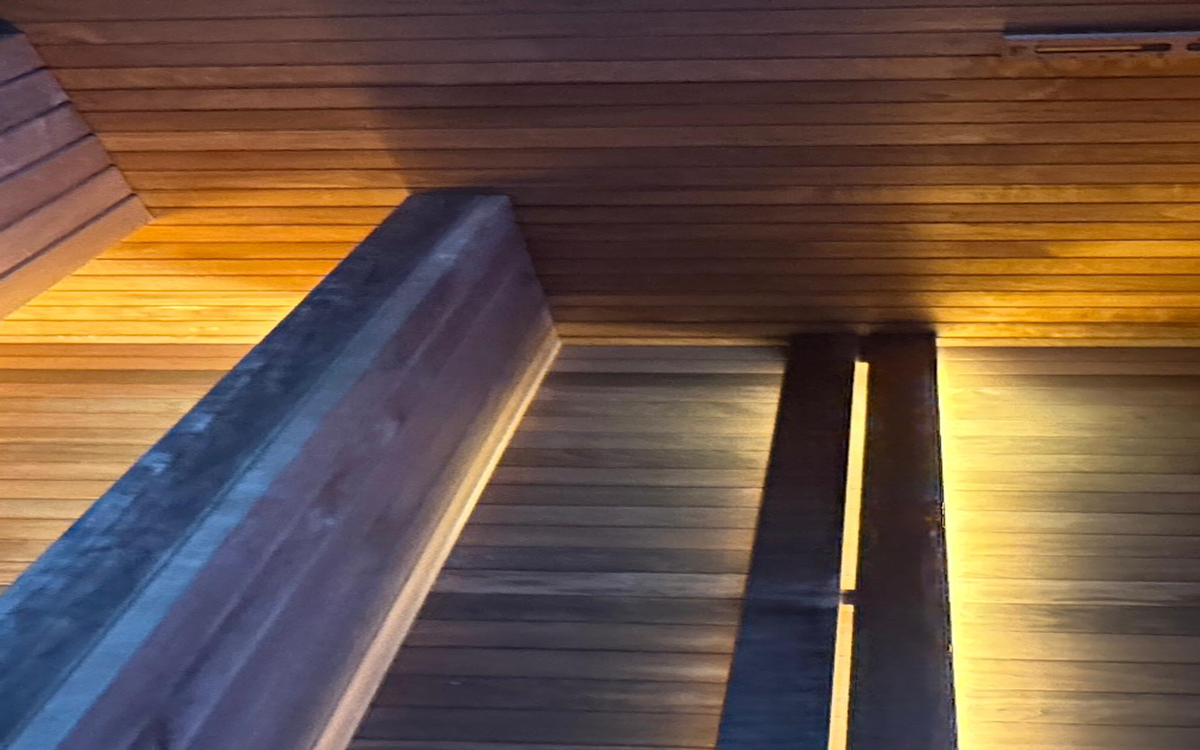
This real view illustrates visible timber surfaces available to an operator. It proves no cleaning method, sanitising result, dryness, session readiness or hotel installation.
Gate 3: remove loose items and clean by the approved method
Remove guest items, loose debris and any hotel-provided accessories according to the local procedure. Keep lost-property handling separate. Then use the method approved for the installed material and component. The product manual or surface schedule should identify what staff may wipe, what must stay dry, which product is permitted and whether rinsing is required.
Harvia's public maintenance guidance says to remove bench covers and the water bucket, dry water droplets and use a damp cloth for cleaning after bathing. It also discusses leaving the sauna to dry. This is manufacturer guidance for the relevant context, not a hotel-wide hygiene protocol and not authority to apply one product or method to every cabin.
HUUM's public maintenance article recommends removing loose debris, washing appropriate benches and floor, and leaving the room well ventilated afterwards. It also discusses deeper maintenance. A hotel should not copy the article's household-style timing or products without checking the installed materials, commercial operating demands and local policy. Between-session reset and periodic deep care must remain separate.
Gate 4: make drying observable
Drying should be an explicit state in the procedure. Record what staff can actually observe, such as no standing water on the defined route and no visible droplets on named surfaces. Do not turn that observation into a claim about moisture hidden within construction, air quality or microbiological condition.
Follow the installed manufacturer instructions for door, vent and heater state. Harvia's guidance includes model and context-dependent drying advice. The correct setting for a hotel cannot be inferred from this article because ventilation design, controls, outdoor conditions and equipment differ. If the approved drying state cannot be reached within the operating window, keep the sauna closed and escalate the scheduling conflict.
Gate 5: document the reset and any exception
A useful record is brief. It identifies the unit, previous session end, reset start and finish, staff member, control state, visible inspection result, cleaning method reference, drying observation, exception and escalation owner. Avoid a meaningless tick that cannot show what was checked.
Record failures as carefully as successful resets. Repeated standing water, damaged surfaces or unexplained warnings may need a separate technical investigation. The reset log should make patterns visible without asking staff to diagnose causes outside their role. Keep personal data out unless the hotel has a defined purpose and handling rule.
For long-term timber and component care, use a separate maintenance plan. Our public guide to Thermowood sauna maintenance addresses a different time horizon. It should not be copied into a short guest-session reset.
Use this copyable between-session reset card
OUTDOOR SAUNA BETWEEN-SESSION RESET
Unit:
Previous session ended:
Reset started:
Operator:

1 CLOSE
- access closed and status shown
- approved control state confirmed

2 INSPECT
- door, glass, benches, floor path, guard and visible equipment checked
- no stop condition found, or exception recorded

3 CLEAR AND CLEAN
- loose items handled
- approved method reference used
- required rinse or wipe completed

4 DRY
- named visible surfaces checked
- approved door, vent and control state set

5 DOCUMENT
- finish time, findings and exception owner recorded

6 REOPEN
- all gates complete
- authorised person:
- reopening time:

STOP OR ESCALATE:
- unexplained control or warning
- visible damage or loose component
- standing water outside accepted condition
- unapproved product or uncertain method
- incomplete drying observation
- any condition outside operator training
Gate | Pass evidence | Stop or escalate | Owner |
|---|---|---|---|
Close | Status and control state recorded | Access or control cannot be secured | Duty operator |
Inspect | Defined visible points checked | Damage, warning or unknown condition | Operator to duty manager |
Clean | Approved method reference logged | Material or product is uncertain | Housekeeping lead |
Dry | Defined observation completed | Standing water or approved state unavailable | Duty operator |
Reopen | All gates signed and timed | Any open exception | Authorised hotel role |
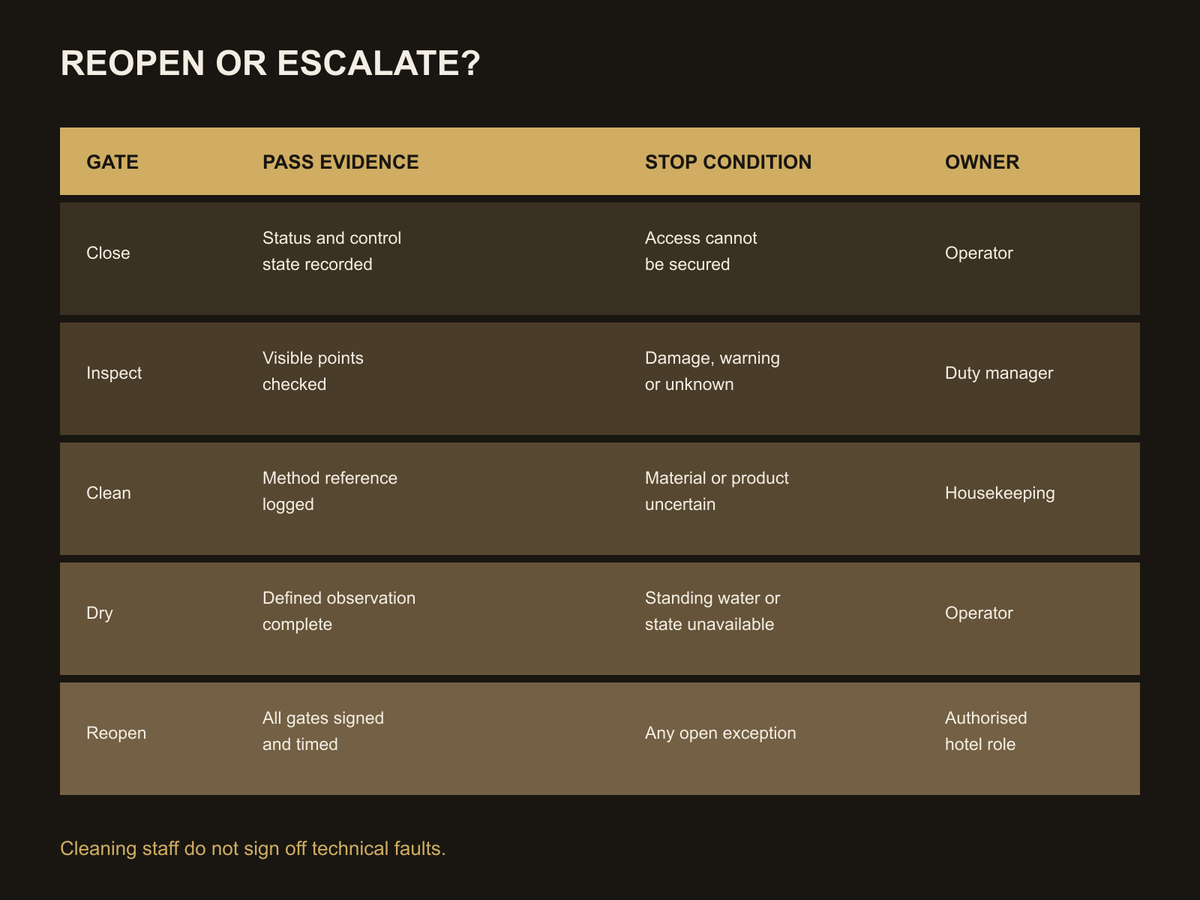
Reopen only when the evidence column is complete and no stop condition remains.
Gate 6: reopen only after a named decision
The person authorised by the hotel confirms that every gate is complete and no exception remains open. Reopening should include the time and operating status. If a technical issue was escalated, a separate competent release is needed under the hotel's procedure. Cleaning staff should not be expected to sign off repairs or control faults.
This boundary protects both quality and authority. The reset operator reports visible conditions and performs approved tasks. The technical specialist addresses equipment issues. The hotel owns guest scheduling and reopening. The manufacturer supplies product information for the installed package. Local advisers validate any legal, safety or hygiene duties that sit outside those documents.
Frequently Asked Questions
How long should a between-session reset take?
There is no universal duration. It depends on the installed cabin, approved cleaning method, drying instruction, occupancy and what staff find. Time the real procedure during commissioning, then set the booking gap around verified work. Never shorten a stop condition to protect a schedule.
Should staff disinfect the sauna after every guest?
This article cannot prescribe medical or hygiene disinfection. The hotel's competent hygiene lead must set any such requirement using local rules, risk assessment, installed materials and product instructions. Staff should use only an approved method and should never improvise a chemical treatment from generic online advice.
Can the heater be left on for drying?
Only if the installed manufacturer instructions and the hotel's approved procedure allow the exact control state. Some manufacturer guidance discusses using heat during drying, but equipment and conditions differ. Staff must not infer a universal setting or duration, and unclear control behaviour is a stop condition.
Is a photograph enough to prove the reset passed?
No. A photograph can record a visible condition at one moment. It cannot prove the approved method was followed, hidden areas are dry, equipment is sound or the room meets a hygiene standard. Use it only as supporting evidence within the complete timed reset record.
Who should authorise reopening?
The hotel should name a role in its procedure. The reset operator may reopen after routine completion if authorised, while technical exceptions need the competent release defined by the hotel. The sauna manufacturer provides product boundaries but does not remotely approve each guest-session changeover.
Sources: Harvia, Maintaining your sauna, HUUM, The Basics of Sauna Maintenance, and Wood Architects cube saunas. Apply the exact installed manuals and the hotel's competent local procedure.
1reading now
Get an email when Giedrius publishes