What Must Be Ready on Site Before a Prefabricated Sauna Arrives?

What Must Be Ready on Site Before a Prefabricated Sauna Arrives?
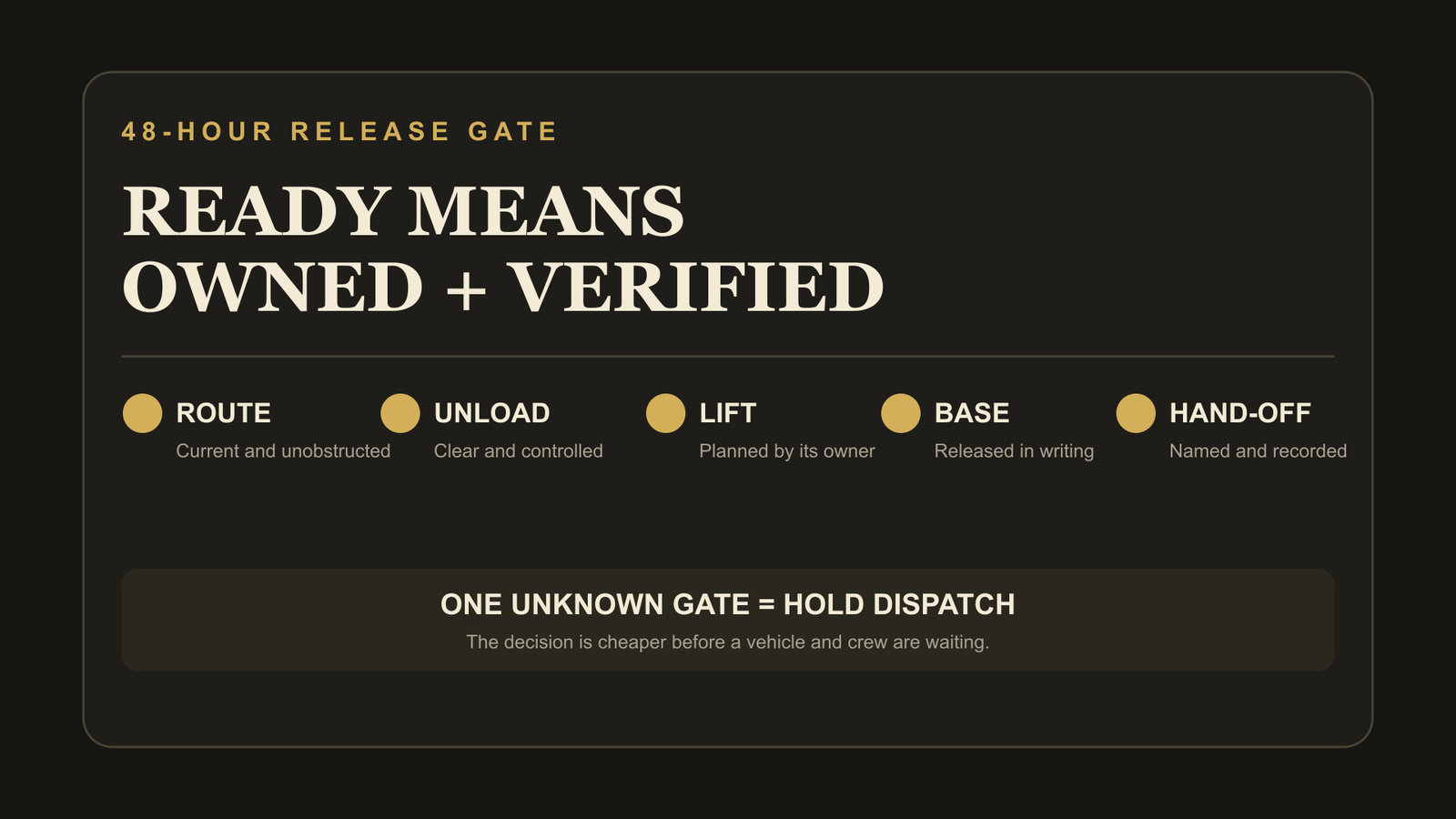
In the final 48 hours, the site should have a confirmed access route, a controlled unload area, an agreed lift boundary, a finished and released base, weather protection, and named people for hand-off. The sauna manufacturer should confirm the actual module data and delivery interface. The site owner, lift contractor, local professionals and electrician must still accept the parts they control. If any gate is unowned or unverified, the sensible decision is to pause the arrival rather than improvise around a suspended module.
Key takeaways
Treat the last 48 hours as a release gate, not a period for finishing design.
Walk and photograph the whole route from public road to unload point.
Let the appointed lift team own its plan, equipment and exclusion zone.
Release the prepared base in writing before the module leaves the factory.
Keep protective materials and a bad-weather decision owner ready.
Name who accepts the module and who takes over every unfinished interface.
Why is the final check different from normal project planning?
By this stage, strategic choices should already be closed. Whether the sauna is assembled or flat-pack is a procurement decision. Where it sits is a design decision. The final site-readiness check asks a narrower question: can today's actual module move through today's actual site and reach a base that has been released for it?
At Wood Architects, we pre-assemble and check saunas before dispatch. That reduces factory uncertainty. It does not clear a road, appoint a crane team, verify a local structure or accept an electrical supply. I want the last review to make those boundaries visible, because confidence without an owner is not readiness.
For context, our public cube-sauna page lists floor-to-ceiling glazing and a 128 mm wall build-up. Those product facts help identify the module being coordinated. They do not approve the route, lifting operation, base or site services.
What should the route check prove?
The route check should start where the delivery vehicle leaves the public road and finish at the agreed unload or lift point. Walk it in the same direction as the vehicle. Record gates, bends, slopes, weak edges, soft ground, parked vehicles, branches, overhead lines and places where other people could enter the working area. Do not replace the lift contractor's assessment with a phone video. The record is an input for that contractor.
UK HSE loading guidance says loading and unloading areas should be clear of unrelated traffic and pedestrians, clear of overhead electric cables, and level, with trailers on firm level ground. This is a UK workplace example, not a universal design rule. It shows why a delivery team needs current site conditions, not an old drawing.
The route record should include an agreed arrival window and a contact who can remove a newly parked vehicle or open a locked gate. A perfect route at yesterday's inspection can fail if today's access is blocked. I therefore ask for a fresh time-stamped walk-through, not only planning photographs.
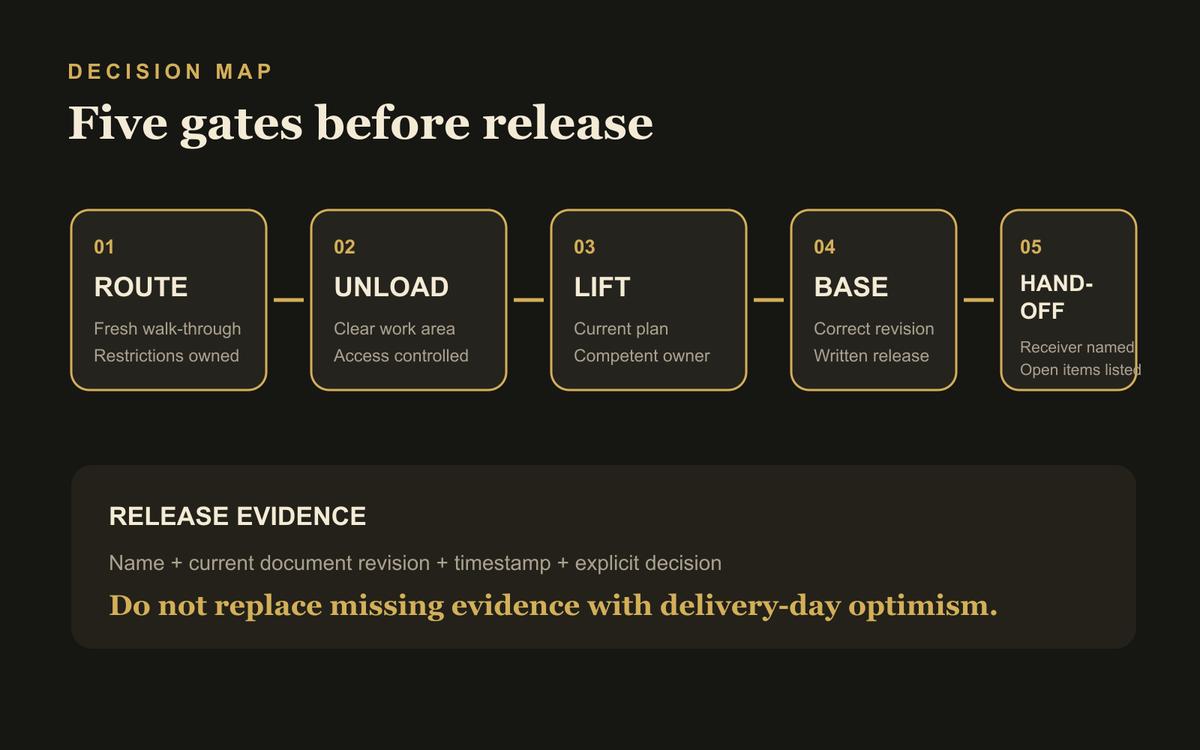
All five gates need evidence and an owner before the delivery is released.
Who should control the lift and unload decision?
The manufacturer should return the verified module dimensions, mass supplied for the actual order, declared lifting interface and handling limitations in the agreed document set. The appointed lift or unload contractor should use that information with a site inspection to select equipment and prepare the operation. The site owner should provide access and coordinate people who could be affected.
HSE lifting guidance says UK work lifting operations must be properly planned by a competent person, appropriately supervised and carried out safely. It also notes that the plan should address risks, resources, procedures and responsibilities. That source does not make Wood Architects the appointed person, and it does not prove that a particular crane or method suits a project outside the source's jurisdiction.
A useful final check is simple: has the lift team confirmed the current route, standing area, radius, environment, exclusion boundary and communication method in its own controlled plan? If the answer is only “the driver will see when they arrive”, the gate is open.
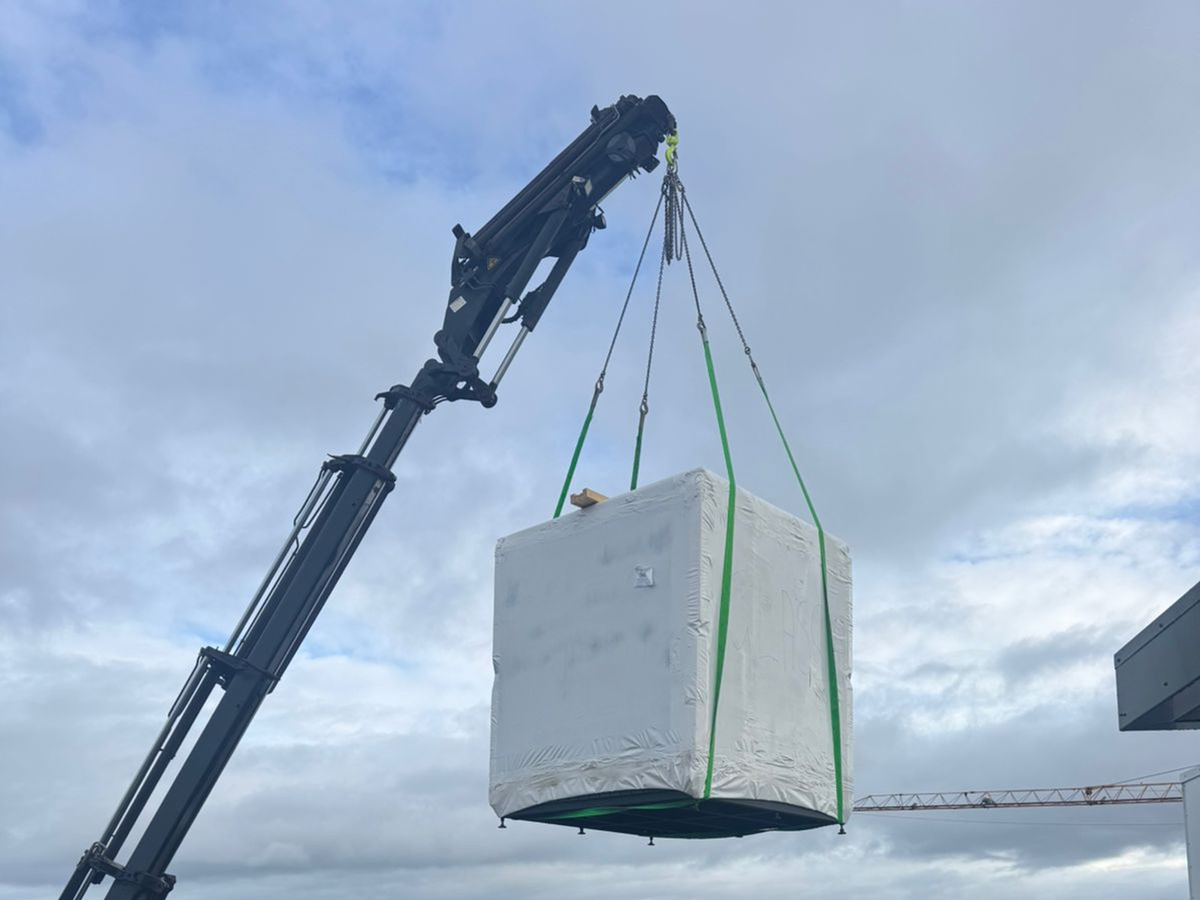
A photographed wrapped prefabricated module during a lift and unload operation. The image does not prove an approved method, lift plan, suitability, weight, product model or completed delivery.
What does a released base mean in the last 48 hours?
A released base is not merely visible concrete, paving or supports. It is the exact receiving interface checked against the manufacturer's current support and footprint information, with the relevant local designer or engineer confirming the site work they own. The manufacturer should identify where the module bears and what access must remain. The local professional decides whether the site construction meets the project requirements.
Ask for one named person to release the base in writing. The record should identify the drawing or document revision checked, any remaining restrictions and the date of the inspection. Do not use the delivery team as the first people to discover that a drain cover, edge detail, unfinished surface or temporary obstruction conflicts with the set-down area.
This article does not prescribe foundation depth, support spacing, levels or structural tolerances. Those are product-specific and site-specific decisions. Our separate article on sauna foundations below frost explains why a local ground and structural decision must stay separate from a delivery-day checklist.
What protection and hand-off arrangements prevent improvisation?
Prepare clean temporary protection for the route and receiving area, plus a secure place for any loose supplied items. Agree who decides whether rain, wind or surface conditions trigger a delay. That person needs the authority to stop the operation. Protection should never hide the base interface or create a slipping, snagging or unstable surface.
The hand-off should begin before the vehicle arrives. Name the person who accepts the module, the person who records condition and the person who controls access after set-down. List interfaces that remain incomplete, such as final electrical connection, commissioning or local inspection. The delivery crew should not be asked to approve work outside its appointment.
The same boundary applies to the electrician. The manufacturer returns product-specific documents and interface information. The electrician designs and connects the local installation under the applicable rules. Delivery readiness can confirm that the hand-off information exists, but it cannot certify the supply or energise the sauna.
Who owns each final gate?
Gate | Evidence before release | Decision owner | Manufacturer boundary |
|---|---|---|---|
Route | Current walk-through, dimensions, restrictions and access contact | Site owner with carrier input | Provides actual module and delivery interface data |
Unload area | Clear, controlled area accepted by the delivery team | Site owner and carrier | Does not control the local workplace |
Lift | Lift team's current plan and exclusion arrangements | Appointed competent lift team | Does not select or approve local lifting equipment |
Base | Written release against the current interface information | Relevant local designer or engineer | Identifies product bearing and footprint interfaces |
Hand-off | Named receiver, condition record and open-interface list | Site owner | Returns product records and agreed delivery evidence |
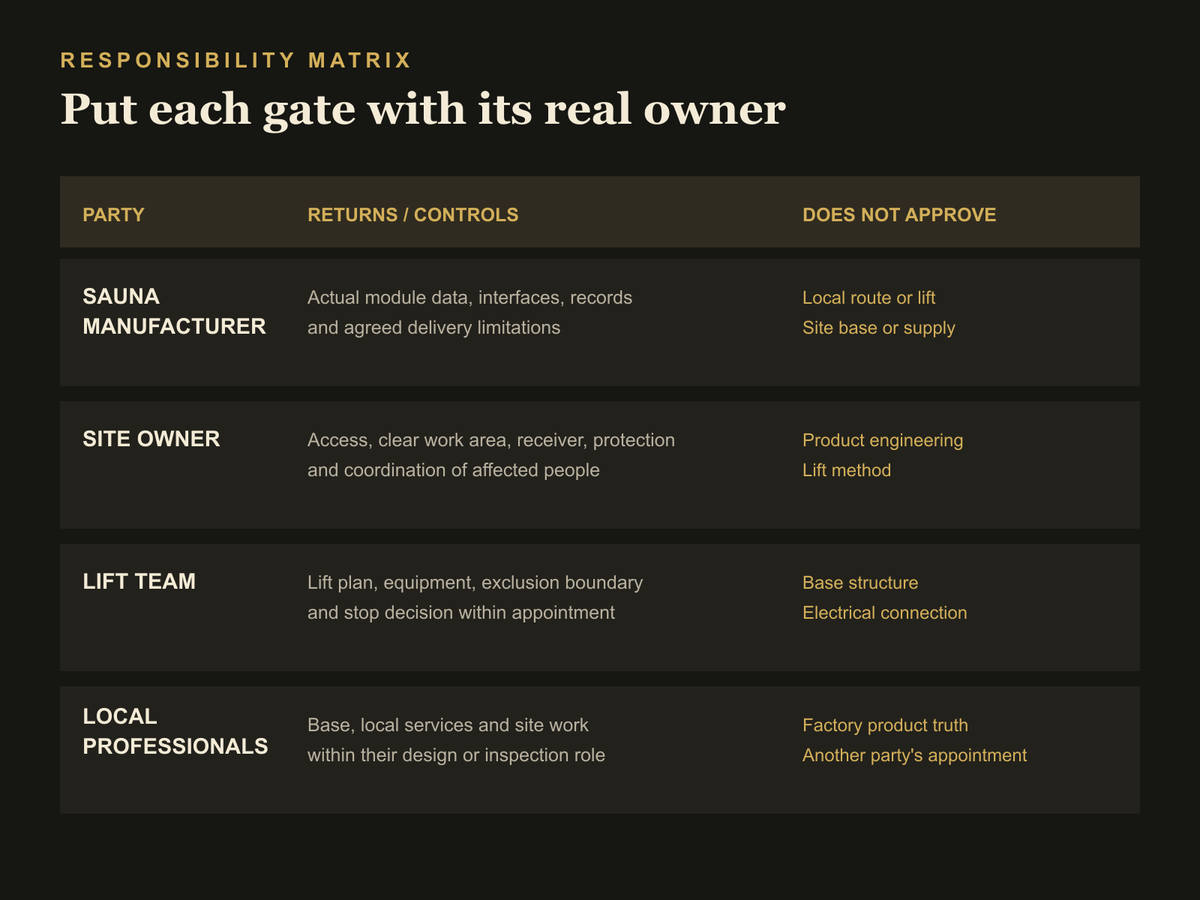
The final gate works when every decision sits with the party able to inspect and own it.
Copy this 48-hour release note
PROJECT:
DELIVERY DATE AND WINDOW:
ACTUAL MODULE REVISION:

ROUTE
[ ] Fresh route walk completed at:
[ ] Access contact:
[ ] Temporary restrictions removed by:

UNLOAD AND LIFT
[ ] Unload area accepted by:
[ ] Lift plan owner and revision:
[ ] Exclusion zone controller:
[ ] Weather stop decision owner:

RECEIVING BASE
[ ] Manufacturer interface revision:
[ ] Base released by local professional:
[ ] Inspection date and restrictions:

HAND-OFF
[ ] Named receiver:
[ ] Condition record owner:
[ ] Loose items storage:
[ ] Open electrical or commissioning interfaces:

FINAL DECISION: RELEASE / HOLD
DECISION OWNER, DATE AND TIME:
The value of this note is not the tick marks. It is the names, revisions and timestamps. A hold is cheaper and calmer than a crew inventing responsibilities beside a waiting vehicle.
Can the sauna manufacturer approve my site route?
The manufacturer can provide verified module dimensions, handling interfaces and delivery limitations for the actual order. The carrier, lift team and site owner must assess the current route and workplace. A manufacturer's drawing cannot confirm ground condition, temporary obstructions, traffic control or local safety duties.
Should the base be checked on delivery morning?
A final visual check is useful, but it should confirm an earlier written release rather than become the first inspection. The relevant local professional should compare the finished receiving interface with the current product information and record restrictions before dispatch, leaving time to correct or hold.
Who decides whether weather stops the operation?
The appointed delivery or lift organisation should define operating limits and the competent person who can stop the work. The site owner must support that decision and keep the area controlled. The sauna manufacturer should not invent a site-specific weather verdict from a remote office.
Does site-ready mean the sauna can be switched on?
No. Delivery release covers access, unload or lift, receiving base, protection and hand-off. Electrical design, connection, testing, commissioning and any local inspection remain separate gates owned by the electrician and other appointed parties. Keep the module isolated until those parties complete their work.
What if one readiness item is still uncertain?
Name the uncertainty, its decision owner and the evidence needed. Then hold dispatch unless that owner closes the gate within the agreed deadline. Do not convert an unknown route, base or lift condition into a delivery-day experiment simply because transport has already been booked.
1reading now
Get an email when Giedrius publishes