How Should a Hotel Plan an Outdoor Sauna's End of Life?

How Should a Hotel Plan an Outdoor Sauna's End of Life?
A hotel should plan an outdoor sauna's end of life before purchase by naming who will isolate the area, disconnect services, assess reuse, remove the cabin, classify each material stream and retain evidence. The contract should distinguish the timber cabin and building materials from the electric heater, controller and other equipment that may fall within electrical-waste rules. Record access, fixings, lifting constraints, hazardous unknowns and local waste routes without promising a universal classification or recycling result.
Key Takeaways
Plan the sauna's exit before purchase, not after the hotel closes the area.
Name owners for isolation, disconnection, removal, material decisions and evidence.
Keep the cabin's material streams separate from the heater, controller and other electrical equipment.
Do not label the whole cabin as WEEE or promise recyclability without project-specific classification.
Require records that identify materials, fixings, access constraints and competent disconnection needs.
Price the removal route and evidence return alongside the product and installation offer.
Hotels often evaluate an outdoor sauna as an opening-day asset. The more durable decision starts with the last day too. From our manufacturer perspective at Wood Architects, end-of-life planning is not a promise that every material will be recycled. It is a practical way to prevent an unknown cabin, live electrical equipment and inaccessible fixings from becoming tomorrow's emergency removal project.

The photograph shows a weathered grey timber surface only. It does not establish the timber's treatment, remaining life, waste classification, recyclability or required disposal route.
Why make the exit plan at procurement stage?
Early planning improves choices that are difficult to change later. The hotel can confirm whether a cabin is intended to be moved intact, dismantled in sections or removed as separated materials. It can review crane access, gate widths, roof or deck interfaces, buried services, permanent landscaping and the ability to isolate power without closing unrelated facilities.
The plan also gives procurement a consistent cost boundary. Our earlier article How Should a European Hotel Compare Two Outdoor Sauna Quotes? includes end-of-life cost within whole-life comparison. This article expands that single line into an owned removal and evidence plan. It does not replace project-specific waste advice or approve a disposal route.
Ask tenderers to state what information will be delivered with the product, what can be updated during service and what is unknown. A useful return identifies major materials, replaceable equipment, fixings, service connections, lifting or dismantling points, finishes and known restrictions. The hotel should decide who keeps that information after staff, operator or maintenance-contractor changes.
Start with prevention and reuse, but verify feasibility
The EU Waste Framework Directive establishes a five-step waste hierarchy. The European Commission's current overview lists prevention, preparing for reuse, recycling, other recovery and disposal in that order. This is a policy framework, not proof that a particular sauna or component can follow a preferred route.
Before something becomes waste, ask whether continued use, repair, relocation or component reuse is technically and commercially realistic. The answer depends on condition, contamination, documentation, transport, compliance at the receiving site and the people authorised to decide. Avoid writing reusable or recyclable as an unconditional product attribute when the future condition and receiving route are unknown.
The consolidated Waste Framework Directive provides the legal definitions and framework current after the 2025 revision. A hotel still needs competent local interpretation when an asset becomes waste and how a holder, contractor or receiving facility must classify and document it.
Separate the cabin from electrical equipment
A sauna is not one homogeneous waste item. Timber cladding, insulation, membranes, glazing, metal fixings, roofing layers, foundations or supports and sealants may need different assessments. Treatment, adhesives, contamination, damage and local acceptance criteria can change the route. The project file should therefore preserve material descriptions without converting them into future disposal guarantees.
The electric heater, controller, sensors, lighting and other powered equipment need a separate review. The consolidated Directive 2012/19/EU, current to 8 April 2024, defines electrical and electronic equipment by its dependence on electric currents or electromagnetic fields to work properly within stated voltage limits. It defines WEEE as such equipment when it becomes waste. This supports checking the relevant equipment, not automatically labelling the entire timber cabin as WEEE.
The exact classification and obligations depend on the equipment, supply arrangement, country, date and role of the parties. The hotel should ask a competent waste or electrical contractor what must be disconnected, removed intact, stored, transported and evidenced. A manufacturer should provide identifiable equipment information within its scope, not issue a universal waste verdict for a future site.
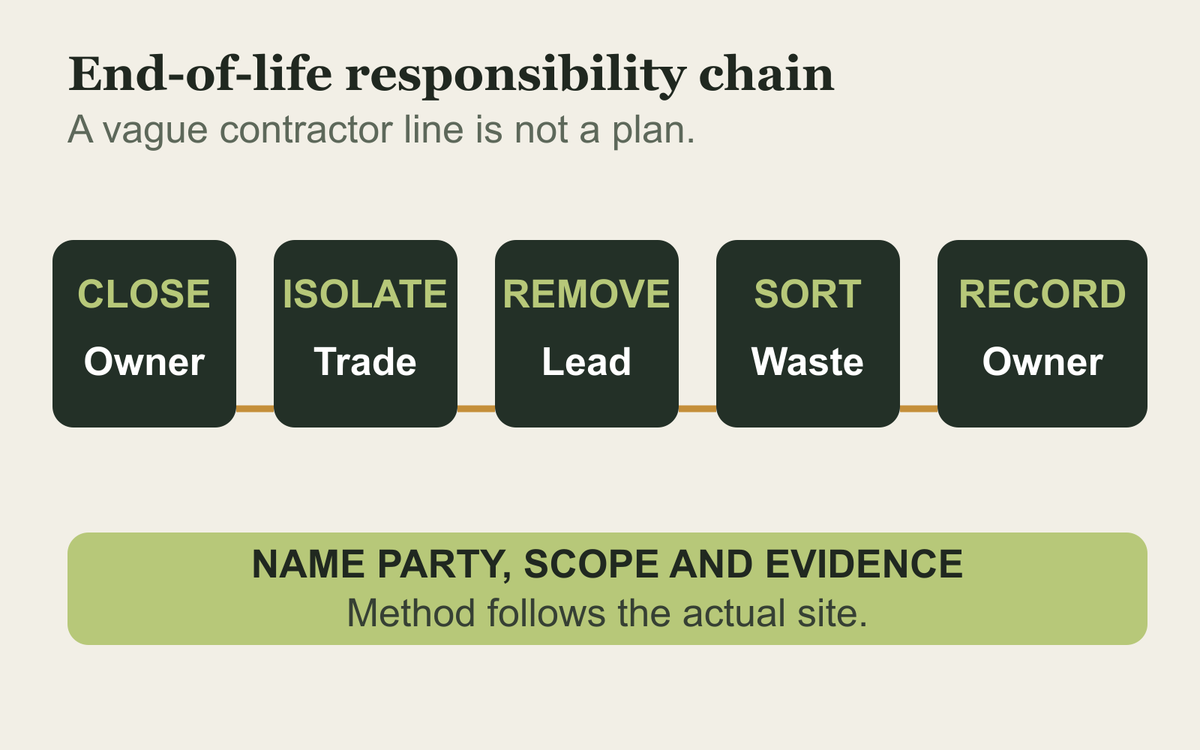
End of life is a chain of owned decisions. Closure, competent disconnection, physical removal, classification, receiving route and records should not be left to one vague contractor line.
What should the contract require?
Use an end-of-life schedule with six returns. First, identify the hotel role that can authorise closure. Second, identify systems that must be isolated and the competent party for disconnection. Third, describe the intended removal method and access assumptions. Fourth, list major material and equipment groups. Fifth, define who decides the receiving route under local rules. Sixth, state what records return to the asset file.
Do not require a fictional future recycling percentage. Require traceability instead. The record can include equipment identifiers, material descriptions, photographs, inspection findings, contractor details, transfer or receiving records where applicable, quantities established at removal and reasons for rejected reuse routes. This evidence lets the hotel explain what actually happened rather than repeat a procurement promise.
Include change control. Replacement heaters, added controls, new roof layers, repairs, coatings and service alterations can make the original plan stale. The operator should update the asset record when work changes the unit or its interfaces. A short accurate record is more valuable than a detailed handover file that nobody maintains.
How should removal risk be reviewed?
Before closure, appoint competent contractors to survey the actual unit and site. Their project-specific risk assessment should decide the isolation, access, protection, lifting and removal sequence. The procurement plan should name who returns that assessment and the completion record. This article does not supply a method statement or pre-classify site hazards.
Also check what must remain protected. Removing a cabin can expose waterproofing, supports, service penetrations, drainage or landscaping. The owner should define who makes good the site, who inspects concealed conditions and who decides whether supports or foundations remain. A removal quote that ends at lifting the cabin away may exclude the most disruptive interfaces.
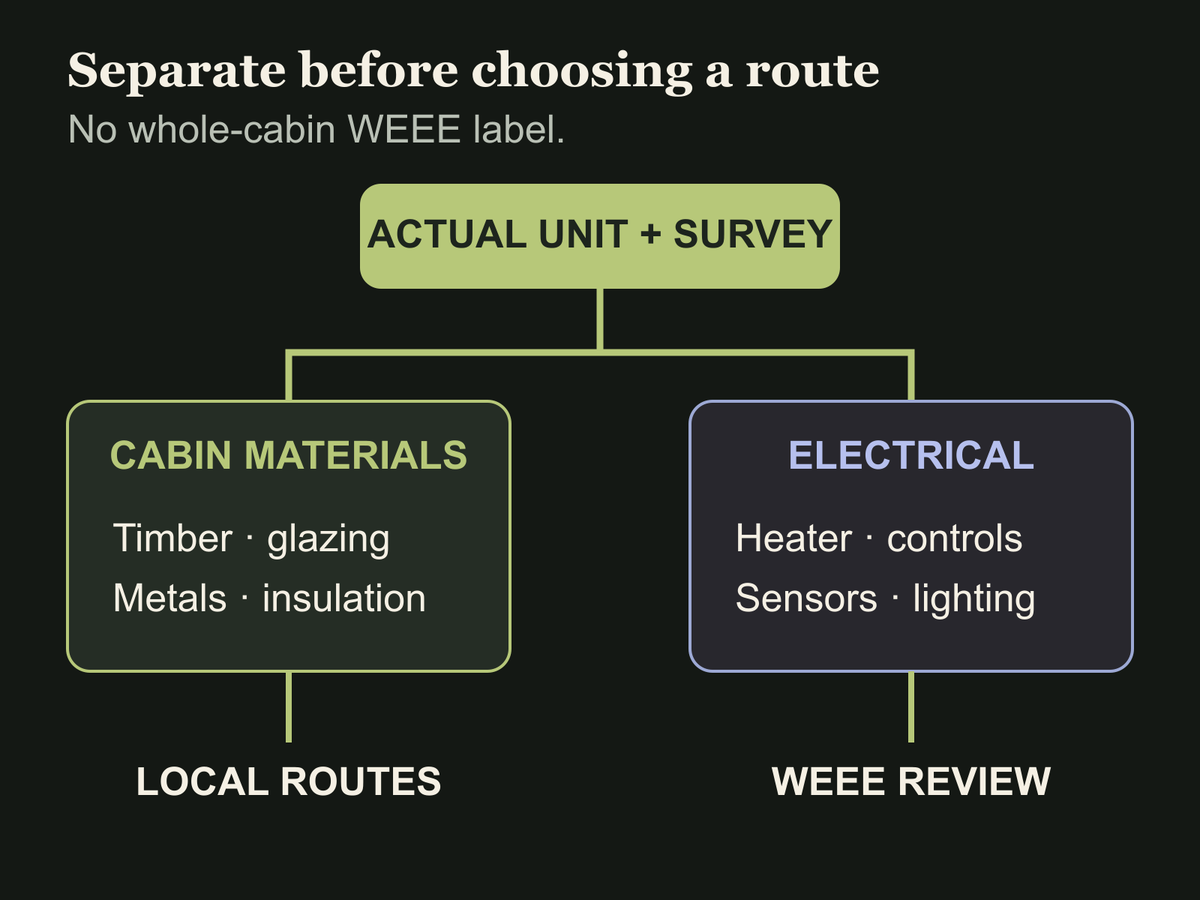
Separate the physical streams before choosing routes. Local competent parties classify the actual materials and electrical equipment at the time they become waste.
What is the manufacturer's useful contribution?
Wood Architects can provide controlled information about the sauna configuration we manufacture, the materials and equipment we specify, and the interfaces visible within our scope. We assemble and check units at our Klaipėda facility before shipment. That provides a known starting record, not a forecast of future condition or local waste status.
The hotel owns continuity. It needs a place for the original record, service changes, inspection evidence and closure decisions. The electrical contractor owns competent isolation and disconnection within the applicable project scope. Waste holders, carriers and receiving facilities act under the rules that apply when removal occurs. Naming those boundaries before purchase is the practical result.
Is an entire outdoor sauna classified as WEEE?
Not automatically. WEEE rules concern electrical and electronic equipment that meets the Directive's definition when it becomes waste. A timber cabin contains separate materials and may include an electric heater, controller, sensors or lighting. Competent local parties should classify the actual equipment and other material streams separately.
Can a supplier guarantee that the cabin will be recycled?
A responsible supplier should not guarantee an unknown future route. Condition, treatment, contamination, local facilities, economics and law can all affect acceptance. The contract can require accurate material information, separable equipment records and evidence at removal, while the competent waste parties decide the route when the asset actually exits service.
What electrical information should the hotel retain?
Retain equipment identity, manufacturer documents, ratings, connection information, controller and sensor references, installation changes and the isolation point recorded by competent parties. This supports future disconnection and classification. It does not authorise hotel staff to isolate equipment or determine WEEE obligations without the required competence and local review.
Should removal cost be included in the original tender?
Yes, at least as a defined scope and assumptions schedule. A future fixed price may be unrealistic, but tenderers can identify likely access, disconnection, lifting, dismantling and making-good boundaries. This exposes exclusions early and lets the hotel compare offers on the same end-of-life responsibilities rather than an undefined allowance.
When must the end-of-life plan be updated?
Update it after changes to equipment, finishes, fixings, supports, services, access, ownership or maintenance responsibility. Review it again before closure because condition and local routes will have changed. The current survey and applicable rules govern the final method, while the maintained asset record supplies the evidence needed to plan it.
1reading now
Get an email when Giedrius publishes