
How Do You Design an Outdoor Sauna for Repair?

How Do You Design an Outdoor Sauna for Repair?
Design an outdoor sauna for repair by mapping each foreseeable service task before the final finishes are fixed. Every maintainable component needs a stable identifier, safe isolation method, access route, working clearance, required competence, replacement path and named decision owner. Keep that information in a repair route card linked to the asset record. The EU right-to-repair framework is useful policy context, but it does not mean outdoor saunas are automatically within its product duties. Repairability here is a procurement and design decision that must be proven for the selected configuration.
Key Takeaways
Design the repair route before choosing finishes that hide it.
Give each serviceable item a stable identity, access method and decision owner.
Keep isolation, inspection and replacement routes separate from diagnostic guesswork.
Record required tools, competence and warranty boundaries at handover.
Use EU repair policy as context, not as a claim that it covers outdoor saunas.
Review repair access whenever a component or site interface changes.
A beautiful sauna can still become a poor asset if a minor failure requires destructive opening, uncertain parts or several trades guessing at responsibility. As a manufacturer, I treat repair access as an architectural requirement, not an afterthought. This guide shows buyers, architects and operators how to specify a visible route from symptom to safe isolation, identified component, competent repair and updated record.
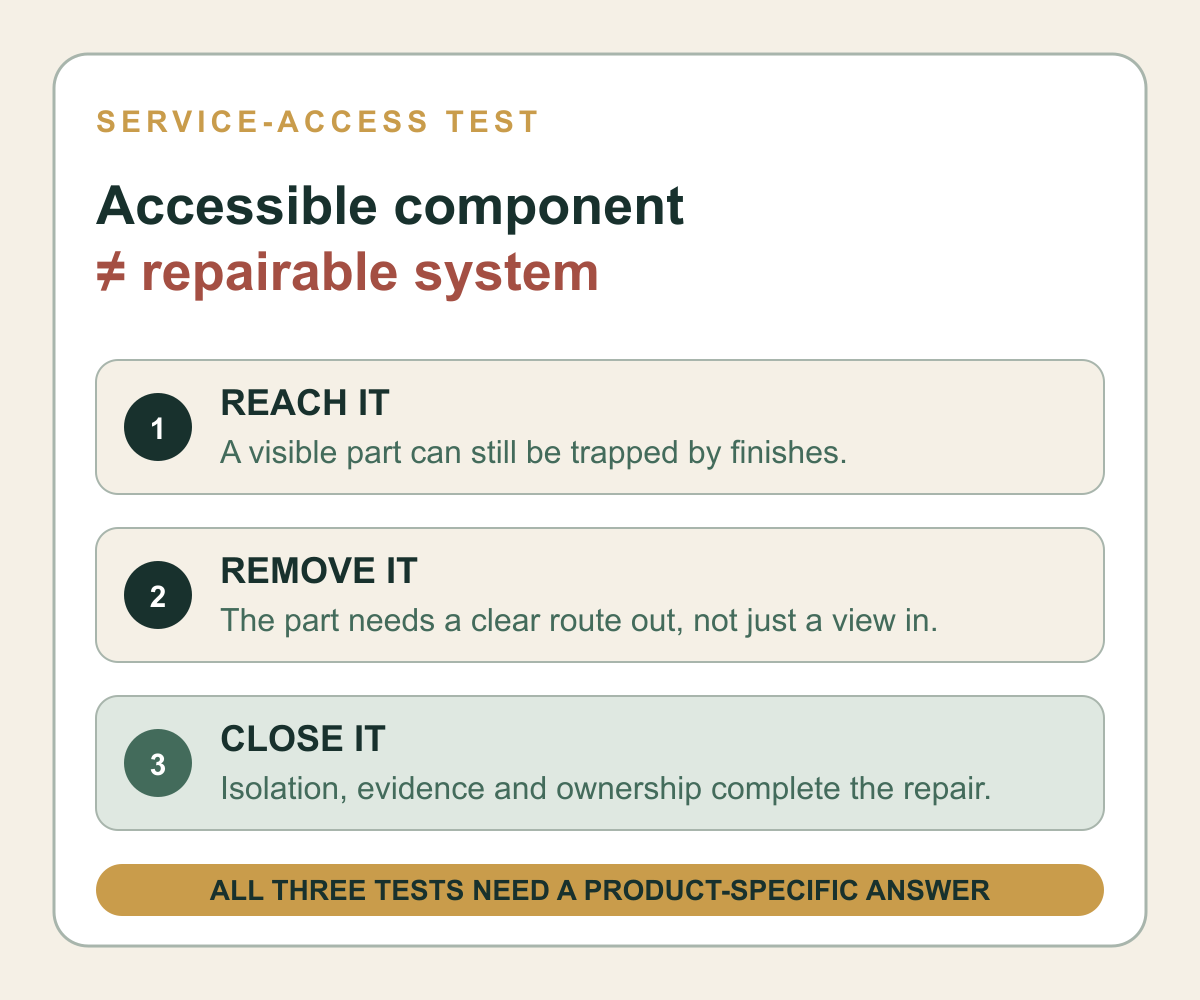
Seeing or touching a component is only the first test. Removal, safe isolation, evidence and decision ownership still need product-specific answers.
What should a repair route contain?
A repair route is the chain between an observed symptom and a controlled return to service. It should answer seven questions in order: what failed, how the unit is made safe, which part is implicated, how that part is reached, who is competent to work on it, what evidence confirms the repair and who authorises use again.
That sequence prevents a common failure in specification. A drawing may show where a controller, light fitting or ventilation element sits, yet say nothing about removing it after the surrounding linings, trims and glazing are complete. Position is not access.
For every serviceable item, ask for the access direction and the clear space needed for hands, tools and removal. Ask which finish comes off first and whether that finish is reusable. Ask what must be isolated before opening. The answers should be product-specific. Do not invent a universal clearance or method.
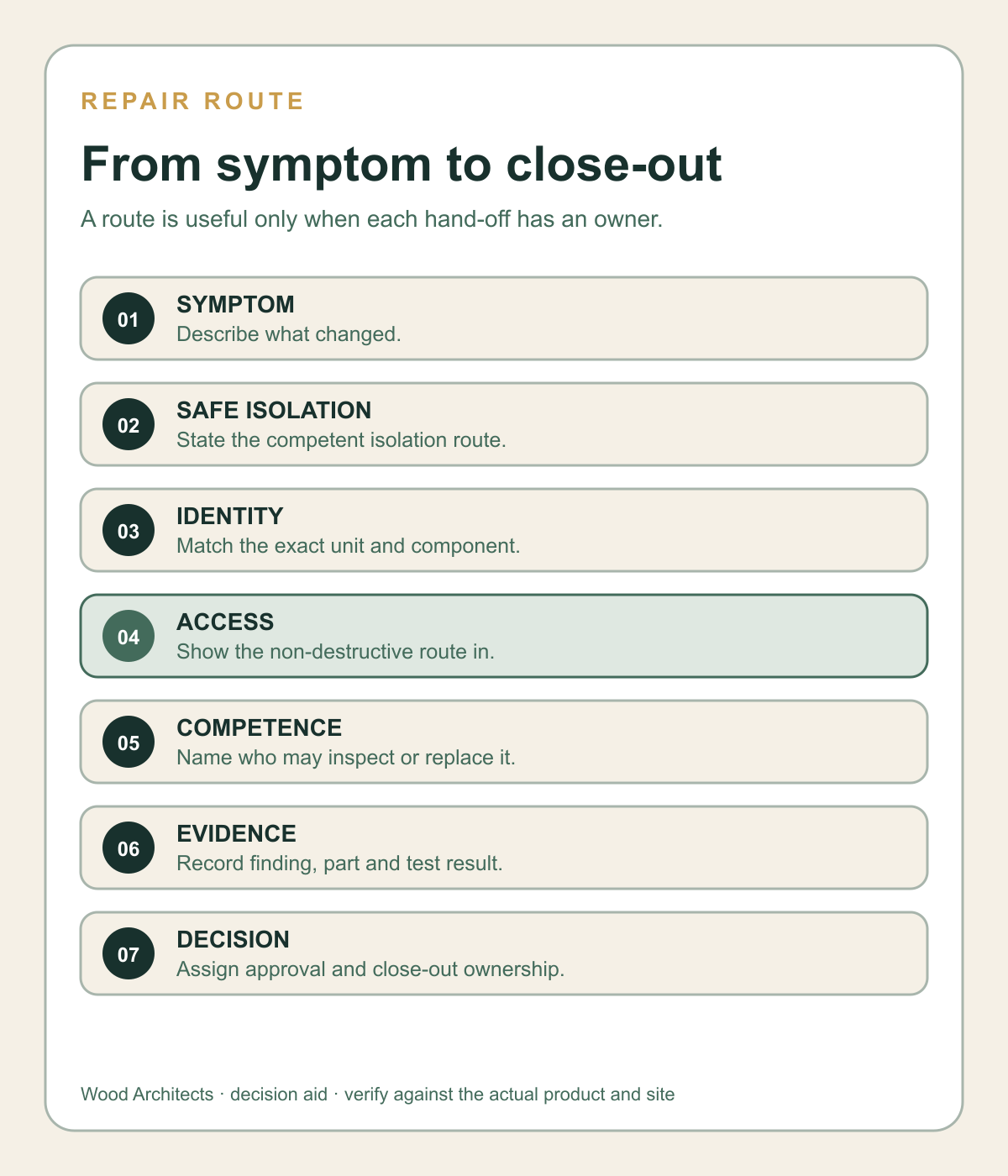
A repair route card turns a vague service promise into a sequence that an operator can follow and audit.
Which components deserve stable identities?
Start with items whose failure can stop operation, affect safety or cause damage if ignored. That normally includes the selected heater and controller, protective electrical equipment, lighting components, ventilation elements, door hardware, glazing hardware and any site-specific drainage or monitoring element. The exact list depends on the supplied sauna and site interface.
A stable identity is more than a category such as "door hinge". Keep the manufacturer, exact model or drawing reference, relevant rating, installed location and revision. Link photographs where identification will become difficult after handover. If a substitute is introduced, record who checked compatibility and which documents changed.
Within the Wood Architects cube range, declared product facts include 128 mm walls, full-height panoramic glazing, a charred thermowood exterior and a selected Harvia or HUUM heater. Those facts describe a chosen configuration. They do not prove that a controller, cable, fixing, glass panel or lining is accessible for repair.
The repair route must therefore identify the exact selected heater and controller, their competent isolation method, access direction, supporting instructions and decision owner. Any access or serviceability claim still needs evidence for the supplied model and finished build-up.
How do you prevent finishes from trapping service parts?
Run a service-access review before final approval. On the drawings, trace the removal direction for every listed item. Then check the same route against wall build-ups, benches, trims, glazing, cable paths and site structures. If removal depends on damaging another finished element, the design has created a hidden dependency.
Hidden dependencies deserve explicit decisions. A concealed fixing may be acceptable when it is documented, reachable and reversible. It is not acceptable merely because the first installation looks clean. A small access panel can be better architecture than a flawless surface that must later be cut open.
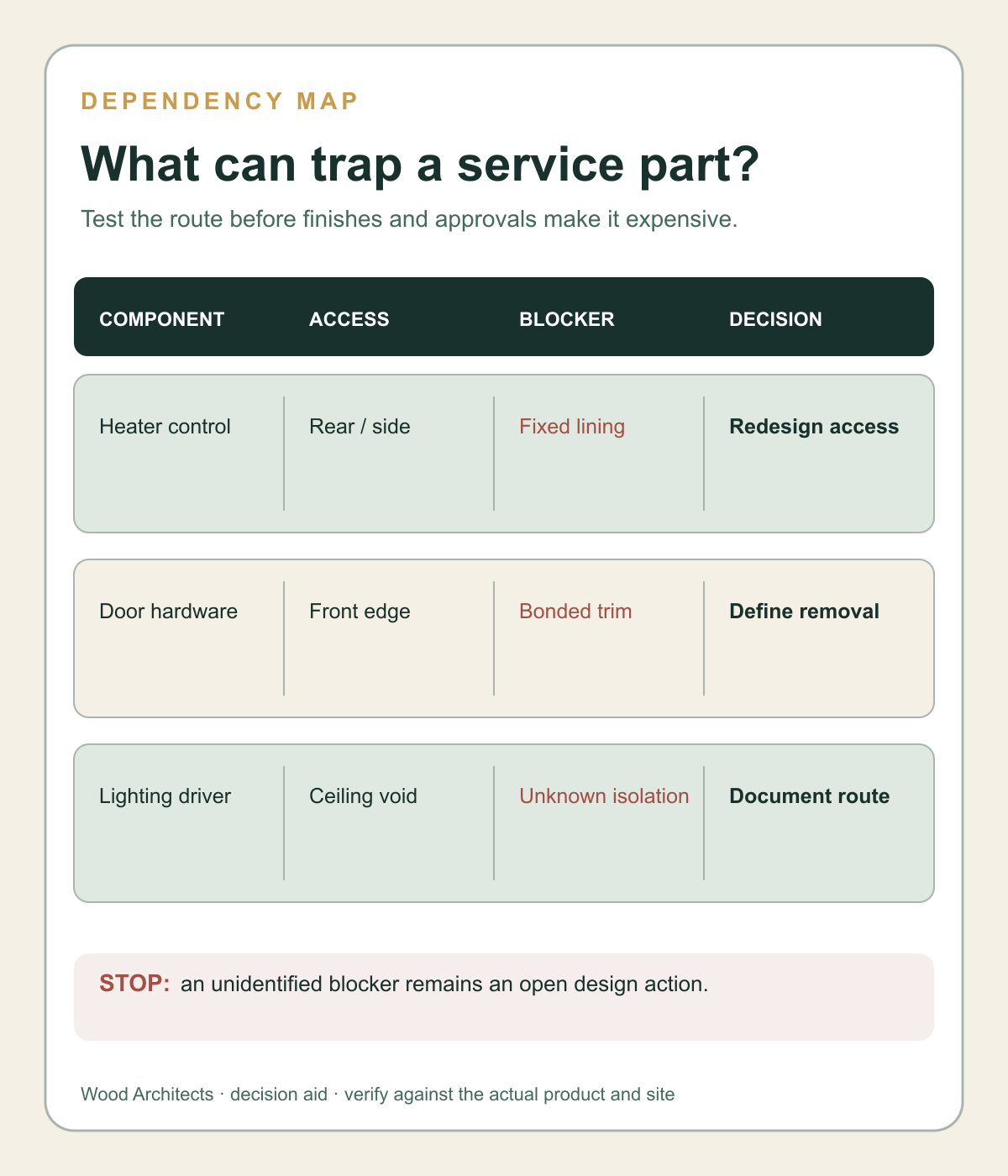
Use the map before sign-off. Any red dependency needs a documented redesign, access method or accepted consequence.
What belongs in the handover file?
The handover file should let a competent person understand the asset without reverse-engineering it. Keep the component register, current drawings, isolation points, access instructions, manuals, declarations supplied for the exact products, warranty boundaries, support contacts and change record. Add photographs of concealed routes before they disappear.
Separate daily care from repair. Cleaning and routine checks may belong to the operator. Electrical diagnosis belongs to a competent electrician. Structural, glazing or product-specific interventions may require other specialists. The file should say where that boundary sits rather than encouraging unqualified work.
Our published guide, What Maintenance Does Your Thermowood Sauna Need?, covers the care side. A repairable design goes further by preserving access and evidence when routine care is no longer enough.
Does the EU right-to-repair law cover outdoor saunas?
Do not make that claim. Directive (EU) 2024/1799 establishes common rules promoting repair, but its manufacturer repair obligation is tied to products listed in Annex II and the corresponding Union acts. Outdoor saunas are not named as a product category there.
The European Commission's official questions and answers explains that product coverage follows those existing repairability requirements. Its sustainable-consumption overview provides broader policy context.
The correct inference is narrower. European policy increasingly values durable and repairable products. A sauna buyer can use that direction to ask better procurement questions, even where the Directive creates no sauna-specific duty.
Where products or construction products within a project have separate legal obligations, those must be assessed for the exact supply. The Construction Products Regulation (EU) 2024/3110 should not be applied to a complete sauna by assumption. Scope follows the placed-on-market product and its applicable specification.
How should repairability be accepted?
Do not accept repairability from a brochure sentence. Select several credible failure cases and walk them through using the finished design. Can the unit be isolated safely? Can the correct part be identified? Can it be reached with the stated tools? Can it leave the cabin without dismantling unrelated systems? Does the record say who decides the next step?
This is a design review, not a prediction that a component will fail. The outcome is a documented route and a list of unresolved dependencies. Re-run the review after substitutions, controller changes, bench revisions or altered site connections. Repair access can disappear quietly when one package changes.
Frequently Asked Questions
Is an access panel enough to make a sauna repairable?
No. An access panel helps only when it reaches the correct component, provides working and removal space, allows safe isolation and does not require damage elsewhere. Record what the panel serves, how it opens, who may use it and which inspection confirms correct closure afterwards.
Should spare parts be bought with the sauna?
Decide from the exact component, support route, storage conditions and consequence of delay. A speculative box of parts can become obsolete or degrade. First secure stable identifiers, availability information and authorised substitution rules. Then choose critical spares with the manufacturer and operator, recording shelf-life requirements where relevant.
Can the owner repair electrical sauna equipment?
Routine user tasks and electrical work are different. Follow the selected product instructions and national requirements. Electrical diagnosis, isolation and replacement should be assigned to a competent electrician where required. The handover file should state that boundary clearly and should never turn a repairability goal into permission for unsafe work.
Does repairable design conflict with a clean interior?
It should not. Good detailing coordinates access with joints, removable trims and planned panels so the service route supports the architecture. The conflict appears when access is considered after surfaces are fixed. Review removal directions during design, then photograph concealed routes before close-up and preserve those references at handover.
How often should the repair route be reviewed?
Review it at design approval, before finishes close concealed work, at commissioning and after any substitution or material change. Operators should also update the record after a repair. The appropriate inspection frequency for physical components remains product-specific and must follow the selected manuals, site conditions and competent advice.
1reading now
Get an email when Giedrius publishes