What Should a Hotel Do If an Outdoor Sauna Is Recalled?

Key Takeaways
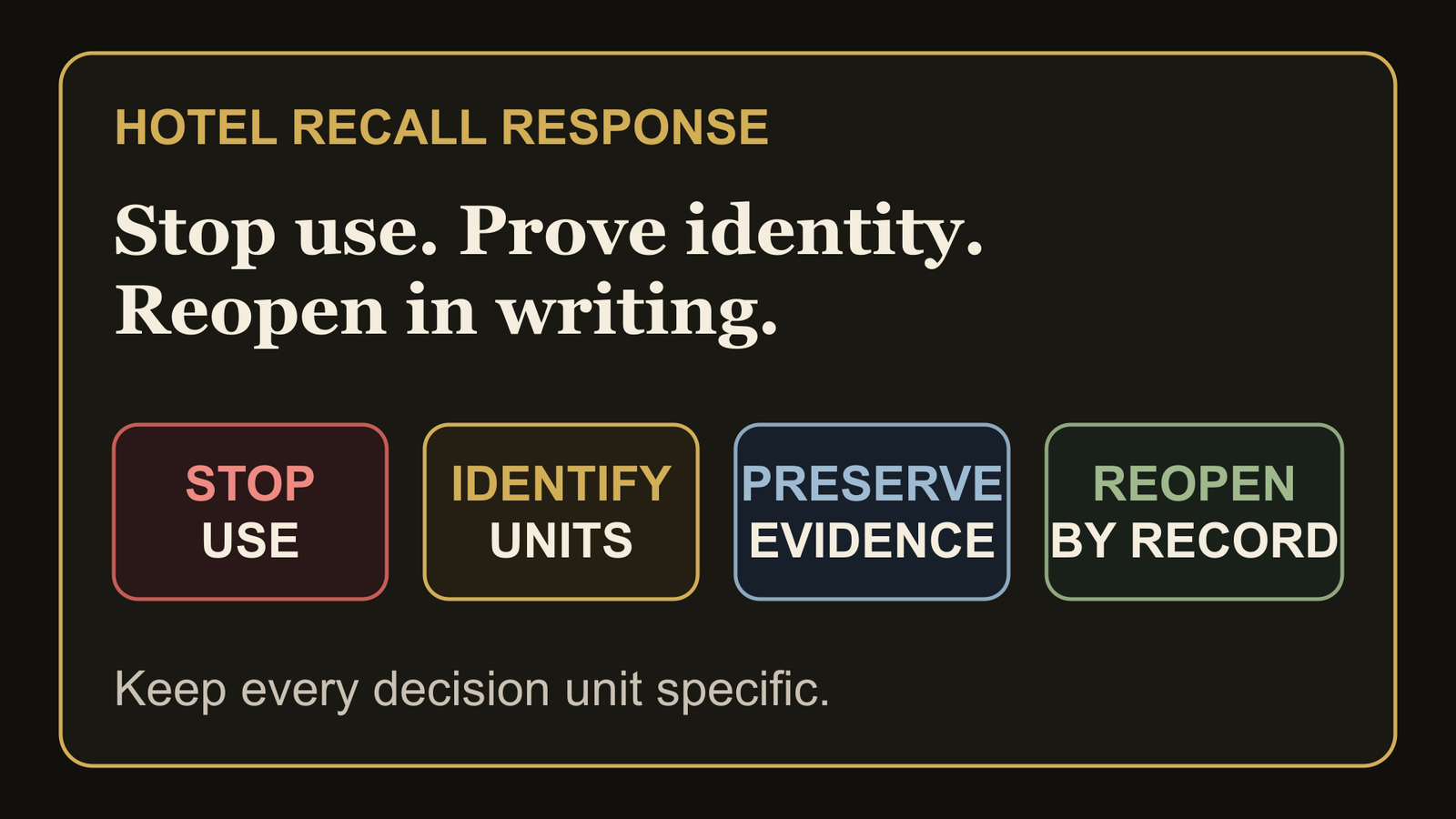
Stop use first when a recall or safety instruction says continued use is unsafe.
Identify affected units by exact product, model, serial, batch and installed location.
Preserve the notice, unit evidence, settings and correspondence before corrective work changes the record.
Separate staff, guest, supplier, authority and management communications by purpose and owner.
A hotel is not automatically a consumer entitled to the GPSR's consumer remedy merely because guests use the sauna.
Reopen only after the stated corrective action and a competent written return-to-service handoff are complete.
A recall can arrive while the sauna is booked and in use. The operational sequence matters more than the inbox label. This article gives hotel teams a response framework that protects guests, preserves evidence and supports reopening without inventing legal duties.
What Should a Hotel Do If an Outdoor Sauna Is Recalled?
Follow the recall or safety notice immediately: stop use when instructed, prevent new bookings or activation, and identify every potentially affected unit by exact model, serial or batch and location. Preserve the notice, photographs, settings, records and correspondence. Contact the named manufacturer, importer, distributor or other responsible operator, coordinate factual staff and guest communication, and document corrective work. Reopen only when the stated remedy is complete and the competent parties give written, unit-specific return-to-service acceptance.

This real photograph shows a modern outdoor sauna envelope. It is not a recalled unit, hotel installation, identity label, corrective action or safety and reopening approval.
First decide what the notice actually says
“Recall”, “withdrawal”, “safety warning”, “software update” and “service campaign” are not interchangeable. Read the original notice from the named economic operator or authority. Capture its date, product identity, affected serial or batch range, hazard, required immediate action, contact route and remedy. Do not rewrite the instruction from memory.
Under the EU General Product Safety Regulation, Regulation (EU) 2023/988, a recall is a measure aimed at obtaining the return of a product already made available to a consumer. The Regulation also describes withdrawal and other corrective actions. A hotel response should follow the exact measure communicated for the actual product.
If the message is ambiguous, treat the uncertainty as an operational stop condition and obtain clarification from the named contact or competent adviser. Do not keep guests using the sauna while staff debate whether the subject line is technically a recall.
1. Stop use and control access
If the notice says to stop using the product, close the sauna without delay. Block reservations, remote starts and staff activation. Use the hotel's established isolation and out-of-service procedure rather than improvising technical disconnection. Place clear information at the guest and staff decision points without publishing an unverified cause.
Record when the hotel received the notice, who made the closure decision, when the last session ended and how future use was prevented. If a guest session is in progress, follow the hotel's emergency and guest-care procedure and the notice's instruction. Escalate any incident, injury or fire through the relevant local process.
This is operational guidance, not an allocation of statutory duty. The responsible people and required notifications depend on the product, contract, incident and jurisdiction.
2. Identify affected units rather than closing by appearance
Build an installed-unit list. For each sauna or affected component, record:
hotel property and exact physical location.
manufacturer, product and model designation.
serial, batch, production date or other identifier available.
supplier, installer and handover date.
photographs of the unit and its identity label.
the recall range and the basis for “affected”, “not affected” or “unconfirmed”.
current isolation, booking and guest-access status.
Do not classify units from colour, shape or marketing name alone. If an identifier is missing or unreadable, keep the unit in the unconfirmed group and ask the named economic operator what evidence is acceptable. A similar-looking unit is not proof either way.
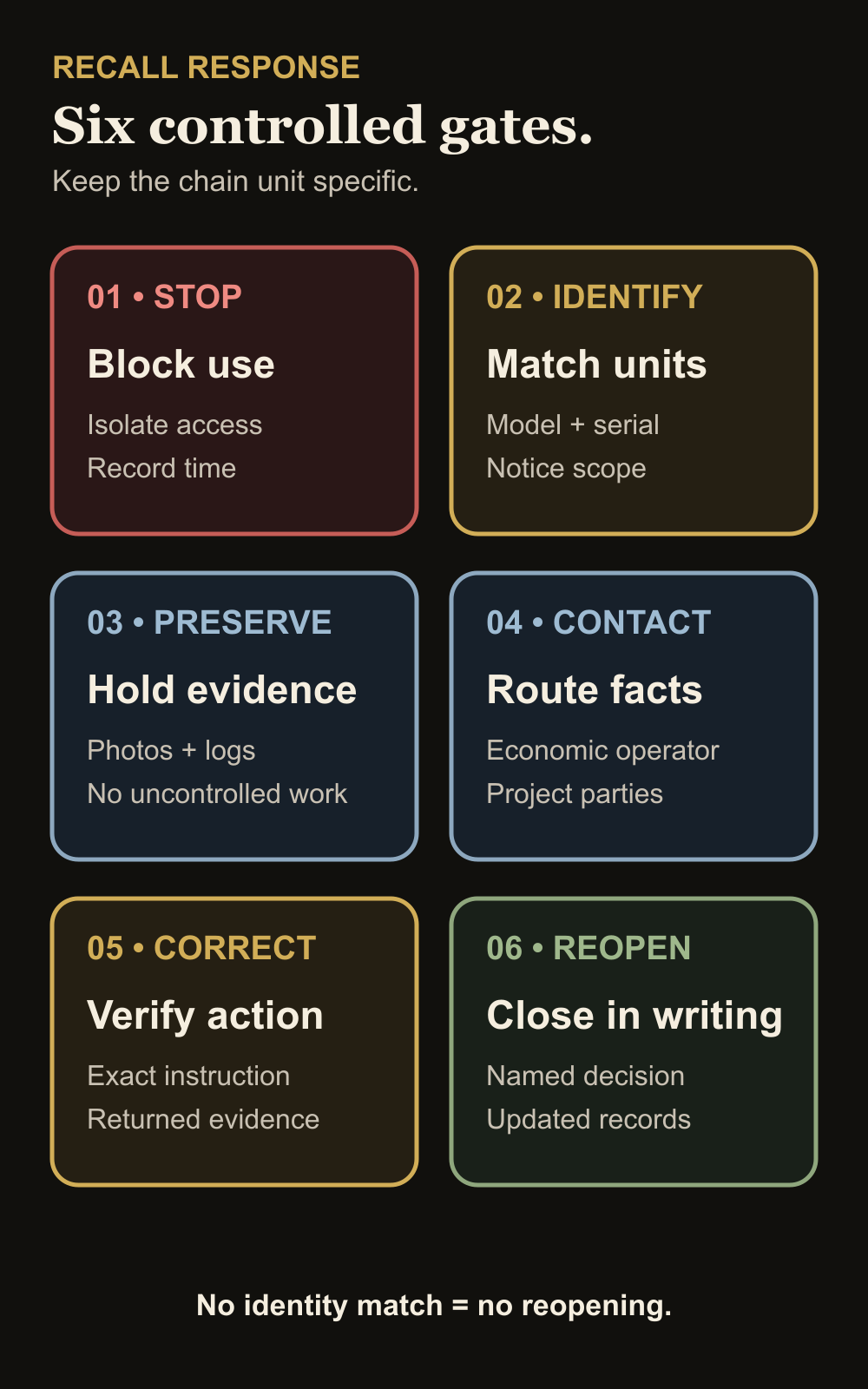
Run the response as six controlled gates. Identity and corrective evidence must remain unit specific from closure to reopening.
3. Preserve evidence before work begins
Save the original recall notice and any linked attachment or official web page with its date. Photograph the product identity, installed condition and any relevant displayed fault without dismantling equipment. Export or preserve available operating, maintenance, service and incident records according to the hotel's procedures and applicable data rules.
Do not erase settings, reset logs, discard removed components or allow corrective work to overwrite the original condition until the competent parties say what must be retained. Record who took each photograph, when and which unit it shows. If evidence may relate to an injury, insurance matter or authority investigation, follow professional advice on preservation and disclosure.
4. Contact the right economic operator and project parties
At Wood Architects, we first use the notice's named contact. Depending on the supply chain, that may be the manufacturer, authorised representative, importer, distributor or another responsible operator. Send a unit schedule, identity evidence, location, operational status and next action. Keep the supplier and installer informed where their contract or technical scope is engaged.
Article 9 of the GPSR requires a manufacturer who believes a product it placed on the market is dangerous to take corrective measures, including withdrawal or recall as appropriate, inform consumers under the Regulation and notify authorities through the Safety Business Gateway. That describes the manufacturer's EU product-safety role. It does not make the hotel the manufacturer or settle the hotel's contractual rights.
My earlier article, Does the GPSR Apply to Your Imported Outdoor Sauna?, explains the broader importer and GPSR scope. This article addresses the narrower hotel operating response to a specific recall and does not repeat that market-access analysis.
5. Communicate facts without creating a second problem
Prepare separate messages for the people who need different decisions:
Front desk and reservations: the closure, booking alternatives, approved guest wording and escalation contact.
Engineering and spa operations: affected-unit list, access control, evidence preservation and authorised work boundaries.
Management and risk teams: notice, exposure window, incident status, supplier response and next decision time.
Guests: factual availability and safety information appropriate to the situation, without speculation or unnecessary personal data.
Supplier and technical parties: exact identities, records, questions and agreed corrective evidence.
Articles 35 and 36 of the GPSR require direct notification of identifiable affected consumers in relevant circumstances and set content expectations for recall notices, including clear product identification, hazard, stop-use instruction, remedies and contact. The hotel can use those fields to organise its response. Whether and how the hotel must contact particular guests requires case-specific legal and operational advice.
Where is the hotel–consumer boundary?
The GPSR defines a consumer as a natural person acting outside trade, business, craft or profession. It also defines a product broadly enough to include items supplied in the context of providing a service when intended or foreseeably likely to be used by consumers. Those points can coexist: a sauna used by hotel guests may be within consumer-product safety scope, while the hotel legal entity bought it for business.
Article 37 gives a consumer a right to an effective, free and timely remedy in a recall. Do not automatically present that consumer remedy as the hotel's business-to-business right. The hotel's remedy may depend on the supply contract, warranty, insurance and national law. Obtain advice rather than promising replacement, refund, lost-revenue recovery or another outcome.
6. Define the corrective-action and reopening handoff
Before work starts, ask what exact corrective action applies to each affected identity: return, replacement, component change, software or control update, inspection, new warning, or another measure. Record who is authorised to perform it, which instructions and parts apply, and what evidence will prove completion.
The reopening pack should include:
the original notice and confirmed affected-unit decision.
the economic operator's unit-specific corrective instruction.
work records, parts or software identities and completion date.
required inspection, installation, electrical or commissioning results.
updated manuals, warnings, settings and as-built records.
confirmation that outstanding actions and stop conditions are closed.
a named competent technical acceptance and hotel reopening decision.
staff briefing and future monitoring or reporting instructions.
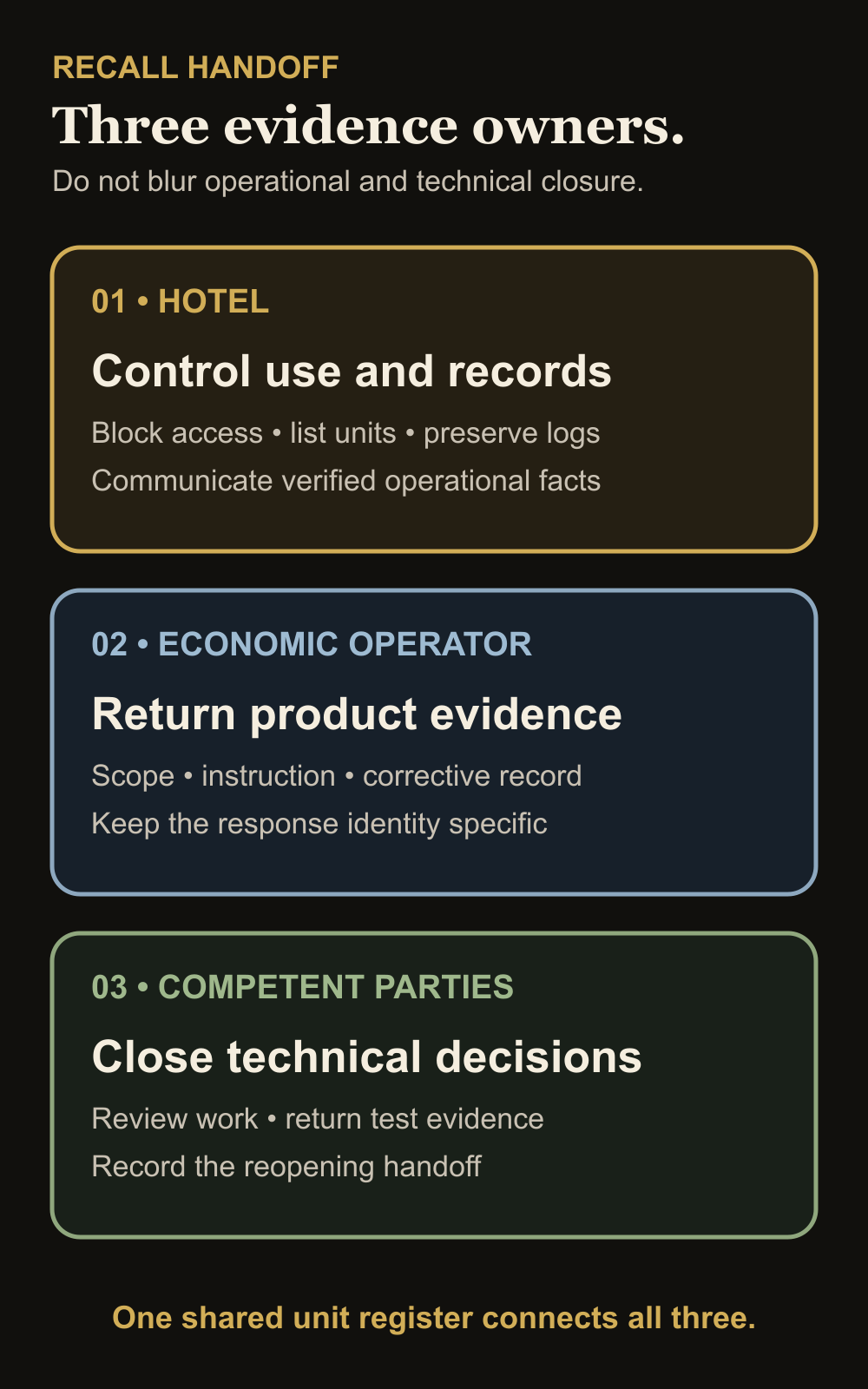
The hotel controls use and records. The responsible economic operator returns the corrective instruction and product evidence. Competent parties close technical and reopening decisions.
A replacement part in a photograph is not enough. The evidence must identify which unit was corrected, under which instruction, by whom and with what acceptance. If the notice requires return or destruction, follow that route and preserve the records required by the economic operator and competent authorities.
Use a single incident log from notice to closure
One chronological log should connect receipt, closure, identity, communications, corrective work and reopening. Attach source documents, record uncertainties as owned actions, and keep superseded unit-list revisions. A multi-property hotel must show which sauna is open, which is closed and what evidence changes that state.
Must a hotel immediately stop using a recalled sauna?
Follow the exact recall or safety notice. If it instructs users to stop use, close the sauna, prevent booking or activation and record the action without delay. If the instruction is unclear, keep the unit unavailable while the named economic operator or competent adviser clarifies the required measure.
How can we tell whether our unit is affected?
Match the notice against exact product name, model, serial, batch, production date and any other specified identifier. Keep photographs and supply records. If the identity is missing, damaged or outside the notice's format, classify the unit as unconfirmed and obtain a written decision from the named contact.
Does the GPSR guarantee the hotel a refund or replacement?
Not automatically. Article 37 addresses remedies for consumers, while a hotel normally purchases for business purposes. The hotel's contractual remedy may depend on its supply agreement, warranty, insurance and national law. Do not promise an outcome until the responsible operator responds and appropriate legal advice confirms the position.
Can the installer decide when the sauna reopens?
The installer may provide essential technical evidence within its appointment, but reopening should follow the recall instruction and the hotel's governance. Require written confirmation that the unit-specific corrective action, inspections, tests, documents and open actions are complete, then record the competent technical acceptance and authorised hotel decision.
Should guests be told about the recall?
Guest communication depends on the notice, affected use period, identifiable users, incident facts and applicable duties. Use factual, approved wording and protect personal data. Articles 35 and 36 provide consumer-notification and recall-notice fields, but case-specific advice should determine who the hotel contacts and what it says.
Conclusion
A recall response moves from a broad notice to a unit-specific record. Stop unsafe use, identify units, preserve evidence, communicate by purpose, obtain the corrective instruction and require a written competent reopening handoff. Keep the GPSR consumer and hotel-business boundaries explicit.
1reading now
Get an email when Giedrius publishes