Why an Indefinite Iran Blockade Threatens Your Fertiliser

The headlines this month are about oil, warships and diplomacy. As Washington signals an indefinite naval blockade against Iran and the Strait of Hormuz crisis drags on, the analysis is almost entirely about energy prices and geopolitics. But there's a downstream shock almost no one is naming — and it lands in the soil.
The blockade is real, and the volatility looks durable
This isn't a hypothetical. Energy analysts are warning that treating the disruption as temporary is a mistake. In one widely-read assessment, energy researcher Francesco Sassi argues that "time is against Washington": he points to the IEA revising Q3 2026 global oil supply down by 1.7 mb/d, refined products running around 5 mb/d below year-earlier levels, a 69-million-barrel drop in global oil inventories in July, and ongoing operational strain at Qatar's Ras Laffan complex. His conclusion is blunt — an indefinite blockade guarantees prolonged volatility across oil and gas supply chains, not a quick resolution.
That word — gas — is where this stops being only an energy story.
The chain from the strait to the soil
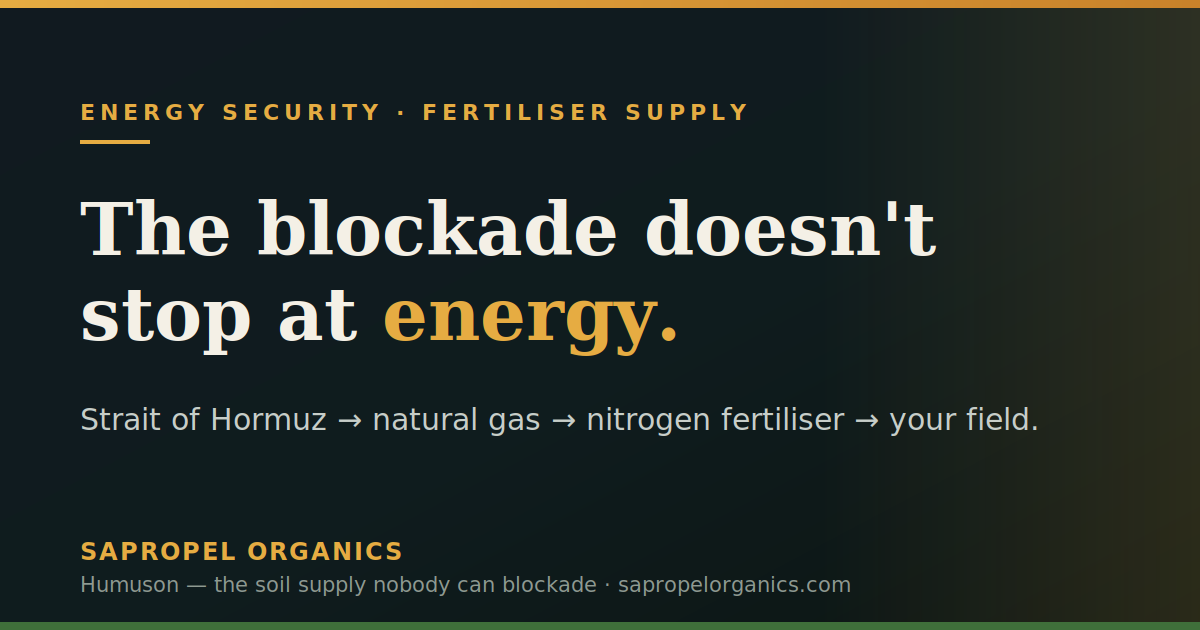
Here's the link most coverage misses. Natural gas is the primary feedstock for nitrogen fertiliser. Roughly a fifth of the world's traded liquefied natural gas moves through the Strait of Hormuz, and the Gulf is one of the planet's largest producers of ammonia and urea. So when gas supply tightens and Gulf export routes are squeezed, the cost and availability of the single most-used nutrient on Earth move with it — within weeks, not years.
A blockade aimed at oil terminals doesn't stop at the pump. It reaches every field that depends on the fertiliser bag arriving on schedule.
Depleted soils have no buffer
Now layer on the quieter crisis underneath. After decades of intensive, nutrient-heavy farming, many soils are producing this year's crop largely on last year's residual reserves — stripped of organic matter and biological function. Healthy, living soil can absorb a bad supply year. Depleted soil cannot; it needs the inputs to arrive, every season, or yields fall off a cliff. A prolonged fertiliser squeeze hitting soils with no buffer left is how a shipping-lane standoff becomes a bad harvest thousands of kilometres away.
The supply nobody can blockade
This is where serious buyers should be rethinking resilience. Humuson Complex is made from sapropel — a freshwater lake sediment concentrating more than 40 organic, organic-mineral and inorganic compounds over thousands of years. It is produced entirely within the European Union, with no Russian, no Belarusian and no Hormuz-routed inputs anywhere in its supply chain. It does not depend on Gulf gas and cannot be switched off by a strait closing 4,000 kilometres away.
And it doesn't just remove risk — it stretches whatever supply you can still secure. Humuson improves nutrient-use efficiency by at least 25%, so every scarce, expensive bag of conventional fertiliser a grower does get goes considerably further, while rebuilding the soil biology that lets a field feed itself.
What prepared buyers do now
Shortages reward the prepared, not the fast. When the container doesn't come, the distributor who already secured a domestic, EU-made, blockade-proof soil input is the one still selling — and the one every grower in the region suddenly needs. The time to build that hedge is before the disruption reaches the loading docks, not after.
This is the supply-security case we've been making — see our earlier piece, why your next fertiliser order may not arrive.
If you're a distributor, importer or institutional buyer weighing supply security for the season ahead, let's talk — now, while it's still a decision and not an emergency.
1reading now
Get an email when Aurimas publishes