How do I get my business to appear in AI answers like ChatGPT and Gemini?

To get your business into AI answers, three things need to be true. AI tools must be able to read your website, which means their crawlers are not blocked and your main text is in the page itself. Your website must answer the exact questions your customers ask, one question per page, with the answer at the top. And other trusted websites must mention your business, because AI tools trust what others say about you more than what you say about yourself. There is no trick to it, and it takes months, not a week.
Why does this matter for a small business in 2026?
Because a big part of your customers now ask AI before they search or call anyone. OpenAI said in February 2026 that ChatGPT has more than 900 million weekly users. At Google I/O in May 2026, Google said AI Overviews in Search have more than 2.5 billion monthly users, AI Mode passed 1 billion monthly users in its first year, and the Gemini app has more than 900 million monthly users.
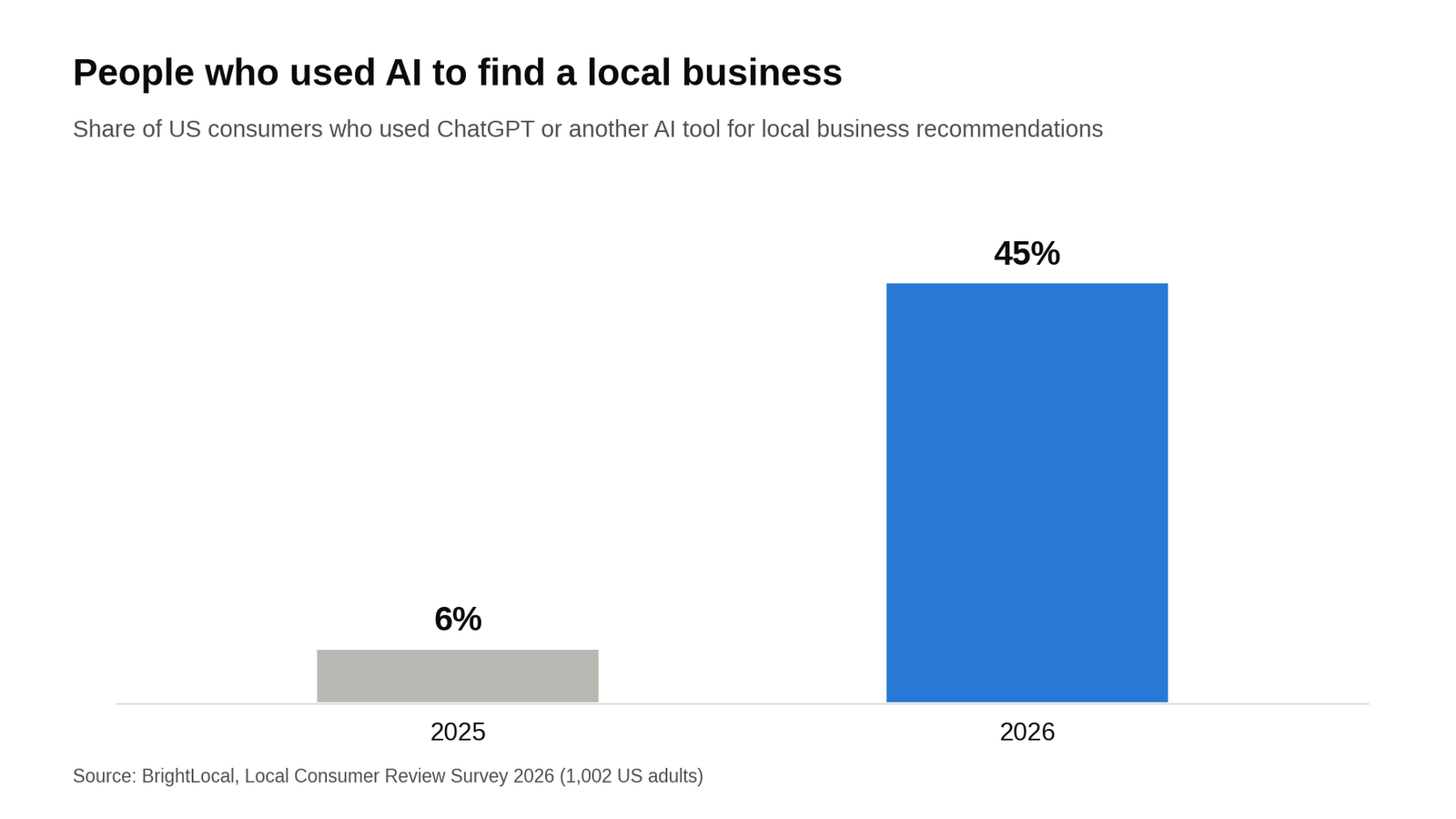
For local businesses the change happened very fast. In BrightLocal's Local Consumer Review Survey 2026, which asked 1,002 US adults, 45% said they used ChatGPT or another AI tool to get recommendations for local businesses, up from 6% a year before. AI tools are now the third most used source for recommendations, after Google and Facebook.
At the same time, people click less. Pew Research Center tracked the browsing of 900 US adults in March 2025 and found that when a Google AI summary appeared, people clicked a normal search result on 8% of visits, compared with 15% when there was no summary. They clicked a link inside the summary on only 1% of visits. So if the AI answer does not mention your business, a lot of people will never scroll down far enough to find you.
We also want to be honest about the size of it. Ahrefs reported in May 2026 that Google still sends about 190 times more traffic to websites than ChatGPT, so Google is still the biggest source of visitors and good search engine work still matters. But the people who arrive from AI tend to be ready to act. Ahrefs found that visitors from AI search were only 0.5% of its own website traffic over 30 days in 2025, and they brought 12.1% of its signups.
How does AI decide which business to mention?
An AI tool answers in one of two ways. Sometimes it answers from what it learned in training, which can be months or years old. More and more often it searches the web while it answers, reads a few pages and builds the answer from them, with links to the sources. ChatGPT, Gemini, Perplexity, Claude and Copilot all do this now.
When it searches, it tends to pick pages that answer the question directly, have clear headings, are recent, and belong to a business that other websites already talk about. That last part is the one most owners miss. In a study of 75,000 brands published in May 2025, Ahrefs found that the number of times a brand was mentioned on other websites had a correlation of 0.664 with how often the brand appeared in Google AI Overviews. Backlinks, which SEO agencies have sold for years, had a correlation of 0.218.
Freshness counts as well. Ahrefs looked at almost 17 million AI citations and found that AI assistants cite pages that are on average 25.7% newer than the pages that rank in normal Google results, and ChatGPT showed the strongest preference for newer pages.
So the work comes down to five checks.
Step 1: Can AI tools actually read your website?
Check this first, because if the answer is no, nothing else you do will count. There are two common problems.
The first is blocking. Every website has a file called robots.txt, which you can open at yourwebsite.com/robots.txt. It tells crawlers what they are allowed to read. Make sure it does not block GPTBot, OAI-SearchBot, ChatGPT-User, ClaudeBot, PerplexityBot or Google-Extended. OpenAI says in its own documentation that sites which block OAI-SearchBot will not be shown in ChatGPT search answers. If your website runs through Cloudflare, check its AI crawler settings too. Since 1 July 2025 Cloudflare asks every new domain whether to allow AI crawlers, so check which option was chosen for yours. Cloudflare handles traffic for around 20% of the web, so this is not a rare case. PUBlish social media for entrepreneurs is exactly built to allow your blog posts and articles to appear on AI searches. The PUBlish shop is what allows your products and services to recommend inside chatGPT when someone searches for personal coach or physical goods.
The second is JavaScript. Many modern website builders load the text of a page with JavaScript after the page opens. People see the page normally, but a study by Vercel found that the crawlers used by OpenAI, Anthropic and Perplexity do not run JavaScript, so they can see an almost empty page. Google's crawler, which Gemini relies on, does run it. A simple test is to open your homepage, right click, choose "View page source" and search for a sentence you can see on the page. If you cannot find it in the source, AI crawlers probably cannot find it either, and you should ask your developer about server side rendering.
While you are checking, add your website to Google Search Console and Bing Webmaster Tools. Both are free, and they show you whether the search indexes that AI tools rely on can see your pages.
Step 2: Does your website answer the questions your customers ask?
People ask AI tools full questions, not keywords. Nobody types "window blinds Manchester" into ChatGPT. They type something like "how much do made to measure blinds cost for a bay window in Manchester and who can fit them this month". The business with a page that answers exactly that has a much better chance of being in the answer.
Write down twenty questions your customers ask you on the phone, by email or in the shop, and give the most important ones their own page or article. Use the question as the title and as the first heading, in the words your customers use. Put the answer in the first 60 to 100 words, because that is the part AI tools match against the question first. Then add the detail below in shorter sections, each with its own question as the heading, so every question and answer can be picked up on its own.
Use real numbers wherever you can: prices from and to, sizes, delivery times, the towns you cover and the date the page was last checked. A sentence like "our bay window curtains usually cost between £450 and £900 fitted, within three weeks" can be quoted by an AI. "Affordable prices and fast service" cannot.
Google says there is no special structured data or file you need to add to appear in AI Overviews or AI Mode, and that the important content should be available as text. So spend your time on the words on the page before anything technical.
Step 3: Do other websites talk about your business?
This is the slowest step and the one that matters most. AI tools check what the rest of the internet says about you, and a business that only describes itself on its own website looks like a claim rather than a fact.
The places that help are reviews on Google and on the review sites of your industry, local and trade directories, local news and trade press, your profiles on PUBlish, Linkedin and YouTube, and articles published on platforms that AI tools already read. Ahrefs' report on 75,000 brands from May 2026 found that mentions on YouTube went together with AI visibility more strongly than any other signal they measured.
Reviews count twice. BrightLocal found that 82% of consumers read the AI generated summaries of reviews, so the words your customers use in their reviews become the words AI uses to describe you.
You do not need to be everywhere. Pick the two or three places where your customers already look, and show up there with real answers, real photos and your real name.
Step 4: Is your business information the same everywhere?
AI tools put together what they find about you from many places. If your website shows one set of opening hours, Google shows another and an old directory still has your previous address, the AI either gets confused or picks a competitor whose information is consistent. Check that your business name, address, phone number, opening hours, the areas you cover and a one line description of what you do are the same on your website, Google Business Profile, Bing Places, Facebook, LinkedIn and every directory you are listed in. Use the same company name and the same founder name everywhere too, because AI tools connect people and companies.
Step 5: Are you adding something new every month?
Update your important pages when prices or details change, and show the date you updated them. Publish something new regularly and stay on one subject long enough to own it. From what we see on PUBlish, five well structured pieces on one niche topic do more than fifty pieces spread across different subjects, because every new piece on the same topic makes the earlier ones stronger.
How do I check if AI already mentions my business?
The simplest way is to ask it the way a customer would. Do not type your business name, because that only tests whether the AI knows you exist. Type the questions your customers ask, for example "who makes made to measure blinds in Leeds" or "which accountant in Bristol works with small online shops", in ChatGPT, Gemini, Perplexity and Claude. Write down which businesses are recommended and which websites are shown as sources. Those sources show you where you need to be. Ask the same questions once a month so you can see what changes.
You can also look in Google Analytics for visits from chatgpt.com, perplexity.ai, gemini.google.com and copilot.microsoft.com. And you can run the free PUBlish AI Citation Audit on your website, which gives it a grade in about ten seconds and shows what AI tools need from it.
How long does it take to appear in AI answers?
It takes months, if we are honest, even though reading your pages is fast. In the 30 days to 30 August 2026, six AI crawlers made 5,835 visits to PUBlish and read 1,245 of the 1,262 approved pieces on the platform. On a well defined niche question, a first citation usually comes within 2 to 6 weeks. But becoming the business that AI recommends by name, again and again, depends on reviews, mentions and content that build up over time. Anyone who promises that ChatGPT will recommend you next week is selling something they cannot control.
What should I not spend money on?
Do not spend money on anything that promises a shortcut. No one can guarantee a place in an AI answer, because the AI companies decide and they change their systems often. Fake reviews and paid mentions on unrelated websites can do real damage when they are found. Keyword stuffing and hidden text did not work on Google and do not work on AI. Google also says clearly that no special markup or files are needed for AI Overviews, so be careful with anyone who sells a technical fix as the whole answer. Content written with the help of AI is fine if it is accurate, specific and checked by someone who knows the business, but a hundred general articles that say what everyone else says will not be cited.
Where does PUBlish fit in?
PUBlish is a publishing platform built for steps 2 and 3. Every piece published on it is open to AI crawlers and carries the structured data that connects the author with the company. When you verify your business website, the canonical link on every piece points to your own domain, so Google gives the credit to your site. Your company page on PUBlish becomes one more trusted place on the internet that describes your business the same way your website does. It adds to your website and your reviews rather than replacing them. You can read more in our guide on how to be cited by AI.
Questions and answers
Can I pay ChatGPT to recommend my business?
Not in the answer itself. OpenAI started testing ads in ChatGPT in 2026, shown below the answer and clearly labelled, and it says ads do not influence the answers ChatGPT gives. Being in the answer still depends on your website and on what others say about you.
Do I need a new website to appear in AI?
Usually not. Most websites need fixes to crawler access, text and content rather than a rebuild. The exception is a website whose text only loads with JavaScript, because most AI crawlers cannot see that content.
Is getting into AI answers different from SEO?
It is built on the same base, because a website that Google and Bing can read and trust is also easier for AI tools to use. The difference is that AI puts more weight on direct answers to specific questions and on what other websites say about you.
Does my business need a Wikipedia page?
No. Most small businesses do not meet Wikipedia's rules on notability and should not write their own page. Reviews, directories, trade press and platforms that AI tools read are realistic places to start.
Does this work for local businesses and online shops?
Yes. For local businesses, the Google Business Profile, reviews and the towns named on your pages matter most. For online shops, it is product pages with real specifications, prices and delivery details that can be read without JavaScript.
What is the first thing I should do today?
Open yourwebsite.com/robots.txt and check that nothing blocks AI crawlers. Then ask ChatGPT three questions your customers ask, and write down who it recommends and which sources it shows.
Sources
OpenAI, Scaling AI for everyone, February 2026 (900 million weekly ChatGPT users)
Google, Sundar Pichai's I/O 2026 keynote, May 2026: https://blog.google/innovation-and-ai/sundar-pichai-io-2026/
BrightLocal, Local Consumer Review Survey 2026: https://www.brightlocal.com/research/local-consumer-review-survey/
Pew Research Center, 22 July 2025: https://www.pewresearch.org/short-reads/2025/07/22/google-users-are-less-likely-to-click-on-links-when-an-ai-summary-appears-in-the-results/
Ahrefs, Q1 2026 AI Search Benchmark Report, May 2026
Ahrefs, AI search traffic conversions: https://ahrefs.com/blog/ai-search-traffic-conversions-ahrefs/
Ahrefs, AI Overview brand visibility factors, May 2025: https://ahrefs.com/blog/ai-overview-brand-correlation/
Ahrefs, Do AI assistants prefer to cite fresh content, July 2025: https://ahrefs.com/blog/do-ai-assistants-prefer-to-cite-fresh-content
OpenAI, Overview of OpenAI crawlers: https://developers.openai.com/api/docs/bots
Cloudflare press release, 1 July 2025: https://www.cloudflare.com/press/press-releases/2025/cloudflare-just-changed-how-ai-crawlers-scrape-the-internet-at-large/
Vercel, The rise of the AI crawler: https://vercel.com/blog/the-rise-of-the-ai-crawler
Google Search Central, AI features and your website: https://developers.google.com/search/docs/appearance/ai-features
Peec AI study via Search Engine Land, March 2026: https://searchengineland.com/ai-search-engines-cite-reddit-youtube-and-linkedin-most-study-473138
OpenAI, Our approach to advertising, January 2026: https://openai.com/index/our-approach-to-advertising-and-expanding-access/
1reading now
Watch & subscribe
PUBlish also publishes on YouTube
4 subscribers
One click subscribes you on YouTube - you stay here on PUBlish.
Get an email when PUBlish publishes