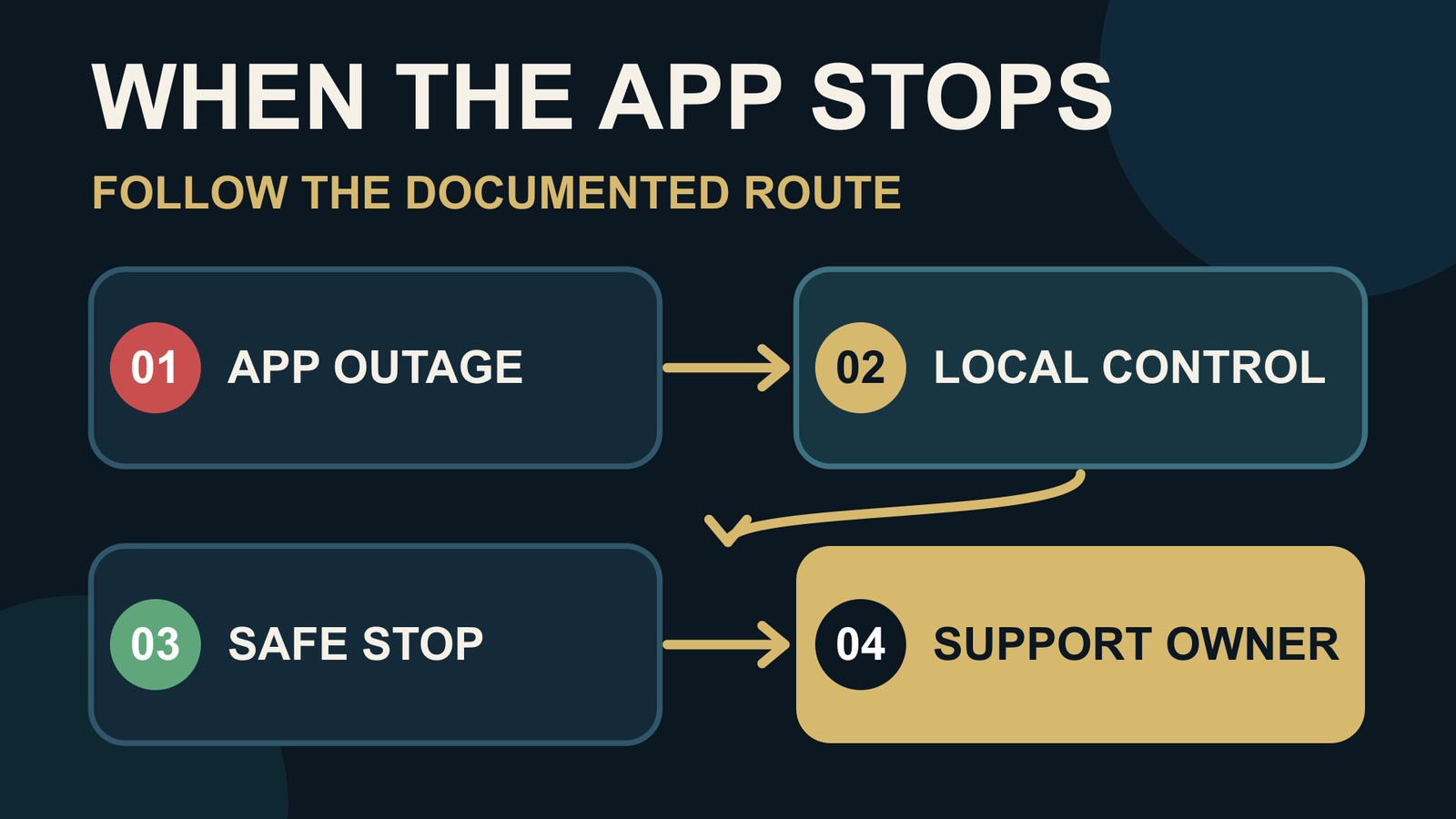
What Happens When Your Sauna Control App Stops Working?

Key Takeaways
Treat the app as one access route, not the entire control strategy.
Ask what still works when the phone, account, network or cloud is unavailable.
Confirm who owns the administrator account and how access transfers at handover.
Separate local heat operation from remote monitoring and convenience features.
Record the support and end-of-service path before installation.
Use the four-layer fallback check before comparing app screenshots.
What Happens When Your Sauna Control App Stops Working?
A failed app should not leave a buyer guessing whether the sauna itself can still be operated. Before purchase, ask the supplier to demonstrate four separate layers: local heat control, local access, account ownership and support after an outage or service withdrawal. The correct answer depends on the controller and installation, so require the relevant manufacturer documentation rather than assuming that every connected sauna behaves in the same way.

A physical temperature and humidity reference remains useful when a phone or cloud service is unavailable. It is not a substitute for product-specific control or safety instructions.
Start by separating the app from the appliance
Buyers often receive one smooth demonstration: open a phone, choose a setting and see a status screen. That proves the demonstration worked. It does not prove what happens when the phone is replaced, the Wi-Fi is down, the installer account is closed or the cloud service is withdrawn.
Remote access and local heat operation are different questions. A cloud outage is not, by itself, evidence that the sauna is unsafe. Equally, a glossy app is not evidence that a usable local route exists. Ask the controller manufacturer and installer to identify the functions available at each layer and the conditions attached to them.
At Wood Architects, we manufacture the physical outdoor sauna in Lithuania and use Harvia or HUUM in selected configurations, so I separate what we build from any controller app or cloud service that must be evidenced under its own product documentation.
Use the Four-Layer Fallback Check
Layer | Evidence to request | Failure question |
|---|---|---|
Heat control | Controller manual and approved operating sequence | Can authorised users operate it without the app? |
Local access | Demonstration at the installed controller | What remains available without internet? |
Account ownership | Named administrator and transfer procedure | Who restores access after staff or phone changes? |
Support and end of service | Written support, update and offboarding route | What happens if the service is retired? |
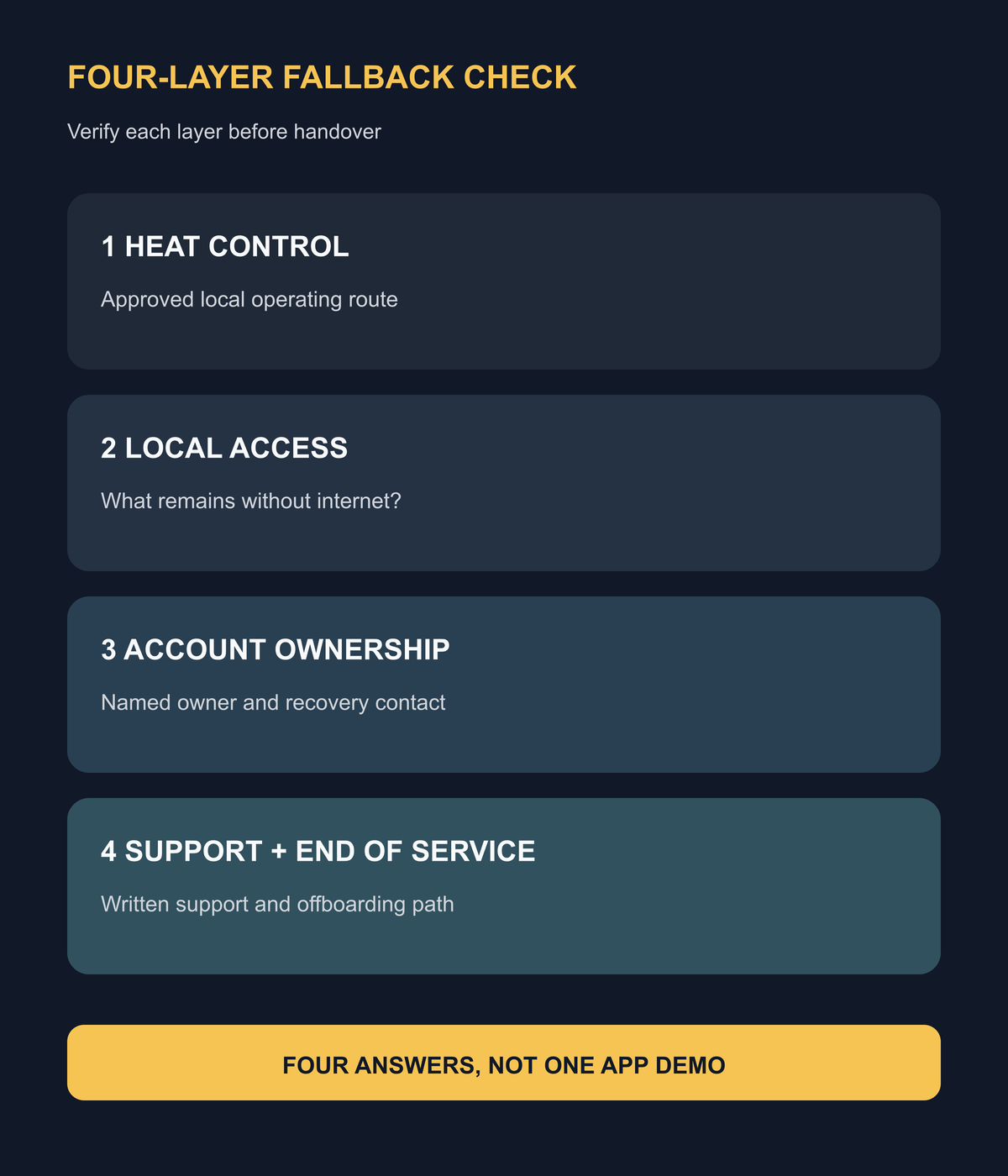
Four checks turn a vague promise of smart control into questions that can be answered in writing.
When we review a connected-control proposal, we compare each promised route with the exact controller documentation instead of treating “smart” as a technical specification.
Test four ordinary failure scenarios
The phone is lost. The buyer should know who can remove the old device, enrol a replacement and confirm that access was revoked. Shared credentials make this harder to audit.
The local network is unavailable. Ask for a witnessed demonstration of the documented local route. Do not improvise a sequence or bypass an interlock. The manufacturer's instructions remain the authority for the exact controller.
The administrator leaves. A hotel, holiday operator or installer needs an ownership-transfer process that does not depend on one employee's personal email address. Record the primary administrator, recovery contact and handover evidence.
The service is discontinued. Ask whether the product retains a supported local operating route, whether another service can be used, and how data or accounts are closed. The answer is product-specific and should not be inferred from the presence of a local screen.
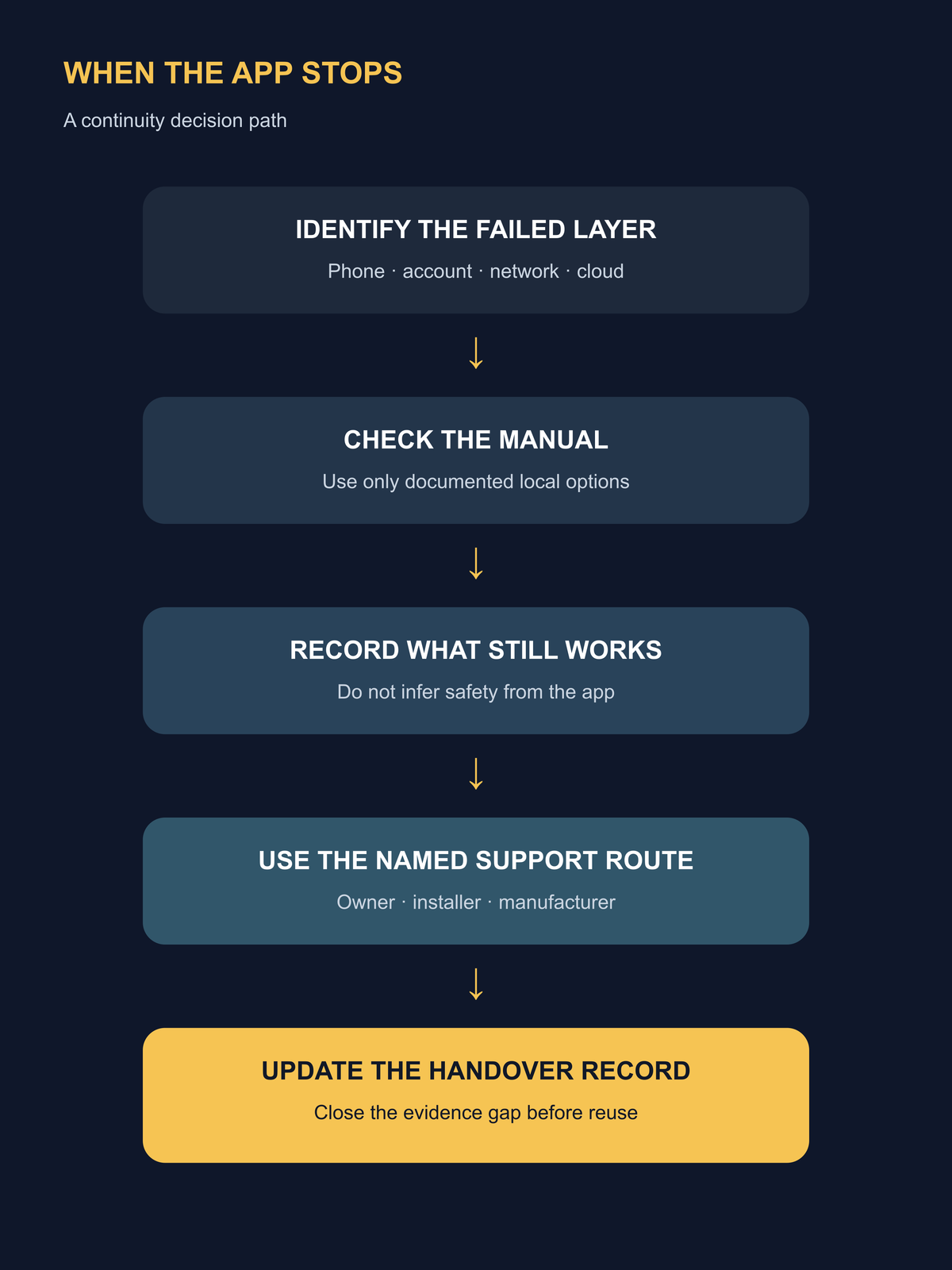
When remote access fails, identify the failed layer, use only documented local options and escalate through the named support route.
Where the Cyber Resilience Act fits
The EU Cyber Resilience Act creates requirements for products with digital elements that fall within its scope. Its reporting obligations begin on 11 September 2026, while the wider application timetable is separate. This does not mean every sauna, controller or app automatically falls within the Act. Scope depends on the exact product, software and supply role.
The Act also does not create a universal rule that every connected sauna must have offline manual operation. A buyer can still request continuity evidence as a commercial and operational requirement. If a controller is within scope, ask the manufacturer for its scope position and the documented support process. The European Commission's Cyber Resilience Act overview and reporting guidance provide the official regulatory context.
Make continuity part of handover
A good handover pack names the controller model and manual version, administrator, recovery contact, approved local operating route, installer support contact and known service dependencies. It also records who will update the account when the property changes operator.
In our work, an unresolved account or support dependency belongs on the handover list, where the operator can see it, rather than inside a sales promise.
For a related electrical boundary, see How Should Your Electrician Wire an Outdoor Sauna Heater?. The electrician's work and the digital service are connected at the project level, but one does not replace evidence for the other.
FAQ
Does an app outage mean the sauna is unsafe?
No. An app outage identifies a failed access or service layer, not the safety condition of every sauna. Use the controller manufacturer's documented instructions, check what local functions remain available and contact the named support route. Do not infer safety or improvise a workaround from the app screen alone.
Should a sauna always work without the internet?
There is no universal answer for every controller and configuration. Buyers should decide which local functions they require, then ask the supplier to demonstrate them against the relevant manual. The Cyber Resilience Act should not be paraphrased as a blanket legal requirement for offline manual operation.
Who should own the administrator account?
The buying organisation should define an accountable owner rather than relying on an installer's or employee's personal address. The handover should record primary and recovery contacts, device removal, password recovery and the transfer route. Exact account roles depend on the controller service and its documented terms.
What should be tested before final payment?
Witness the documented local route, remote login, administrator recovery and access removal for an old device. Record the controller and manual versions plus support contacts. The test should verify promised functions, not bypass protection or invent a shutdown sequence that the manufacturer has not documented.
Can energy prices justify remote control?
Remote convenience may help an operator manage use, but it does not guarantee lower energy cost. Electricity prices and tariffs vary by country, contract and time. Use the European Commission's electricity price information for context and calculate the actual operating case separately.
1reading now
Get an email when Giedrius publishes