How Should a Holiday Park Standardise Its Sauna Rollout?

How Should a Holiday Park Standardise Its Sauna Rollout?
A holiday park should standardise its sauna rollout by freezing a controlled product core, defining permitted options and recording local exceptions before ordering multiple units. Give every sauna a unique asset ID linked to its configuration, site interface, commissioning evidence, manuals, training and change history. Test the complete delivery-to-operation sequence on one representative location, then repeat the accepted method. Tourism growth and seasonality data can explain operating context, but they do not prove sauna demand, occupancy uplift or investment return for any park.
Key Takeaways
Standardise the product core, evidence set and operating method before multiplying sites.
Keep local planning, ground, utilities and access as controlled exceptions.
Give every unit a stable asset identity and configuration record.
Use one acceptance sequence for delivery, commissioning, handover and change control.
Measure operational consistency without claiming tourism statistics prove sauna returns.
Freeze a baseline only after one representative unit has been tested end to end.
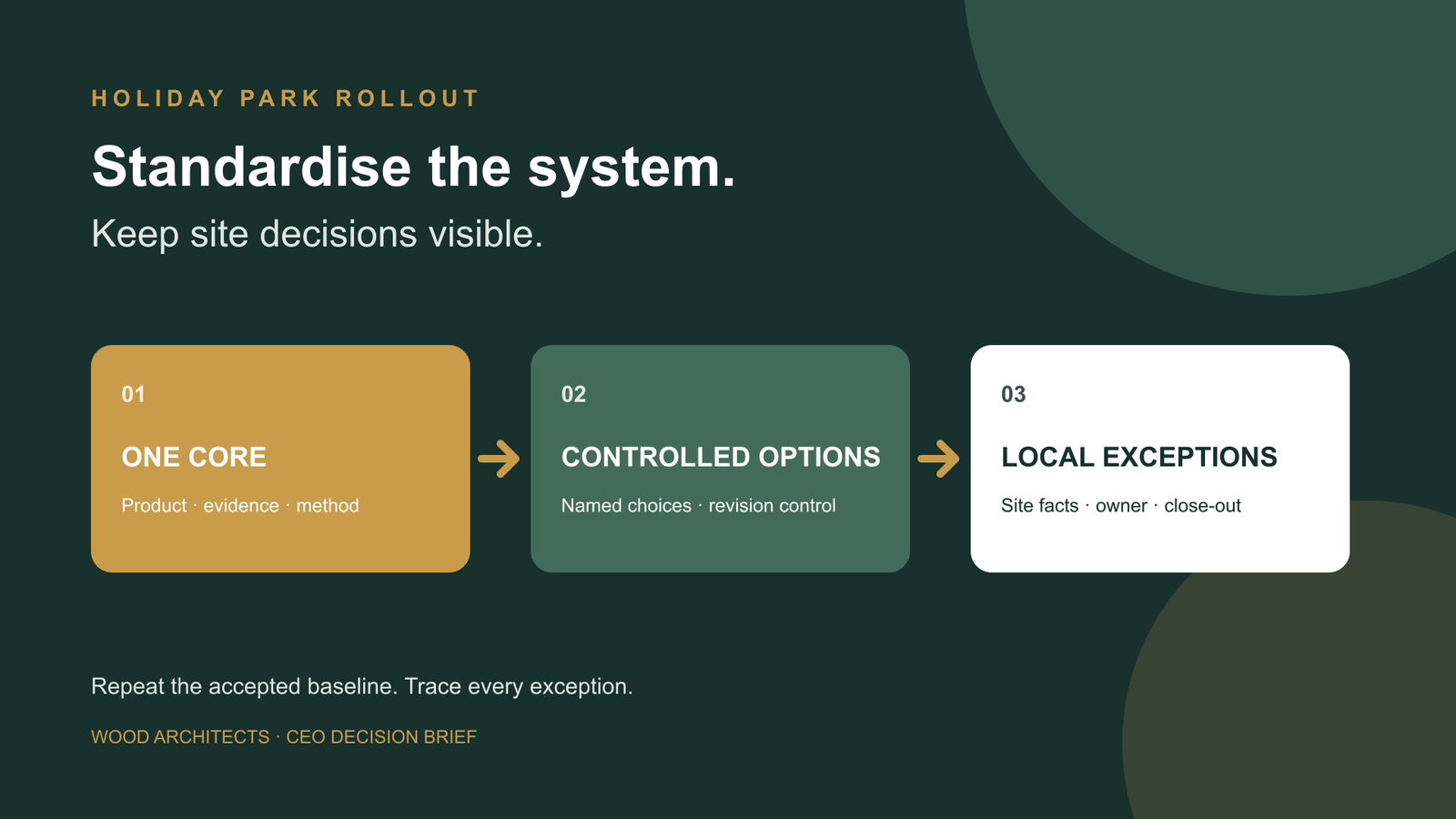
A holiday park does not gain consistency by ordering several cabins that look alike. It gains consistency when each site team receives the same controlled product core, evidence, commissioning sequence and operating method, while local conditions remain visible. As a manufacturer, I would treat the first unit as a repeatable system test and every later unit as a traceable instance, not a copy-and-paste purchase.
At Wood Architects, our repeatable core starts with the cube configuration we manufacture in Lithuania: full-height panoramic glazing, a 128 mm wall build-up, charred thermowood exterior and the selected Harvia or HUUM heater. I keep foundations, site electrics and local approvals as named site exceptions. Those site decisions cannot be hidden inside one universal cabin claim.

A real HUUM heater and timber lining are visible components that a programme can identify in its product core. The image is not evidence of rollout consistency or operating performance.
What belongs in the standard core?
The standard core is the part that should remain the same across the rollout unless formal change control approves otherwise. Define the sauna model and dimensions, internal layout, selected heater and controller, glazing arrangement, door hardware, lighting, ventilation design, finishes, labelling, documents and operator-facing instructions.
Standardisation must be specific enough to detect drift. "Same heater size" is not the same as an exact model and control arrangement. "Black exterior" is not a finish specification. The baseline should use stable drawing and document references with revisions.
Do not freeze a baseline from a sales rendering. Freeze it after the first representative unit has passed delivery, site connection, commissioning, operator handover and a practical cleaning and access review. A rollout multiplies whatever the first standard contains, including its omissions.
Which decisions must stay local?
A repeatable unit still meets a different site each time. Planning permission, ground conditions, foundations, drainage, flood route, electrical supply, data connectivity, lifting access, fire strategy, guest circulation and local approvals can vary. Keep these items in a local-edge schedule rather than forcing them into the product standard.
Each local item needs an owner, required evidence and decision date. For example, the park may own the ground investigation and supply point, while the appointed electrician owns the final connection and testing. The manufacturer should state the product interface it needs, not silently absorb site assumptions.
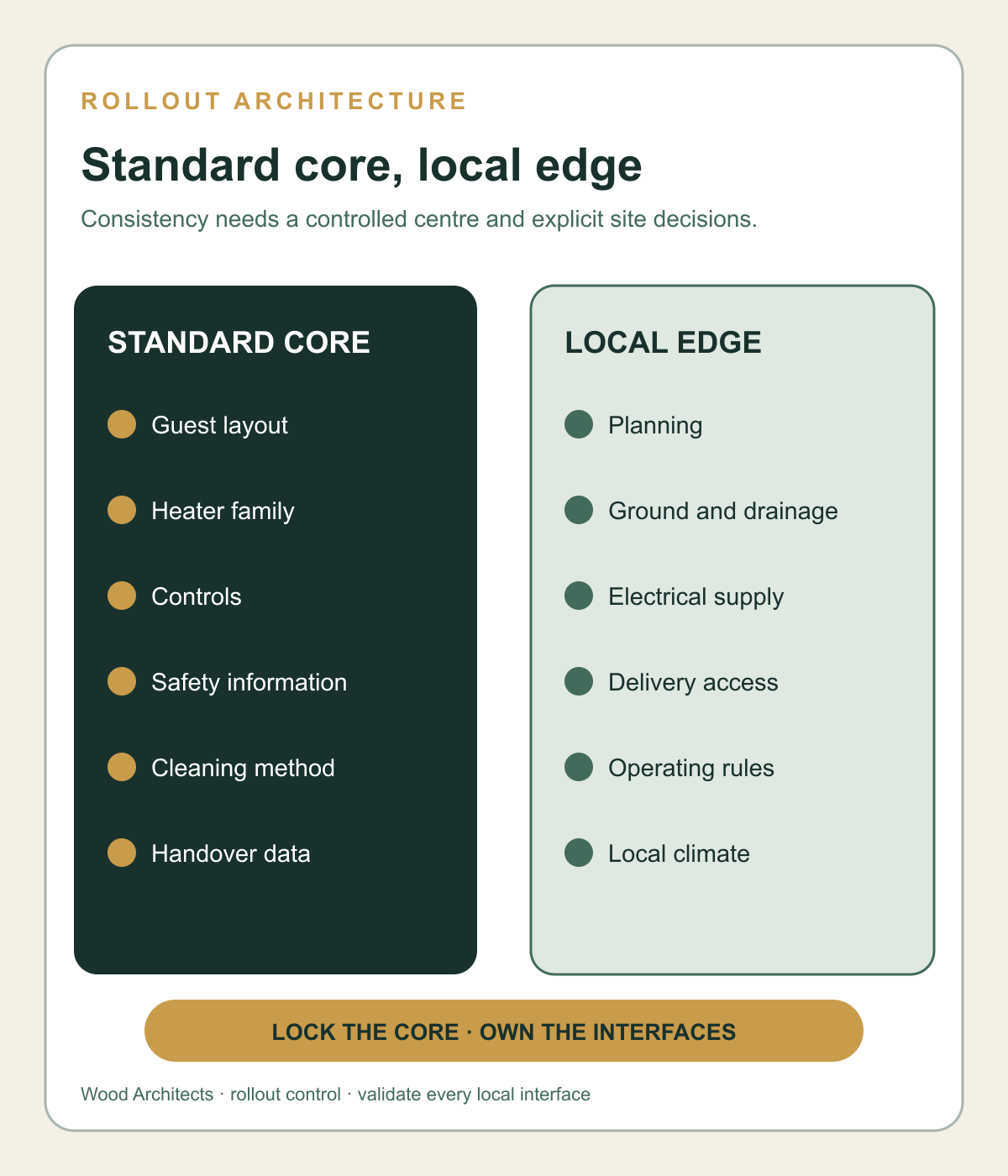
Standardise the centre. Control the edge. Unowned local interfaces are where a repeatable rollout becomes a sequence of exceptions.
A controlled exception is not a defect. It is a difference with a reason, competent review, approved consequence and updated record. The danger is an invisible exception introduced by a site team, installer or substitute product without the rest of the programme knowing.
How should every unit be registered?
Create a repeatable-unit register before the second order. Each row should identify the park location, asset ID, baseline revision, approved options, local exceptions, key product serial numbers, delivery status, commissioning date, responsible people, handover completion and open actions.
The register is not a substitute for the full technical file. It is the index that points to the right file. It should let a manager answer a basic question quickly: which exact configuration is operating at this pitch or lodge, and what changed from the approved standard?
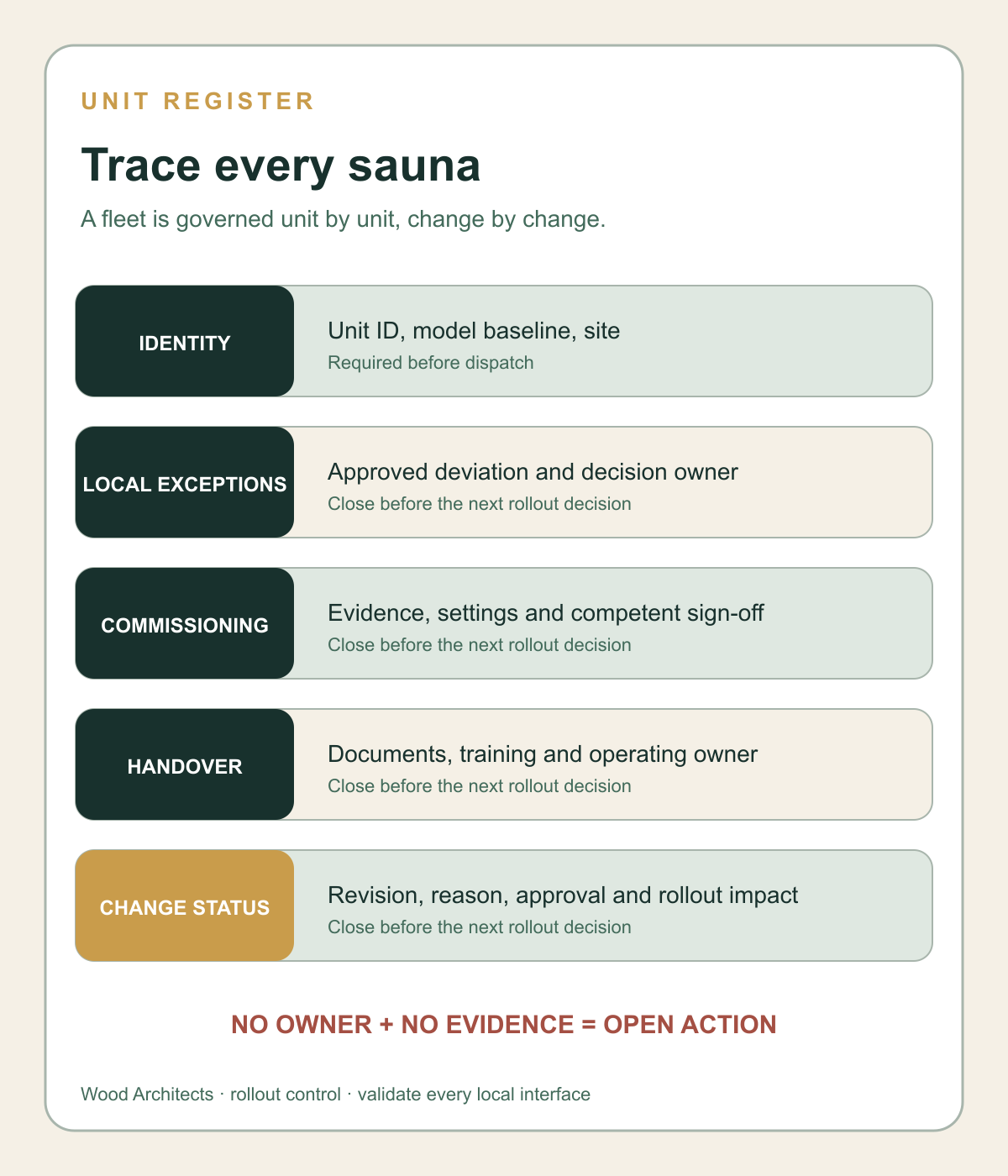
The register makes each sauna traceable without turning the whole rollout into one undifferentiated asset.
What should the first-unit acceptance prove?
Use the first unit to test the sequence, not merely the cabin. Confirm delivery access and lifting assumptions, protection on arrival, connection information, commissioning responsibilities, controller setup, local operation, guest instructions, cleaning access, incident escalation and document transfer.
Include the people who will actually operate the park. A technically complete handover can still fail if reception cannot explain safe use, housekeeping cannot reach required areas, or maintenance cannot identify an isolation point. Record questions and amend the standard pack before release of later units.
Our guide, Should Your Outdoor Sauna Arrive Assembled or Flat-Pack?, explains why delivery method and site access belong in procurement. For a multi-unit programme, that decision must be tested against every location, not copied from the easiest site.
What do tourism statistics tell a holiday park?
They describe the market context, not the business case for one amenity. Eurostat reported nearly 3.1 billion nights in EU tourist accommodation in 2025, up 2.2% from 2024. That says European accommodation activity was substantial. It does not say a sauna will increase bookings or justify a rollout.
Seasonality is operationally relevant. Eurostat's 2025 seasonality summary says July and August represented 31.1% of annual nights and August nights were 3.6 times January's. The implication for a park is to model staffing, maintenance windows and guest processes by its own season. It is not evidence of sauna demand.
Eurostat also reported 951.6 million nights booked through major short-stay platforms in 2025, 11.4% more than in 2024. Again, that is sector data. It cannot establish occupancy uplift, pricing power or return for a particular park.
The European Commission's tourism transition pathway provides wider context on a green and digital transition, resilience, inclusion and stakeholder implementation. Use it to frame governance questions, not to infer sauna returns. Build the investment decision from local guest research, operating costs, capacity, risks and measured pilot results.
How should rollout changes be controlled?
After baseline approval, every proposed change should state the reason, affected units, documents, interfaces, training impact and approval owner. A replacement controller may alter instructions. A different glazing arrangement may alter access and lifting. A revised site layout may change drainage or guest circulation.
Do not let each park location optimise independently. Review changes once at programme level, then decide whether they are a one-site exception or a new baseline revision. Update future orders and operating files accordingly. That discipline is how standardisation becomes learning rather than rigidity.
Frequently Asked Questions
Should every holiday park sauna be identical?
No. The product core and operating method should be consistent, while planning, ground, utilities, delivery access and other site conditions remain controlled local decisions. Record each exception against the baseline, explain why it exists and confirm who approved its technical and operational consequences.
How many units should be included in the pilot?
There is no universal number. Choose a representative location that tests the important interfaces and operating conditions, then define acceptance before ordering the wider programme. If the estate has materially different site types, one unit may not expose every risk. Use evidence, not an arbitrary batch size.
Can Eurostat data justify the sauna investment?
No. Eurostat describes tourism nights, seasonality and platform bookings at aggregate levels. It does not measure demand for a sauna at your park, occupancy uplift, guest willingness to pay or return. Use local research, a defined pilot and measured operating results for the investment case.
Who should own the rollout register?
Assign one programme owner with authority to maintain the baseline, approve changes and require complete site records. Local teams can supply evidence, but fragmented ownership creates conflicting versions. The register should also name the responsible person for each unit's commissioning, handover, open actions and later configuration changes.
What should staff training cover?
Training should match roles. Guest-facing staff need clear use and escalation guidance. Housekeeping needs cleaning boundaries and defect reporting. Maintenance staff need isolation, inspection and support routes within their competence. Managers need records, access control and incident ownership. Use the selected product instructions and verify understanding at handover.
1reading now
Get an email when Giedrius publishes