Part 2 on Breathwork: Safety and Informed Choice

The other day, I wrote about my ponderings on whether and, if so, through what mechanisms breathwork could potentially reduce inflammation (if curious, see here: https://www.pub-lish.com/en/read/fe0e668d-2fd2-4d2f-8733-e347d1563d54).
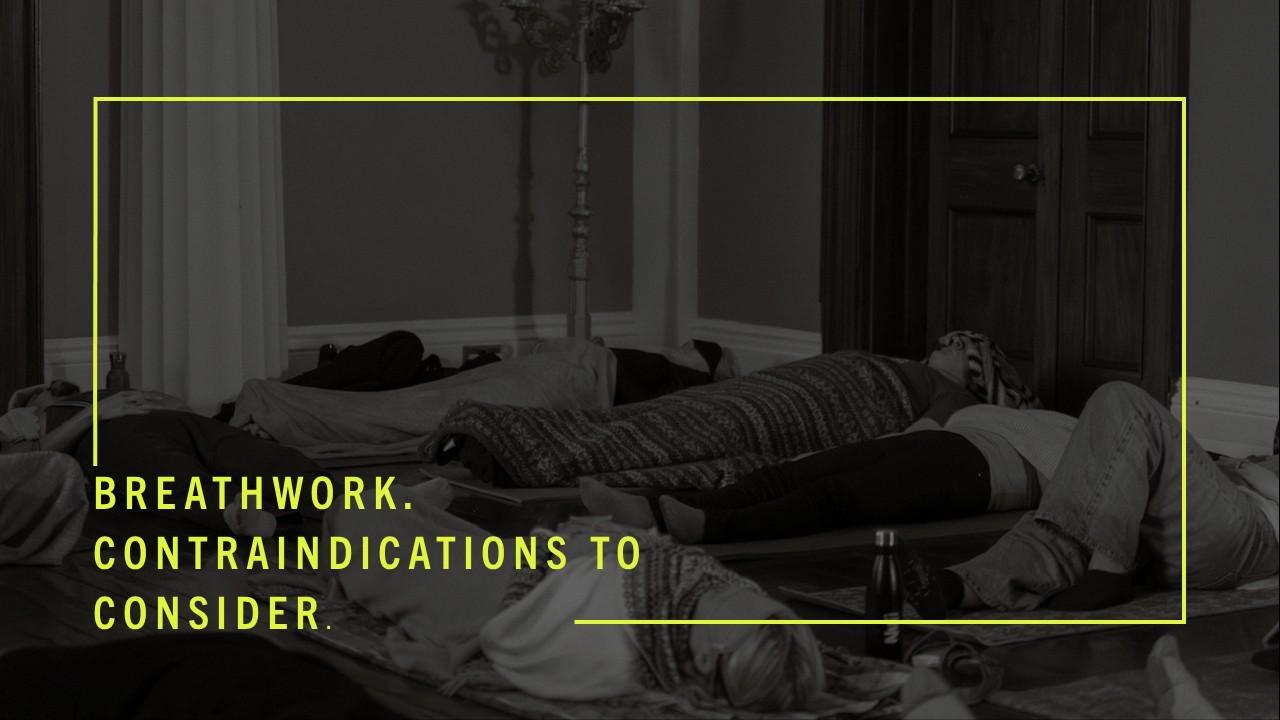
Today, given how saturated the place is with breathwork offers, I feel it is important to raise awareness about contraindications when it comes to high ventilation breathwork. Just today, I deleted an email from one of the facilitation training providers that was titled something like ‘Get paid for getting people high.’ While I have no issue with people choosing to exercise their cognitive liberty and bodily sovereignty by whatever means, I feel that it is somewhat irresponsible and, hence, ethically questionable to make light of what can be an unpredictable experience, especially as a practitioner offering a service.
*
As any somatic practice, breathwork temporarily changes our physiology by affecting our inner chemistry. The prevailing theory is that breathwork, especially the most currently sought-after in the West hyperventilation techniques due to their potential to induce altered states of consciousness (often abbreviated as ‘ASC’ in the literature) is via the mechanism of reduced CO2 saturation in our blood (CO2 helps to keep our blood vessels expanded, therefore, when CO2 saturation drops, the blood vessels become more constricted and blood chemistry temporarily changes) (Havenith, et. al., 2025; Kartar, et. al., 2025).
I won’t bore you much longer with technical explanations; but I wanted to briefly mention this mechanism of action as, from it, more or less directly follow the following contraindications:
• Pregnancy
• High Blood Pressure that is not controlled with medication.
• Cardiovascular disease and/or irregularities including prior heart attack
• Aneurysms – if either you have had an aneurysm or if more than one person in your immediate family (parents, siblings, children) has had one
• History of strokes, seizures or TIAs (Transient Ischemic Attacks, sometimes referred to as ‘mini-strokes’)
• Epilepsy
• Detached Retina
• Glaucoma
The above list is based on the physiological mechanisms of action and the resulting pressure and blood chemistry changes during breathwork. They may not necessarily (but may be) be based on any observed adverse effects for each of the listed conditions, but they are derived by drawing informed inferences by juxtaposing the current evidence of breathwork action and the known condition pathology.
The next list is more consequential and less absolute:
• If you’re taking prescription blood thinning/anti-clotting medications (because high-ventilation potentially ASC-inducing breathwork techniques can induce vigorous movements and the breather may accidentally injure themselves and draw blood)
• Osteoporosis that is serious enough whereby moving around actively could cause physical damage to the body
• Asthma – consult your facilitator in advance and, if you decide it is safe for you to participate, have your inhaler available
• Prior physical injuries that are not fully healed and could be re-injured through intense movement
Mental health conditions as potential contraindications:
• Prior diagnosis by a health professional of bipolar disorder or schizophrenia
• Hospitalisation for any psychiatric condition or serious emotional crisis in past 10 years such, as an attempted suicide, nervous breakdown or psychotic break
• PTSD – not an automatic exclusion criterion, but consult the would-be facilitator prior to participating
• Any other medical, psychiatric or physical conditions which would impair or affect ability to engage in activities involving intense physical and/or emotional release
The above list has been compiled by the NeuroDynamic Breathwork® developers and practitioners.
*
I appreciate that this list may seem daunting and put anyone who hasn’t yet experienced it from ever wanting to engage in it. Having said all that I said, there are millions of people worldwide safely engaging in these practices and gaining great mental and physical health benefits. But I thought it important to write this piece so that curious people become better informed and know what questions to ask if and when their curiosity gets the better of them, so that they can make an informed decision. Also, some of the contraindications may be safely managed with adaptations to the setting, by choosing a one-to-one face-to-face session rather than one delivered online and other measures.
As such, I wish to add a short, unplanned little bit below.
How to gauge if the facilitator you are considering is safe:
• They will provide you with as much information as you will need and answer any questions; THERE ARE NO STUPID QUESTIONS. Dismissive or minimising attitude towards any worries or questions you may have would not make me feel safe or empowered to use my own agency in an informed way.
• No one facilitator will have all the answers, but I would treat it as a tell sign how comfortable they are to admit to that and the effort they are willing to put in to help you find your own safety-related information, be it through coaching you to use your own agency in seeking our information and deciding, referring you to someone more experienced in a particular area of facilitation or suggesting you seek medical advice before engaging in breathwork.
• A ‘know-it-all’ would be a red flag for me. Science is only just starting to ‘catch up’, therefore, a ‘know-it-all’ is not even a possibility. And while the same can be said about more or less anything in life – that there will ALWAYS be a degree of unknown and, therefore, impossible to predict – the would-be facilitator’s ability to openly discuss this fact and help you decide on the best available information should be indicative of their own motivational drivers to offer such service.
• YOU SHOULD NEVER FEEL RUSHED TO SIGN UP or PARTICIPATE. If I felt like that with someone who I may be considering as my potential practice facilitator, FEELING RUSHED at any stage would be an immediate red flag for me.
Training and credentials matter, but ethics and value alignment matter no less.
*
It is very likely that I may have missed something. If and when something comes to my attention, I will continue to spread awareness. But, in the meantime, try to listen to your gut feeling. There’s always a degree of anticipation when we are about to engage in an experience we never experienced before. That’s healthy. But if anything feels uncomfortable in terms of safety – physical, psychological or emotional – continue looking. There’s no rush.
IMPORTANT NOTE: this content is for educational purposes and by no means should be treated as a substitute for personalised professional medical or mental health advise.
*
NOTE. I appreciate that not everyone who is curious will have access to some of the articles in full as they may be behind a paywall, but some are open access while those that don’t, often allow us access to the ‘Abstract’ where the summary of the finding or the ideas can be found.
*
Subscribe using the bell button under the cover picture for the weekly digest sent straight to your inbox.
*
References:
Havenith, M. N., Leidenberger, M., Brasanac, J., Corvacho, M., Carmo Figueiredo, I., Schwarz, L., ... and Jungaberle, A. (2025). Decreased CO2 saturation during circular breathwork supports emergence of altered states of consciousness. Communications Psychology, 3(1), 59.
Kartar, A. A., Horinouchi, T., Örzsik, B., Anderson, B., Hall, L., Bailey, D., ... and Colasanti, A. (2025). Neurobiological substrates of altered states of consciousness induced by high ventilation breathwork accompanied by music. Plos one, 20(8), e0329411.
1reading now
Watch & subscribe
Lina Jan also publishes on YouTube
18 subscribers
One click subscribes you on YouTube - you stay here on PUBlish.
Get an email when Lina publishes