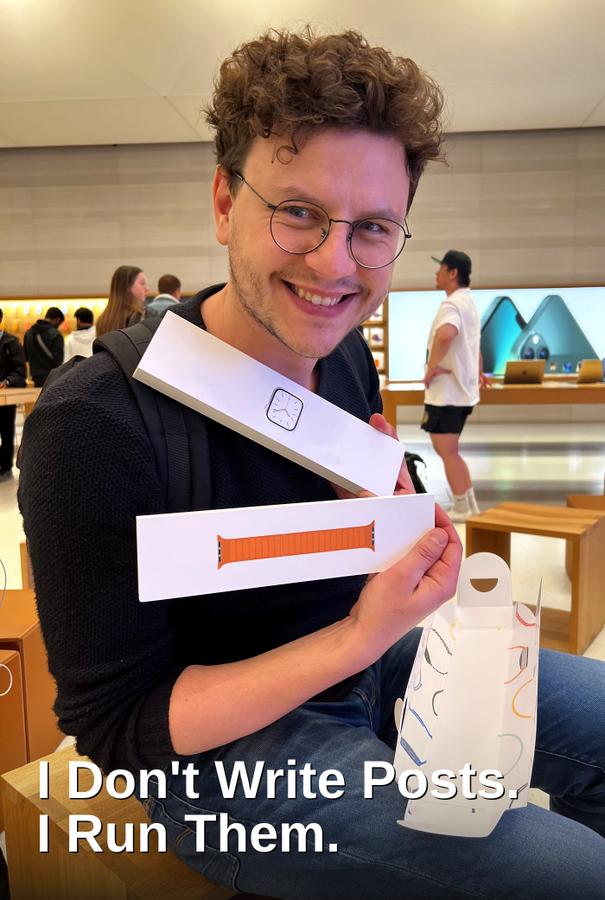
I Don't Write Posts Anymore. I Run Them

Most of my posts don't start at a desk. They start somewhere in the middle of a run, when my head finally stops juggling five things and lands on the one worth keeping.
The problem used to be that by the time I got home and opened my laptop, half the thought was already gone. The sharp version I had halfway through the run turns into a flat, generic version by the time I'm typing it out.
Now I'm on my 3'd km. Running. After 7-day week and trying to organise my thoguhts. Here's what's in my mind:

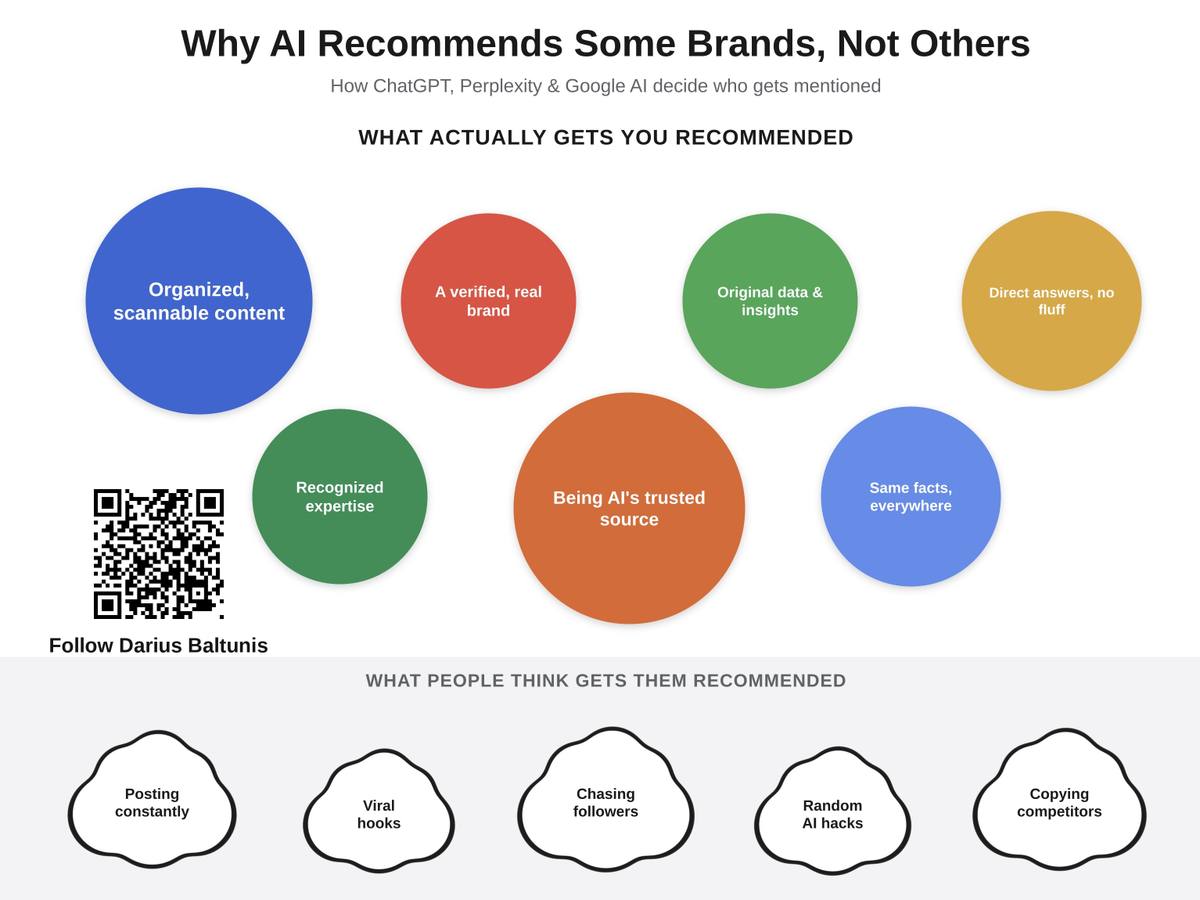
I test this all the time. Ask ChatGPT for a recommendation, ask Perplexity the same thing worded differently, ask Claude the same question again a few days later. Same handful of names come up every time, in almost every category I try. Not the loudest brands. Not the ones spending the most on ads. Just the ones that show up structured, verifiable, and said the same way in enough places that the model stops treating them like a guess and starts treating them like a fact.
It's strange looking back at history. The biggest companies, even entire countries, get replaced by something new eventually. Here's a question I keep coming back to: MrBeast built his whole following in YouTube's early days, when the platform was still empty and nobody had figured it out yet. What's that same move today, now that AI is the big shift? We already know how to post and record videos. The real question is whether that's even the right game anymore. What's the new YouTube - the empty room everyone will wish they'd walked into early?
Daniel Priestley's been teaching a version of this for over a decade - pitch, publish, product, profile, partnership. I've heard it echoed in enough rooms and accelerators by now, Dent included, to know it's not a coincidence. The goal was always the same too. More people know you, more power you have. Only the audience changed, and so did the way you reach them. So how do you actually build that audience now?
YouTube launched about 20 years ago. Back then it was basically empty, just a handful of people figuring out what a camera was even for. Today around 500 hours of video get uploaded every single minute - something like 8 hours of footage landing every second, before you even finish reading this sentence. Podcasts went the same way. A show like DOAC - full studio, camera crew, editors, a data team testing every cut before it airs - runs well into five figures an episode once you count everything. That's just the going rate for that level of production now. We're not competing with the founder down the street anymore. We're competing with iPhone cameras and AI tools that can produce broadcast quality content for almost nothing.
Same game, new platform, every time the platform changes. It used to be a stage. Then a blog. Then YouTube. Then a podcast studio with a full data team. Now it's a model reading everything, all the time, and it never forgets and never gets bored. Every citation compounds instead of resetting when the algorithm moves on to the next trend. Wikipedia figured this out two decades before any of us had a word for it. It's not the best written thing on the internet. It's not the most entertaining. It's just been structured, consistent, and verifiable for 20 years straight - which is exactly why it's the first place every AI model reaches for an answer.
I don't think we'll talk about Google SEO the way we do now, in a couple of years. It'll become the old platform. But old doesn't mean small or weak - those are two different things. Look at Apple. Still one of the biggest companies in the world, but not the one everyone's watching nervously in the AI race anymore. They had every advantage to make a real move in AI, and investors gave them more patience than almost anyone else in the industry to do it. They still haven't shown their hand. Maybe that's discipline. Maybe it's hesitation. Either way, they're still huge. Google SEO will probably end up in a similar spot - still there, still working, just not the thing deciding who wins anymore. The new sentence will simply be - if you're not visible to AI, you're not visible anywhere. That's already happening. Most people just haven't noticed yet.
There's a Warren Buffett rule that keeps sticking in my head - invest in the companies you actually use every day. Look around, and AI already is that company. It's becoming the first place people go for news, for finding a restaurant, for research, for translation, for code, for almost anything they'd normally search for. If we're using it this much already, we're not going to use it less. So if AI becomes the number one place people go for answers within a couple of years, there's only one question left. How do you become the answer?
That's why I'm on PUBlish - a platform for exactly this. A place for entrepreneurs to post and publish in a way that's built for how visibility actually works now, not how it used to work. Most founders I talk to are still optimising for somehitng they never understood. Now when the game rules has changed, I'd rather be early to the new ones, even if it means explaining myself a hundred times before anyone else sees it, and I hope - you too.
Want to join me for a run? 🏃👟
1reading now
Watch & subscribe
Darius Baltunis also publishes on YouTube
187 subscribers
One click subscribes you on YouTube - you stay here on PUBlish.
Get an email when Darius publishes