Wallpaper Online Sales 2025-2026: Top Countries, Best Platforms (Why Shopify Leads), and How to Sell More

The global wallpaper market is worth about $13 billion in 2025. The United States buys the most, the UK has the strongest online wallpaper culture, and Germany is the heart of wallpaper manufacturing in Europe. Shopify is the most popular platform for wallpaper stores in English-speaking markets, while WooCommerce leads globally. The biggest problem in selling wallpaper online is that customers don't know how much to buy. A Shopify app called WallpaperCalc fixes that.
1. How big is the wallpaper market in 2026?
The global wallpaper market is worth about $13.07 billion in 2025. It is expected to grow to $16.64 billion by 2031. That is about 4.2% growth per year.
But the headline number hides the real story. The wider market is growing slowly. The online channel is growing fast. Inside the digital-printed wallpaper segment, online retail is growing at around 20% per year - the fastest of any channel.
About 36% of digitally printed wallpaper is now sold online. The rest still goes through interior designers, contractors, and physical shops. So most of the market is still offline, but online is where the growth is.
Wallpaper has had a comeback. Five years ago, many people thought wallpaper was dying. Today it is one of the strongest categories in home decor, helped by peel-and-stick designs, custom murals, and AR visualization tools.
2. Which countries sell the most wallpaper online?
The wallpaper market is heavily concentrated in a few places.
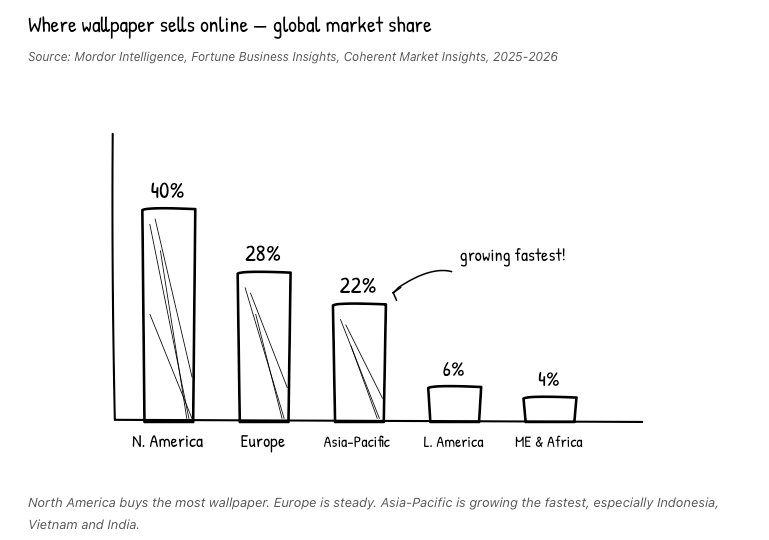
United States: The biggest single market. North America holds about 40% of the global wallpaper market. Most major online wallpaper retailers are American.
United Kingdom: One of the strongest online wallpaper cultures in the world. Heritage brands like William Morris and Sanderson have huge online presence. Many small independent online shops also do well.
Germany: The wallpaper manufacturing capital of Europe. A.S. Création (the largest European wallpaper maker) and Rasch are based here. Strong B2B online sales.
France: Home to luxury wallpaper houses like Pierre Frey. Premium online customers.
Sweden and the Nordics: Punching above their weight in online. Rebel Walls is one of the world's top panoramic wallpaper brands.
Asia-Pacific: The fastest-growing region. Indonesia, Vietnam, and the Philippines added 10 million urban households between 2024 and 2026. India and China are growing fast but mostly in local online stores.
3. Top online wallpaper stores around the world
Here are the main types of online wallpaper sellers and some real examples.
USA — big-volume mass market
Wallpaper Boulevard, Wayfair, Target. These sell wallpaper from many brands and ship across the country.
USA — design-led brands
Chasing Paper, Hygge & West, Tempaper, Serena & Lily, Lulu and Georgia, Anthropologie. These have their own designs and focus on style. Most are on Shopify.
UK — heritage and luxury
Sanderson Design Group (which owns William Morris, Sanderson, and Zoffany) leads the heritage market. F&P Interiors is a strong online seller of designer wallpapers from premier UK houses.
UK — independent online retailers
Wallpaper-uk.com is a good example. Small family business, big online presence, fast delivery. Many of these run on Shopify or WooCommerce.
Europe — manufacturers and luxury
A.S. Création (Germany) is the biggest wallpaper manufacturer in Europe. Pierre Frey (France) is the luxury leader. Rebel Walls (Sweden) dominates panoramic murals globally.
Niche and custom
Livettes (peel-and-stick), Decoyard (custom murals), and a growing number of AI-powered custom design platforms. Custom wallpaper is one of the fastest-growing parts of the market.
4. What platforms do wallpaper stores use?
Most online wallpaper stores run on one of four platforms.
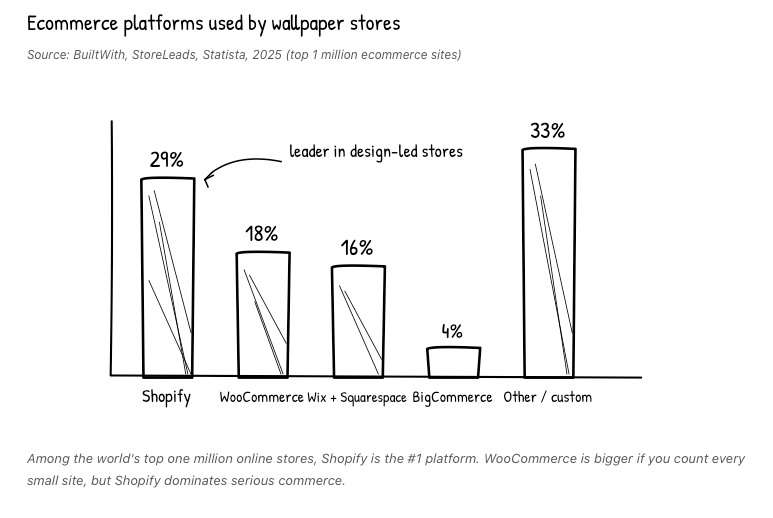
Shopify — the dominant choice in the US, UK, Canada, Australia. About 30% of US ecommerce sites use Shopify. Most design-led wallpaper brands run on it.
WooCommerce — a free plugin that runs on top of WordPress. The most popular platform globally with about 35% of all online stores. Very common in mainland Europe and Asia.
BigCommerce — smaller share, used by some mid-market wallpaper retailers, especially those who also sell B2B to interior designers.
Custom or Magento (Adobe Commerce) — used by large brands with their own development teams (Sanderson Design Group is on Magento, for example).
5. Why Shopify wins for wallpaper retailers
If you sell wallpaper online and you are not yet at enterprise scale, Shopify is usually the right choice. Here is why.
Easy to set up. A small wallpaper brand can go from no website to selling in a weekend.
Strong app store. Shopify has thousands of apps for things wallpaper stores actually need: calculators, AR visualizers, sample request forms, multi-currency, automated emails.
Wallpaper is visual — and Shopify loves visuals. Shopify's own data shows that products with 3D or AR content get 94% higher conversion rates than products without. For a wallpaper store, that is a huge advantage.
Big in the right markets. Shopify has 30% market share in the US and 23% in the UK — the two biggest online wallpaper markets in the world.
Built-in payments. Shopify Payments handles credit cards, Apple Pay, Google Pay, Klarna, Afterpay. Important for high-ticket wallpaper sales.
Easy to grow internationally. Multi-currency, multi-language and multi-region inventory all work out of the box.
WooCommerce can be cheaper if you already run a WordPress site. But the trade-off is more setup work, more security responsibility, and slower performance unless you invest in good hosting. For most wallpaper brands, the Shopify monthly fee pays for itself in time saved.
6. The biggest problem in selling wallpaper online
If you talk to any wallpaper retailer, one problem keeps coming up: customers do not know how much wallpaper they need.
It sounds small. It is not.
When a customer orders too little, they have to reorder. The new rolls might come from a different batch with slightly different colour. They are angry. They blame the shop. Some return everything.
When a customer orders too much, they feel ripped off. They demand a refund on the extra rolls. Sometimes they leave a bad review even though the shop did nothing wrong.
This single problem causes the majority of customer service emails and returns in online wallpaper stores. It also lowers conversion, because some shoppers leave the site rather than risk getting the maths wrong.
The fix is simple. Add a wallpaper calculator to your product pages. Let the customer enter their wall height and width. Show them exactly how many rolls or panels they need before they add to cart.
7. WallpaperCalc — a Shopify app that fixes it
If your wallpaper store runs on Shopify, there is a free app built exactly for this problem.
WallpaperCalc for Shopify
A simple calculator that customers use directly on your product pages. They enter their wall dimensions. The app instantly tells them how many rolls or panels they need.
Free to install.
Works with rolls or panel-based products.
Supports centimetres and inches.
Reduces returns from quantity mistakes.
Increases conversion by removing the maths problem.
Works inside the Shopify Admin you already use.
Install WallpaperCalc on Shopify →
Available on the Shopify App Store. Built for wallpaper, wall panel, and wall covering merchants.
Even if you do not install WallpaperCalc, the takeaway is the same: add a calculator to every wallpaper product page. It is the highest-leverage change you can make.
8. Other things worth knowing for wallpaper stores
A few more useful trends and tips from the latest research.
AR visualization works — and it works hard
Shopify's data: products with 3D or AR content get 94% higher conversion rates. Returns drop by up to 40%. For wallpaper, this is huge because customers cannot picture the result.
Peel-and-stick is the fastest-growing category
Removable wallpaper is exploding. It appeals to renters, design-curious customers, and anyone afraid of commitment. If you do not sell at least some peel-and-stick options, you are missing a big slice of new buyers.
Custom and personalised designs are growing
About 62% of users now prefer customised designs over off-the-shelf. AI-powered custom design tools are appearing fast. Panoramic murals (one big design covering the whole wall) are a fast-growing premium category.
Sustainability matters more than you think
55% of customers say they want eco-friendly wallpaper materials. PVC-free, water-based inks, recycled paper substrates — these are no longer nice-to-haves for a premium brand.
Samples are still critical
Wallpaper is one of the few categories where physical samples remain essential. Offer them. Even free samples often pay for themselves in higher conversion. Make ordering a sample as easy as one click.
Reviews with photos beat any marketing copy
Real customer photos of installed wallpaper convert better than any product shot. Ask for them. Offer a small discount for the next order in exchange.
TikTok and Instagram drive trends
Wallpaper is one of the most "TikTokable" home categories. A single viral video can drive months of sales on one pattern. Watch what is trending visually, not just by keyword.
9. Frequently asked questions
How big is the global wallpaper market in 2026?
About $13.07 billion in 2025, growing to $16.64 billion by 2031. The online channel is the fastest-growing part of the market.
Which country buys the most wallpaper online?
The United States is the biggest single market, with about 40% of the global wallpaper market. The UK has the strongest online wallpaper culture per capita. Germany is the manufacturing centre of Europe.
What is the best platform to sell wallpaper online?
For most small and medium wallpaper retailers, Shopify is the best choice. It leads in English-speaking markets, has the best apps for wallpaper-specific needs, and handles high-AOV sales well.
Is Shopify the most popular platform for wallpaper stores?
In the US and UK, yes. Shopify has 30% market share in the US and 23% in the UK. WooCommerce is more popular globally but is more common for general WordPress sites than for design-led brands.
What is the biggest problem when selling wallpaper online?
Customers do not know how much wallpaper they need. They guess and either order too little or too much. A wallpaper calculator app like WallpaperCalc fixes this.
What is WallpaperCalc?
WallpaperCalc is a free Shopify app that lets customers enter their wall dimensions and instantly see how many rolls or panels they need. It supports cm and inches and works with both roll-based and panel-based products. Install it here.
Does AR visualization help sell more wallpaper online?
Yes. Shopify's data shows 94% higher conversion for products with 3D or AR content, and returns drop by up to 40%. For visual products like wallpaper, it is one of the highest-impact features a store can add.
1reading now
Get an email when WallpaperCalc publishes