Should You Convert Your Garden Shed or Buy a Purpose-Built Sauna?
Convert your garden shed only if the structure is sound, dry and large enough, and you are ready to rebuild the inside as a real sauna: insulation, a sealed foil vapour barrier, a ventilated air gap behind the cladding, solid fixings for the heater and benches, and a new electrical supply. If the shed would need a new floor, roof or walls to get there, a purpose-built outdoor sauna is usually the cheaper and safer route.
It looks like a cost decision, but it is really a moisture decision. A garden shed is built to keep rain out, not to manage hot, humid air trying to escape through its walls.
What a shed has to become to work as a sauna
A sauna is a building envelope that holds heat and vapour inside and lets the structure dry after each session. The heater maker HUUM sets out the key layers in its guide on how to build a moisture-resistant and durable sauna room: foil-faced insulation boards, typically 30 to 50 mm, every joint sealed with foil tape into a continuous vapour-tight layer, and a ventilated gap of at least 20 mm between the foil and the timber lining.
The same guide warns that the weak points are junctions, cable entries and vent openings, and that a small gap can let moisture condense inside the wall for years before anyone sees it. In a shed conversion almost every junction is improvised.
So a conversion means stripping the inside to the frame and adding insulation, a sealed foil layer, battens for the air gap and a sauna-grade timber lining, finished with sauna wax or nothing, not ordinary paint or varnish.
Five checks before you convert your shed
If two or more fail, the conversion is turning into a new build.
Structure. The frame, floor and roof must be dry, level and free of rot.
Size. Each wall loses several centimetres to insulation, foil, battens and lining. Check you still have room for a usable bench, the heater's safety distances and headroom above the top bench.
Fixings. Heavy items such as a wall-mounted heater and bench supports must not hang on the insulation or the lining alone. They need blocking or reinforcement planned into the frame.
Electrics. An electric sauna heater normally needs its own circuit, and larger heaters often need a three-phase supply. A garden shed rarely has either, so budget for a qualified electrician to run a new cable from your consumer unit.
Floor and water. The floor gets wet every session, so it must drain and dry, with the wall layers joined to it so moisture cannot creep under the lining.
When a purpose-built sauna makes more sense
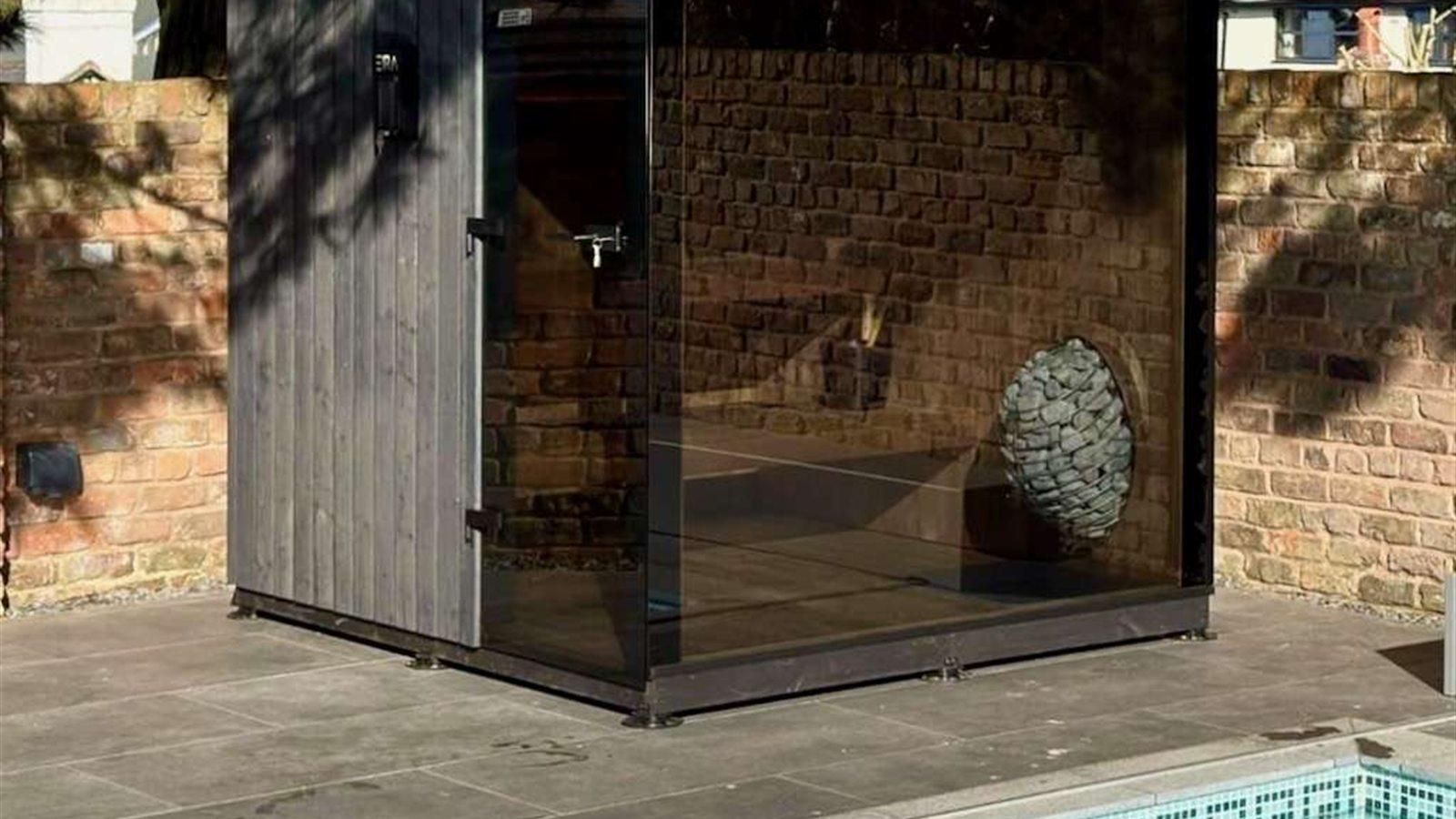
A purpose-built outdoor sauna arrives with these problems solved in the design rather than on site. As an example of what that looks like, the Wood Architects cube sauna has 128 mm walls with 40 mm foil-faced PIR sauna insulation, an interior lined in A-grade thermo-treated aspen, an EPDM rubber roof membrane, and an 8 mm tempered glass front. It leaves the factory in Lithuania fully assembled, so the vapour layers and junctions are built and checked indoors rather than improvised in a garden. Barrel saunas from the same maker use Nordic spruce or thermowood and are typically shipped assembled.
You still need a level base, a power supply sized to the heater and delivery access, but those are groundwork and wiring jobs, not a rebuild.
Compare the real conversion bill, lining timber, insulation, foil and tape, heater and controls, ventilation, electrical work and your own time, against the purchase price. Giedrius Patlaba's piece Are Cheap Outdoor Saunas Worth It for Your Customers? explains where low-cost builds usually cut corners, and the same weak spots, timber, wall build-up and winter details, apply to a home conversion.
A simple way to decide
Convert if the shed is sound, the internal space still works after insulating, and you are confident in sealing a vapour barrier properly or will pay someone who is. Buy purpose-built if the shed needs structural work, if the inside would be too cramped once lined, or if you want a sauna you can use in winter without worrying about what is happening inside the walls.
Related questions
Can you put a sauna heater in an uninsulated shed? Not usefully: most heat escapes and steam condenses in the bare structure.
Do you need planning permission to convert a shed into a sauna? It depends on your country and the building's size and position, so check local outbuilding rules first.
Is a converted shed safe to use with a wood-burning stove? Only with a chimney fitted to the stove maker's clearances and checked by someone qualified.
Sources
HUUM, How to build a moisture-resistant and durable sauna room. Wood Architects, cube sauna specifications and barrel sauna range.
1reading now
Written by
 Pijus KazlauskasCo-owner of Wood Architects, Lithuanian premium sauna manufacturer35 pieces · 13 followers
Follow Pijus to see new posts in your feed, on your phone or by email.
- views