What should a custom t-shirt builder with logo upload do on a Shopify product page?

When Deloitte surveyed 1,560 adults in Great Britain in 2015, 36% said they were interested in buying personalised products or services, and one in five of those were willing to pay a 20% premium. That premium only reaches your till if the customer can see their own logo on the shirt and trust the price before they pay.
What should a custom t-shirt builder with logo upload do on a Shopify product page?
It should let the customer upload a logo, see it on a picture of the shirt straight away, drag it into place and add a line of text. It should let them pick the colour and where it is printed, front only or front and back, and show the price change with every choice. For clubs and companies it should take every size in one go. Then it should put the logo file and every choice on the Shopify order, fit your theme, and work as well on a phone as on a computer.
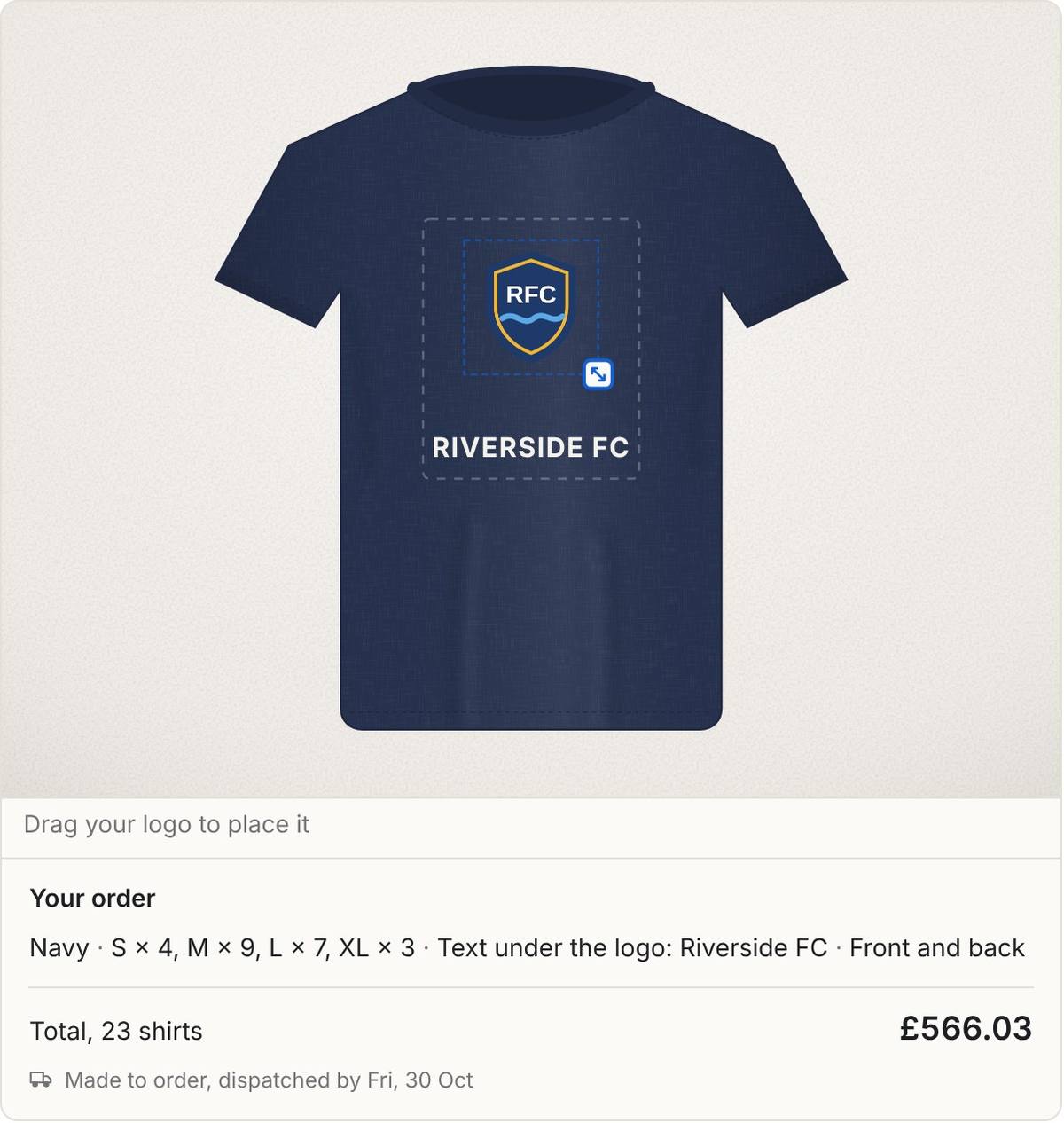
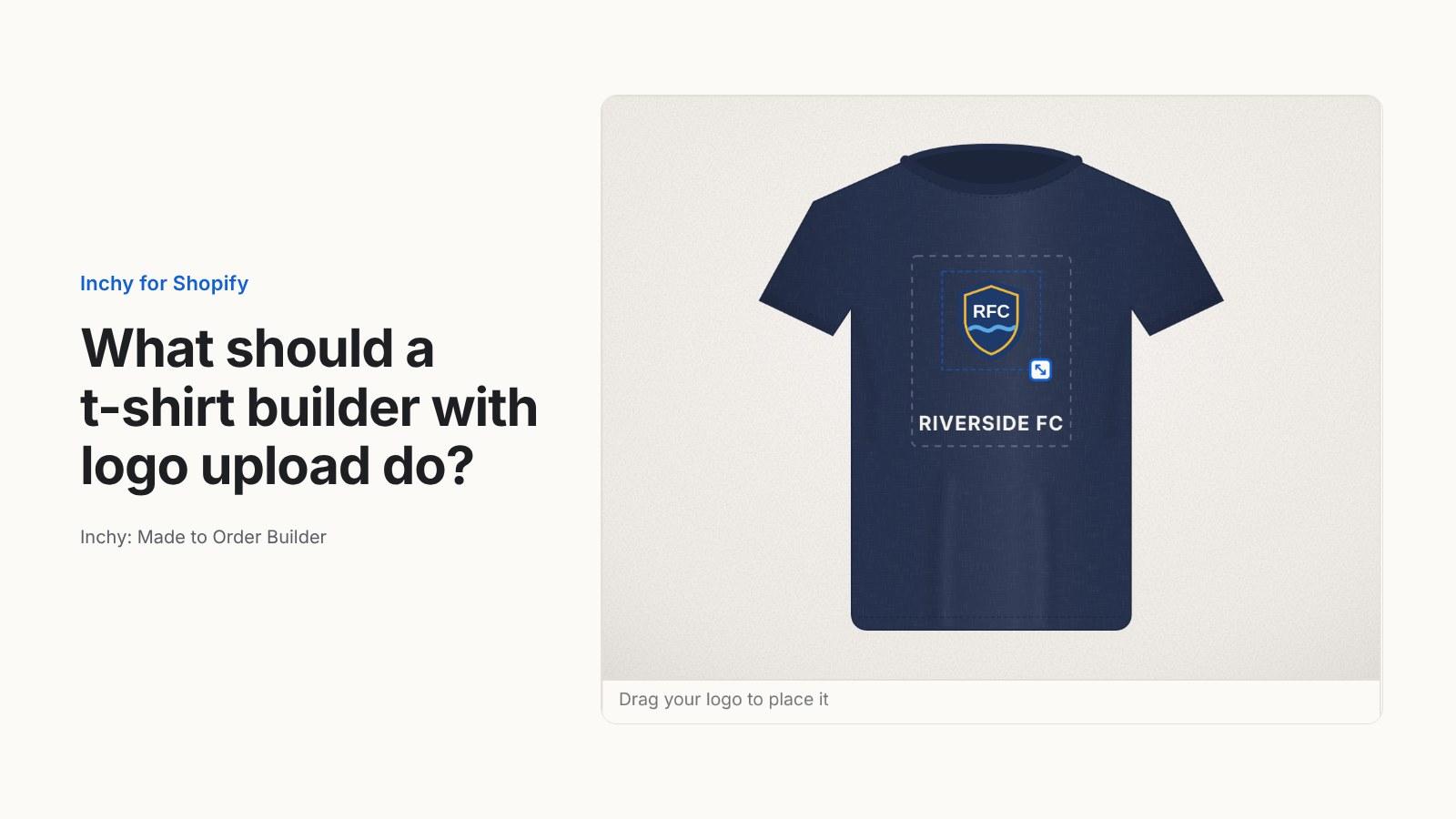
The demo shirt with a club crest uploaded and dragged into place. The summary under the picture updates with every choice.
What should happen when the customer uploads a logo?
The logo should appear on the shirt the moment it is uploaded, inside a marked print area, with a handle to move it. The customer should not have to guess how it will look. The demo takes PNG, JPG, WebP or PDF files up to 5 MB, shows the file name once it is in, and has a Remove link for the wrong file.
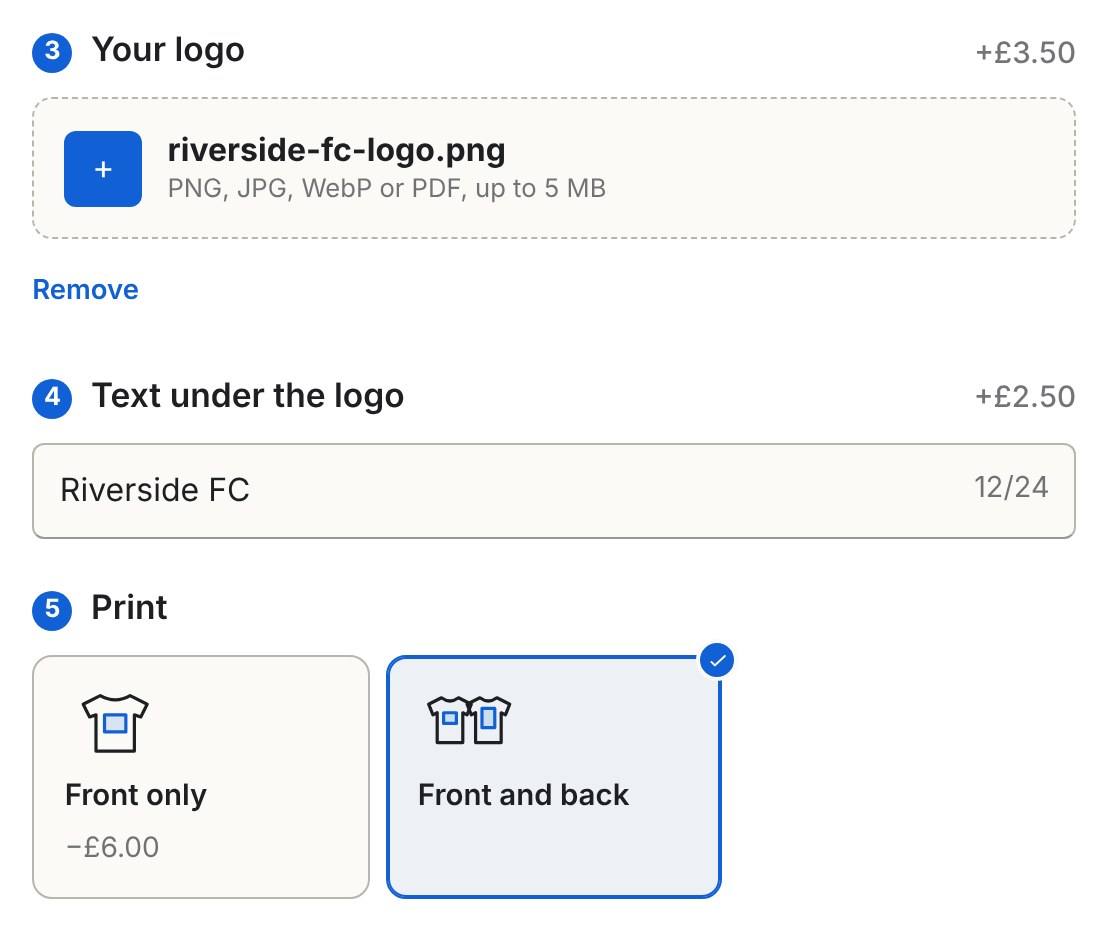
The text field should count characters, so nobody types a name that will not fit; the demo allows 24. The print choice should be a picture, not a word: front only or front and back, with the price difference on the card.
How should the logo, the text and the print be priced?
A simple way to price a printed shirt is a base price plus extras, and the builder should show them in plain numbers. In the demo the shirt starts at £16.95, the logo adds £3.50, the text adds £2.50 and printing on the back adds £6.00, so one shirt with everything is £28.95. Colour costs nothing extra. A breakdown under the total lists each part, and the Add to cart button carries the total.
With Inchy you set this as one price per item with extras for the logo, the text and the print. Quantity prices then work on top, which is how a team order gets cheaper per shirt. That is covered in how to take a team t-shirt order in every size in one go.
Why does the order have to be right first time?
In the UK, the 14-day right to cancel an online order does not apply to goods made to the customer's specifications or clearly personalised. A shirt with a club crest on it is personalised. That spares you change-of-mind returns, but if what you print is not what the customer asked for, it is still your problem.
So the builder has to capture everything the printer needs: the colour, each size and how many, the logo file, where the logo sits and how wide, the exact text and the print side. Inchy puts all of it on the Shopify order and on the production sheet, for example "Logo placement: centre, upper chest, 9 cm wide". The sheet is shown in how to print a production sheet for made to order orders.
Will the builder match my theme?
Inchy is a theme app block for Online Store 2.0 themes, which is every current Shopify theme. It takes your theme's fonts and text colour, and nothing is changed in your theme files. Shopify's own guidance says app blocks can be added, removed, reordered and configured by the merchant in the theme editor, and that an app built this way is removed from the theme automatically when it is uninstalled, with no clean-up needed.
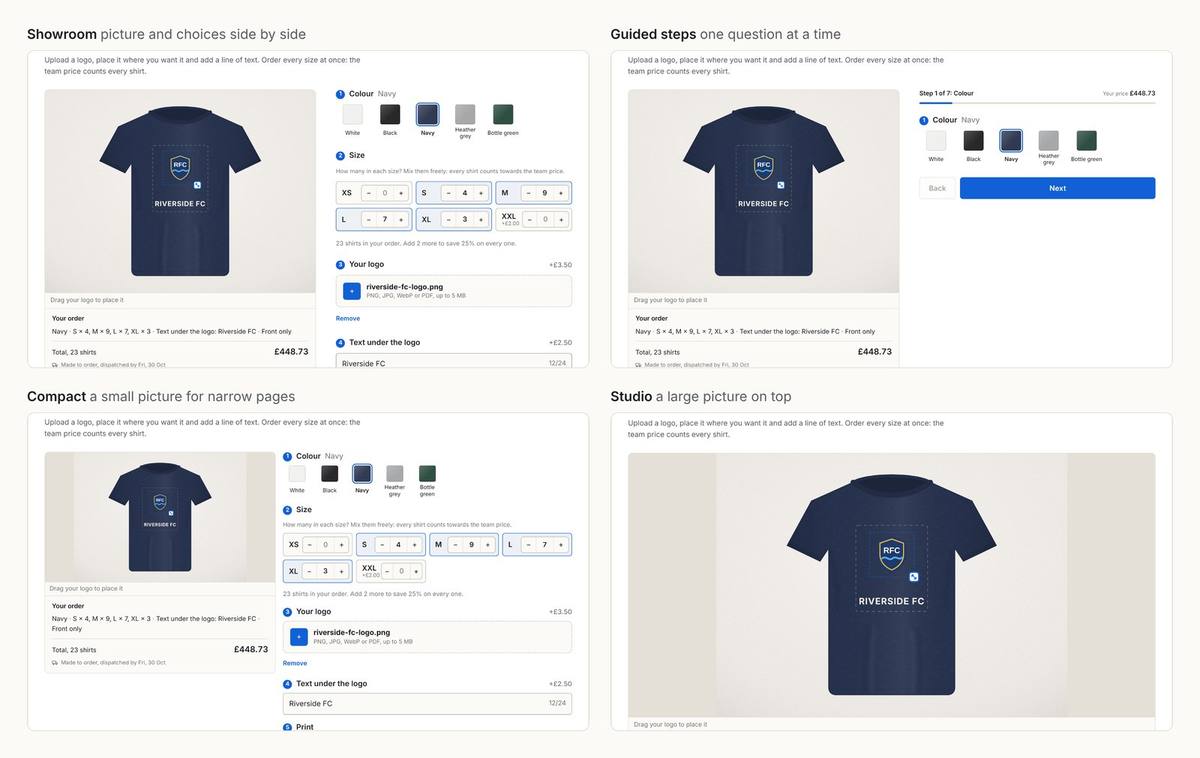
There are four looks, Showroom, Guided steps, Compact and Studio, and four styles, Clean, Warm, Luxe and Bold. Showroom and Compact in your own colours come with the Team wear plan, and every look and style comes with the Made to measure plan. You can switch between them on the live demo.
How should the builder work on a phone?
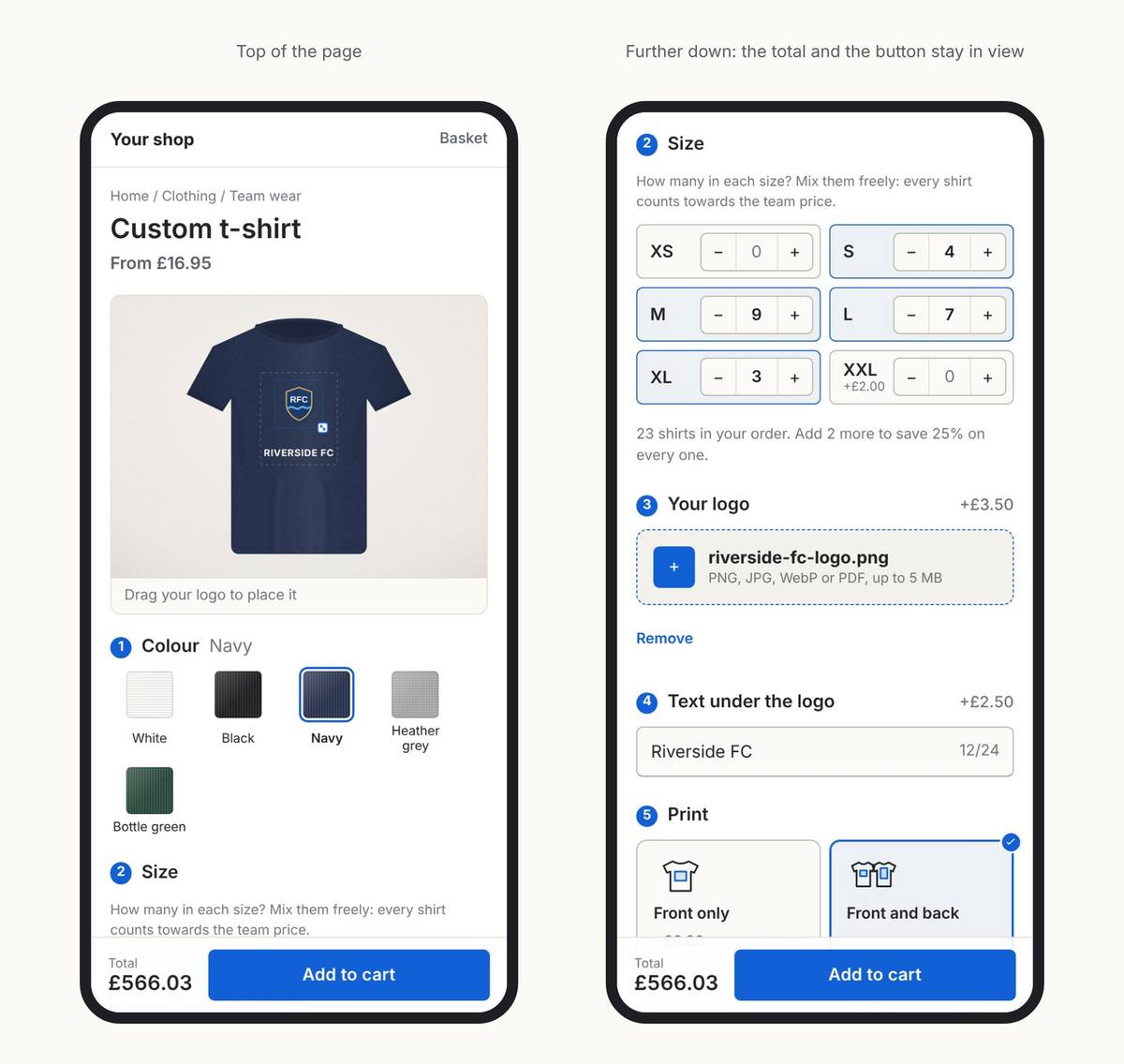
The picture comes first and the choices follow one under the other, with buttons sized for fingers rather than a mouse. As the customer scrolls through sizes, logo and text, the total and the Add to cart button stay at the bottom of the screen, so the price is always in view.
Questions and answers
What logo files can customers upload?
In the demo, PNG, JPG, WebP or PDF files up to 5 MB.
Can the customer move the logo?
Yes. They drag it into place on the picture of the shirt, and the placement goes on the order.
Does the logo file reach the order?
Yes. It is on the Shopify order and on the production sheet, with a link to open the file.
Can I sell a tote bag or gift wrap with the shirt?
Yes. Add-ons sit in the product form. With Bundle kits, part of the Made to measure plan, you can sell them as a set for less: the demo sells a matching tote and gift wrap together for 20% less.
Will the price on the page be the price at checkout?
Yes. The checkout works the price out again from your rules, on every Shopify plan.
What does it cost?
$19.99 a month on the Team wear plan, with unlimited products, billed by Shopify with no fee per order.
Put your own shirt, colours and prices into the builder and try it on your own product page. See Inchy and try the live builder. Start the 7-day free trial on the Shopify App Store.
Sources
Deloitte, Made-to-order: the rise of mass personalisation: survey of 1,560 GB adults, 2015; 36% interested in personalised products; one in five of those willing to pay a 20% premium.
The Consumer Contracts (Information, Cancellation and Additional Charges) Regulations 2013, Part 3: regulation 28(1)(b) and the 14-day cancellation period in regulation 30.
Shopify Partners, Theme app extensions: app blocks added, removed, reordered and configured in the theme editor, and removed automatically on uninstall.
Inchy live demo: sample UK prices, file types and character limit, read on 21 October 2026.
Written with AI. Every figure is checked against the sources listed above.
1reading now
- views
Get an email when Inchy: publishes