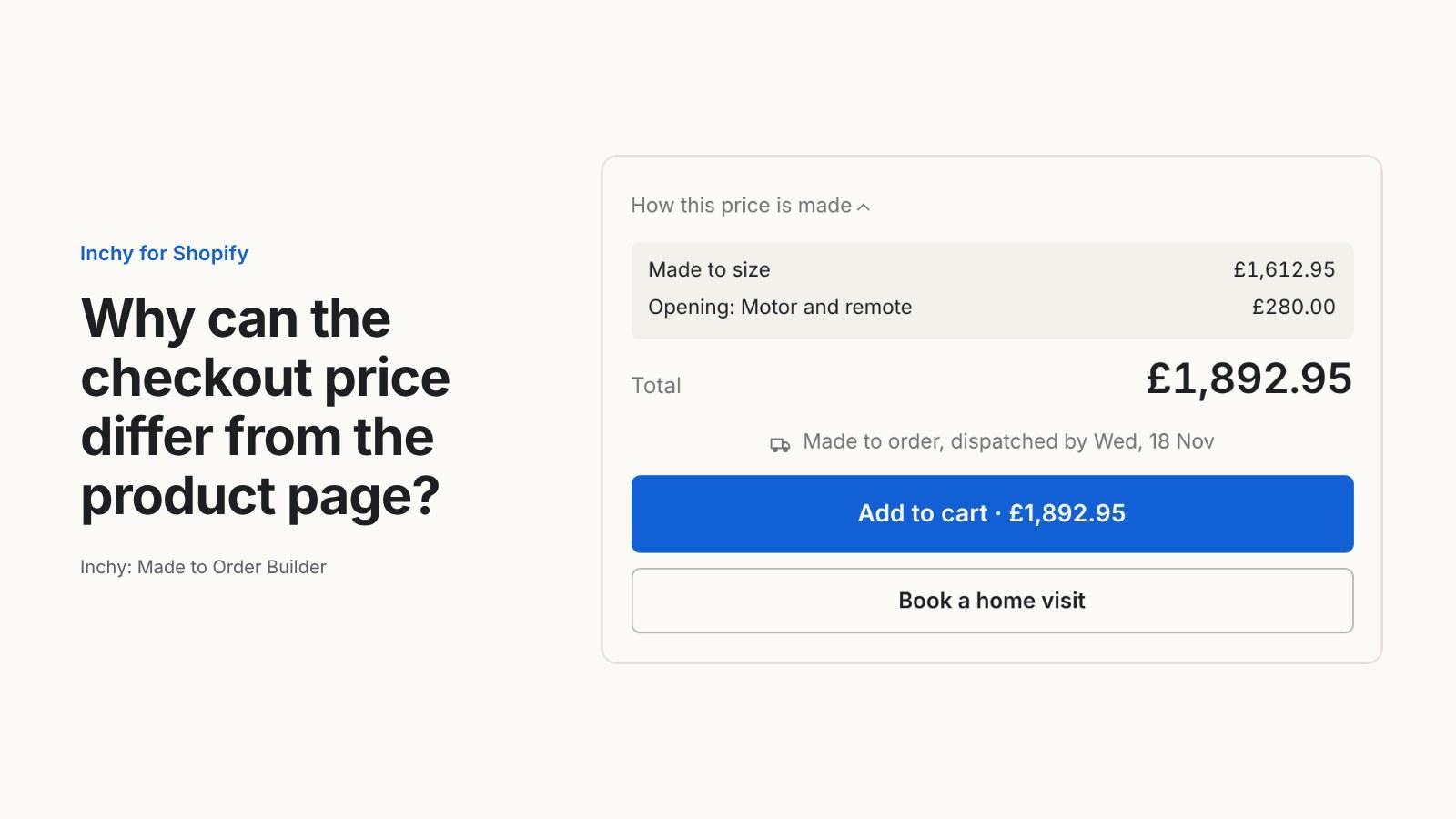
Why can the checkout price differ from the product page on Shopify, and how do made to order shops stop it?

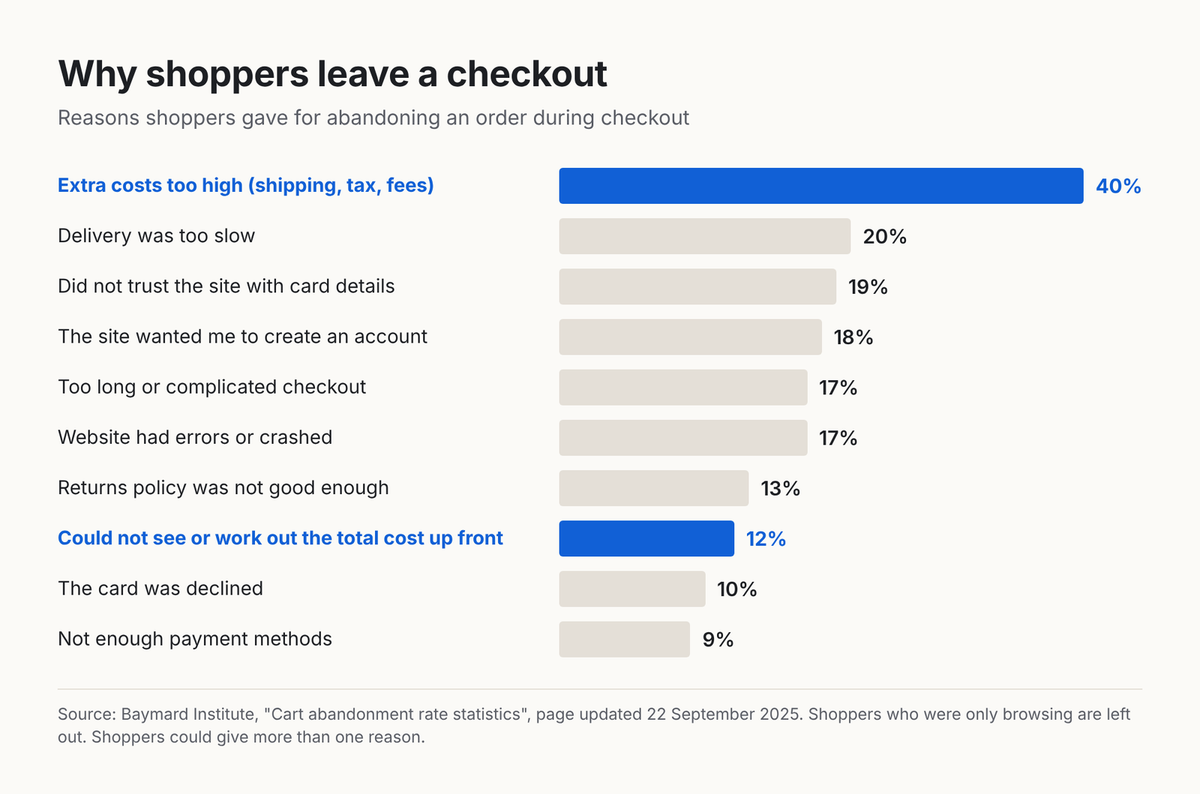
Baymard Institute puts the average documented online cart abandonment rate at 70.22%, and the top reason shoppers give for leaving a checkout is extra costs that are too high, at 40%. For a made to order shop, the worst version of that is a checkout total that does not match the price the product page has just shown.
Why can the checkout price differ from the product page on Shopify, and how do made to order shops stop it?
On Shopify, the product page and the checkout can be priced by different things. A script in the theme can show a price for the chosen size, but the checkout charges what is on the basket lines: each variant's own price and any add-on products, less any discounts that apply. If those do not add up to the figure on the page, the customer sees a different total. Made to order shops stop it by pricing from one set of rules in both places, with the checkout working the price out again so it cannot be changed in the browser.
What makes the two prices drift apart?
The price lives only on the page. A calculator shows £1,892.95, but the basket line carries the variant's own price, because a note on a basket line, such as a size or a name, does not change what Shopify charges.
Add-ons sold as separate products. The motor or the logo goes in as its own line, and the customer can remove it in the basket, or the total splits in a way the page never showed.
Quantity prices that count the wrong thing. A team price has to count every shirt across every size. If it counts one line at a time, the page and the basket disagree. There is more on this in how to take a team t-shirt order in every size.
Prices sent from the browser. If the page tells the checkout what to charge, someone can change that figure on the way.
Currency rounding. If you sell in more than one currency, Shopify can round converted prices for each market, and those rounding rules cannot be customised. A calculation in the theme has to land on the same converted figure, or the two drift.
Why does it matter more for made to order shops?
A shop selling stock has one price per variant, set once. A made to order shop has a different price on nearly every order: an awning at 420 × 300 cm with a motor, a team order of 23 shirts at the 12 or more price. Each of those is worked out on the product page, and each has to arrive at the checkout as the same number.
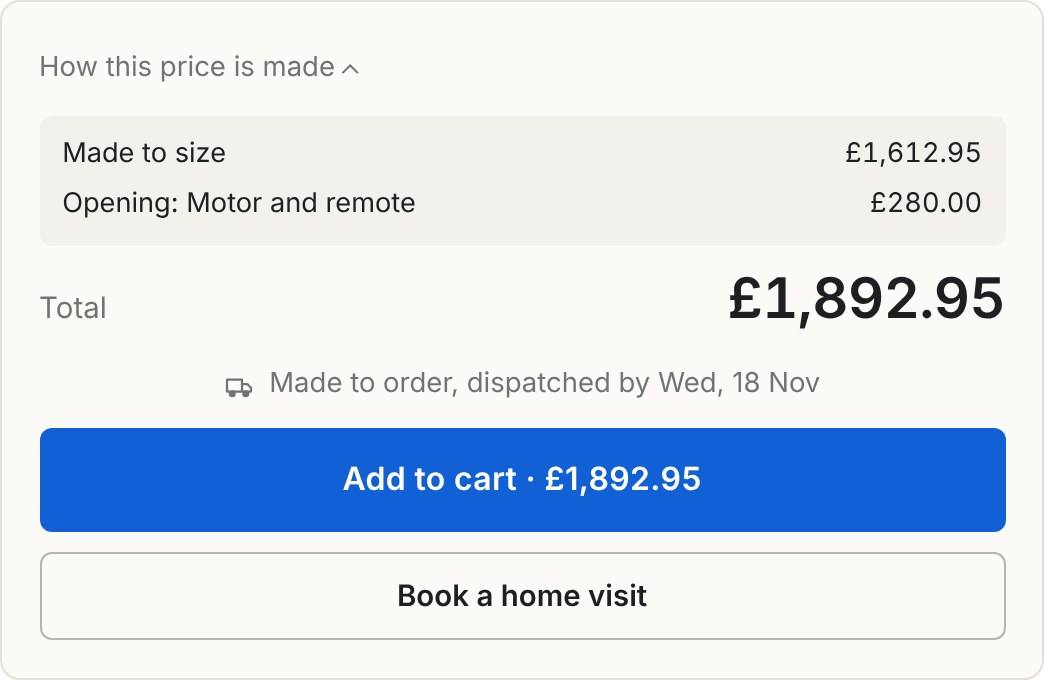
The customer also needs to see the total before the checkout. In Baymard Institute's research, 12% of shoppers who left a checkout said they could not see or work out the total cost up front. A breakdown of how the price is made, with the total on the basket button, answers that on the product page.
Can an app change the line price at checkout?
Shopify has a Cart Transform function that can override the price, title or image of a line in the basket. Shopify's developer documentation also says that only development stores and stores on a Shopify Plus plan can use apps with its update operations. A method built on that will not work for a shop on any other plan.
Inchy works the price out again at checkout from your own rules and works on every Shopify plan, so a shop on a smaller plan gets the same protection as a large one.
How does Inchy keep the product page and the checkout the same?
The page and the checkout use the same price rules: your grid, your extras, your quantity tiers and your sets.
At checkout the price is worked out again from those rules, so it cannot be changed in the browser.
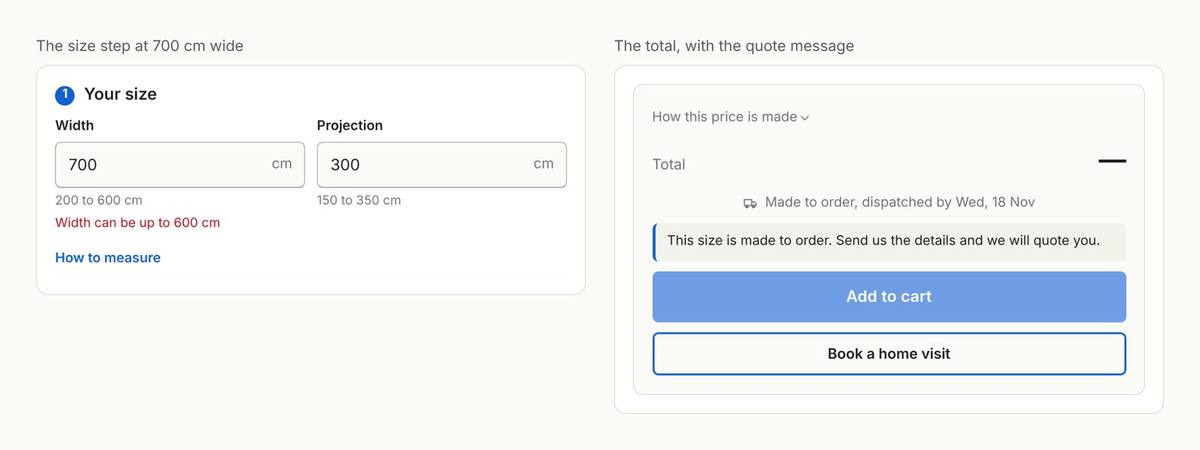
A size outside your limits, or a product added without a size, is stopped before payment.
Team savings and set savings are taken again at checkout, so the basket matches the page.
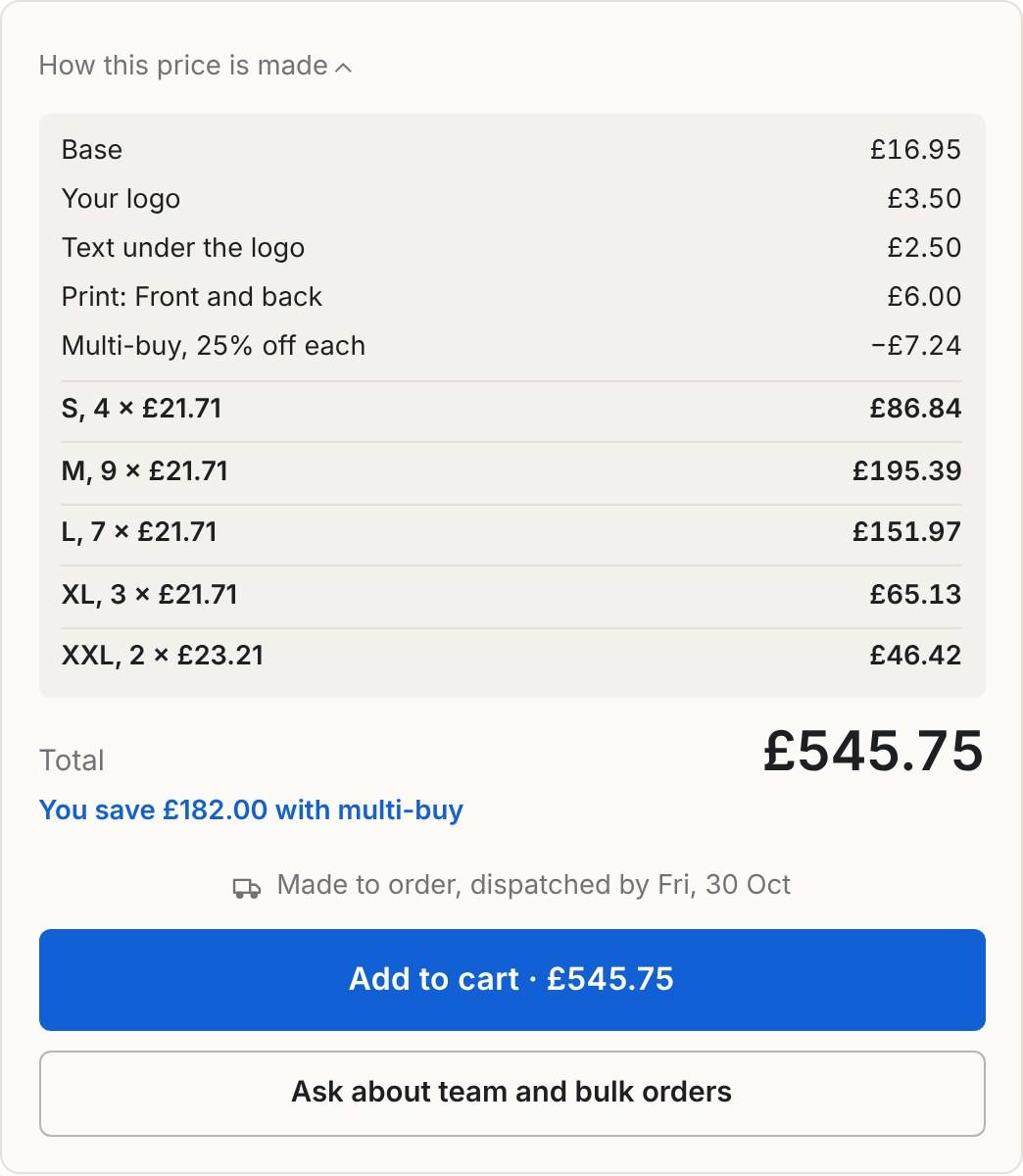
Sizes that cost more are handled the same way. With 25 shirts in the demo order, two of them XXL, the page shows the XXL line at 2 × £23.21 and the other sizes at £21.71 each, £545.75 in total. In a live shop, that is the total the checkout charges. Try it on the live demo, and see how to price add-ons like a motor or a winter cover for extras priced by size.
Questions and answers
Can a customer change the price in the browser?
No. Inchy works the price out again at checkout from your rules, so a figure changed on the page is not what gets charged.
Do I need Shopify Plus?
No. Inchy works on every Shopify plan.
What if a customer types a size I do not make?
It is stopped before payment, with a message under the size field and an offer to send the details for a quote. See how to sell made to measure awnings on Shopify.
Does the Add to cart button show the price?
Yes. In the demo it reads "Add to cart · £1,892.95", and on a phone the total stays at the bottom of the screen as the shopper scrolls.
Is pricing add-ons for the size included?
Yes, in the Made to measure plan at $99 a month, with unlimited products, billing through Shopify and no fee per order.
Set up one made to order product with your own rules, add it to the basket and compare the checkout with the page. See Inchy and try the live builder. Start the 7-day free trial on the Shopify App Store.
Sources
Baymard Institute, Cart abandonment rate statistics: 70.22% average from 50 studies; reasons for abandoning a checkout; page updated 22 September 2025.
Shopify.dev, Cart Transform Function API: update operations can override a line's price, title or image; only development stores or Shopify Plus stores can use apps with them.
Shopify Help Center, Rounding prices: converted prices rounded per market; the rounding rules cannot be customised.
Inchy live demo: sample UK prices, team order with XXL and size limit messages, read on 21 October 2026.
Written with AI. Every figure is checked against the sources listed above.
1reading now
- views
Get an email when Inchy: publishes