Why You Should Apply Fertiliser Better, Not More

Read any fertiliser market update this autumn and the same picture emerges: prices elevated, supply chains strained, demand climbing into the harvest season, and the shortage no longer theoretical but showing up in company earnings and farm budgets alike. Buried in the numbers, though, is a signal more important than any single price — one that tells buyers exactly how to respond.
The shortage is now in the price
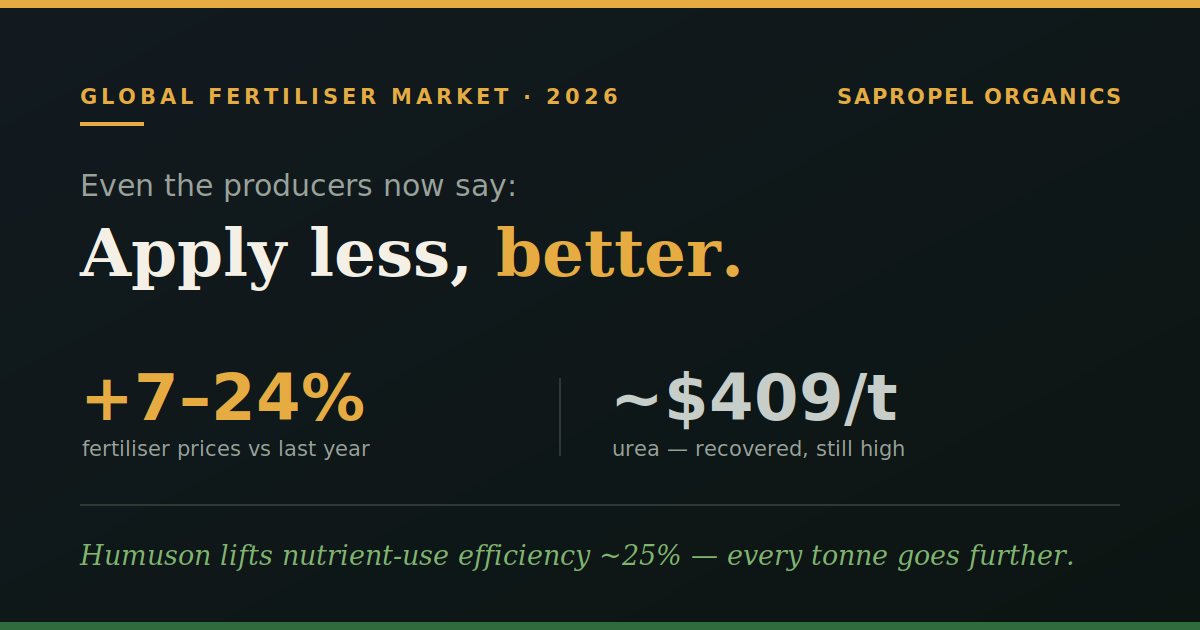
Fall 2026 fertiliser prices are running roughly 7–24% above last year's levels as the Northern Hemisphere harvest approaches. Urea has recovered to around $409/t as Strait of Hormuz negotiations progress and China adopts a more flexible export stance, but "recovered" still means well above where it sat a year ago. UN trade data shows the Hormuz disruption materially hit fertiliser and chemical exports earlier this year — a point the WTO's data on the disruption documents in detail — and companies are feeling it directly: Wesfarmers reported higher fertiliser costs tied to the Middle East conflict even as its chemicals-and-fertiliser earnings rose 18.5%. New supply is coming — OCP is targeting 4.5 million tonnes of additional phosphate capacity by the end of 2026 — but capacity of that scale takes time to arrive, and demand is not waiting for it.
The signal most people miss
Here is the line worth stopping on. Uralchem — a major fertiliser producer — is now publicly calling for balanced fertiliser application to help address land degradation. Sit with that. When a company whose business is selling fertiliser starts advocating for using it more efficiently and in better balance, the logic of the market has shifted. The message from inside the industry is no longer "apply more." It is "apply better."
That is not a soft sustainability talking point. In a market where every tonne is expensive and not guaranteed to arrive, efficiency is simply the rational economic response.
What "use less, better" actually requires
Applying less while protecting yield is not achieved by cutting rates and hoping. It requires the soil to do more with each unit of nutrient — which means restoring the biology and structure that make nutrients available in the first place. That is exactly the role Humuson Complex plays. Made from sapropel, it reactivates soil microbiology, rebuilds organic matter and improves nutrient absorption, lifting nutrient-use efficiency by around 25%. It also helps the crop draw on nutrients already locked in the soil. In practice, that is how a farmer applies less expensive mineral fertiliser without surrendering the harvest.
Stability in an unstable market
There is a second advantage in a market this volatile. Humuson's cost base is not tied to gas, sulphur or Gulf shipping lanes — it is produced from certified lakes within the EU, with a composition identical batch after batch. While urea swings on Hormuz headlines and Chinese export policy, this is the stable line in the plan, and it makes the volatile inputs you still buy go further. In a market defined by uncertainty, that predictability is worth as much as the efficiency itself.
The takeaway
The market has stopped rewarding the reflex to simply buy more. Prices are high, supply is uncertain, and even producers are pointing toward efficiency and balance. The buyers who thrive through the final quarter of 2026 and into next year will be the ones who read that signal early: secure what you can, and make every tonne work harder. That is the same logic behind our earlier piece on the fertiliser allocation crisis.
If you're a distributor, buyer or grower planning through this market, the smartest move isn't just chasing tonnes — it's getting more crop from every one you secure. Let's talk.
1reading now
- views
Get an email when Aurimas publishes