Which Wood-Treatment Documents Should Your Architect Request?

Key Takeaways
There is no universal document pack for every treated timber component.
Start with the component, treatment process, purpose and intended use.
Ask for a safety data sheet only where the supplied substance or mixture requires one.
For biocidally treated articles, check active-substance status and the applicable label decision.
Connect each document to the specified product, finish and batch or order.
Close contradictions before approving a sample or release for manufacture.
A folder full of generic certificates can still leave the architect unable to identify the treatment on the ordered timber. At Wood Architects, we manufacture outdoor saunas in Lithuania, so I prefer a proportionate pack that connects each claim to a named component. This guide turns a vague request for “all certificates” into a short evidence schedule a supplier can answer.
Which Wood-Treatment Documents Should Your Architect Request?
Request a project-specific treatment statement, product identity, intended use, applicable label and safe-use instructions. Add an authorisation reference, safety data sheet, technical data sheet or batch record only when the treatment and legal status make it relevant. No single document pack is mandatory for every timber product. The architect's job is to connect each claimed property to the actual component, process and evidence, then record gaps before specification approval.
Build the request from the component
Begin with one line in the material schedule: exterior cladding, interior wall lining, bench board, subframe or decking. Record the species, profile, finish, exposure and location. Then ask whether the component is untreated, thermally modified, coated, impregnated with a preservative, or subject to several treatments.
This order matters because a safety data sheet is primarily a communication tool for substances and mixtures. The European Chemicals Agency's safety-data-sheet guidance explains when an SDS should be supplied for hazardous substances or mixtures and certain other cases. It does not make an SDS a universal certificate for every finished timber article.
If the component was treated with or incorporates a biocidal product, use the ECHA treated-articles route. If it was modified by heat alone, ask for the process statement and product performance information instead of inventing a chemical dossier.
Match the evidence to the claim
Claim or process | Sensible evidence request | What not to assume |
|---|---|---|
Thermally modified timber | Process declaration, product data and intended-use limits | That a biocidal product or SDS must exist |
Applied oil, coating or adhesive | Exact product identity, technical data and SDS where applicable | That a generic brand leaflet identifies the supplied formulation |
Preservative-treated timber | Biocidal product identity, active substance, intended protective function and label decision | That “treated” proves the relevant use is permitted |
Biocidal property claim | Exact claim, supporting treatment record and final treated-article label | That all durability language is automatically a biocidal claim |
Factory-applied multi-layer finish | Layer schedule, application instructions and maintenance compatibility | That one top-coat sheet describes the complete system |
The point is not to collect the greatest number of PDFs. It is to close the evidence chain. A document should identify the product, version and responsible supplier. The material schedule should show where it is used. The installation and maintenance instructions should not contradict the exposure or substrate.
Separate product authorisation from article information
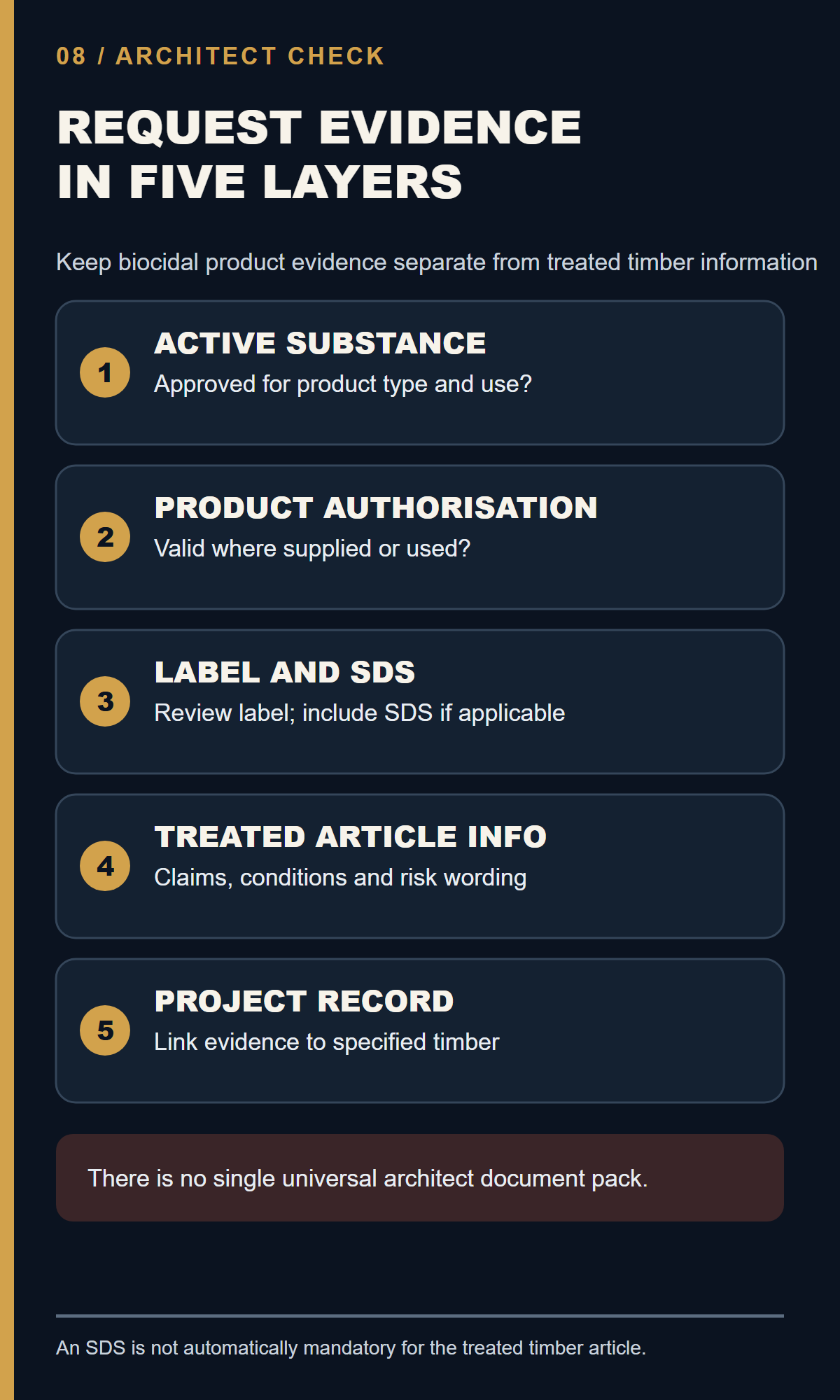
A biocidal product normally needs authorisation before it is made available or used in the EU. ECHA's getting-started guidance for biocides separates active-substance approval, product authorisation and treated-article duties. Those are related checks, but they are not interchangeable documents.
For preservative-treated timber, ask which product was applied and for the relevant product type and use. Confirm the active-substance and authorisation position through the appropriate official database or competent authority. Then check whether the finished article needs the particulars described by Article 58 of the Biocidal Products Regulation.
A product authorisation does not tell the architect where the treatment was used in the sauna. A treated-article label does not replace project details such as component location and finish. An SDS for a coating does not prove that the correct coating was applied. The review needs all applicable links, not one impressive document.
Send a copy-ready treatment evidence schedule
Use one row per timber component. The request below is deliberately an ask-and-check list, not a declaration that every item is legally mandatory.
Copy-ready supplier request
Project: [PROJECT]. Component: [COMPONENT / DRAWING REFERENCE].
State the timber species, grade, profile, exposure and intended use.
Describe every treatment or finish, including thermal modification, preservative, oil, coating, adhesive or factory-applied layer.
For each applied product, provide the exact product name, manufacturer, intended function and current technical data sheet.
Provide a safety data sheet where the supplied substance or mixture requires one or where it is otherwise applicable.
If a biocidal product was used, provide its identity, active substance, relevant product type or use, authorisation reference and treated-article label decision.
Provide final labels, safe-use, installation and maintenance instructions where applicable.
Connect the response to the quoted product and order or batch reference.
List any requested item that is not applicable and explain why.
Resolve contradictions before approval
Compare the supplier response with the drawing note, quotation and physical sample. If the specification says heat-modified wood but the maintenance sheet names a preservative, ask whether it is an additional treatment. If a coating is described as suitable outdoors but its data sheet excludes the expected exposure, pause the approval.
Version control matters. Record the document title, revision and access date. A link to a changing web page is useful, but preserve the version used for the design decision. If the supplier substitutes a product, reopen only the affected line rather than treating the entire evidence pack as unchanged.
Architects can use the same discipline when checking visual specifications. Our article on material risks in cheap outdoor saunas shows why a component-level description matters. A polished photograph cannot resolve an unidentified treatment system.
That is the useful answer to Which Wood-Treatment Documents Should Your Architect Request? Ask for the minimum evidence that proves the actual process, status and application, and add documents only when their trigger is present.
Choose one high-exposure timber component today. Populate the request with its drawing reference and send it before approving the finish. The result should be a closed evidence row, not an indiscriminate archive.
Frequently Asked Questions
Is an SDS mandatory for every treated timber product?
No. Safety data sheets primarily communicate information about substances and mixtures in the cases defined by REACH. A finished timber article does not automatically require an SDS merely because it was treated. Ask for the SDS of an applied substance or mixture where applicable, and request article information separately.
Should an architect request a treatment certificate?
Request a project-specific treatment statement, then identify what evidence supports it. A certificate may be useful when it names the process, product, component and order. A generic certificate can still leave traceability unresolved. The appropriate evidence depends on whether the timber was modified, coated or biocidally treated.
What should identify a biocidal treatment?
Ask for the applied product, active substance, protective purpose, relevant product type or use, authorisation reference and final treated-article label decision. These fields test different parts of the evidence chain. Their presence in a request does not mean that every field must appear on every finished timber label.
Can thermal modification and a coating both apply?
Yes. Timber can be thermally modified and later receive an oil, coating or another treatment. Record the layers separately because their technical information and legal status may differ. Do not let a heat-treatment declaration obscure a later applied product, or let a coating sheet replace the modification specification.
How should the architect record a non-applicable document?
Ask the supplier to mark the item “not applicable” and give a short reason tied to the process. For example, heat modification without an applied substance may not generate an SDS for the timber. A reasoned response is more useful than a blank cell or an unrelated document.
When should a timber approval be paused?
Pause when the component cannot be linked to the treatment record, a claimed property lacks an explanation, document versions conflict, or the stated use falls outside supplied instructions. The pause should name the missing decision evidence. It should not demand every possible certificate regardless of relevance.
1reading now
Get an email when Giedrius publishes