What Fire Evidence Should a Hotel Request for an Outdoor Sauna?

Key Takeaways
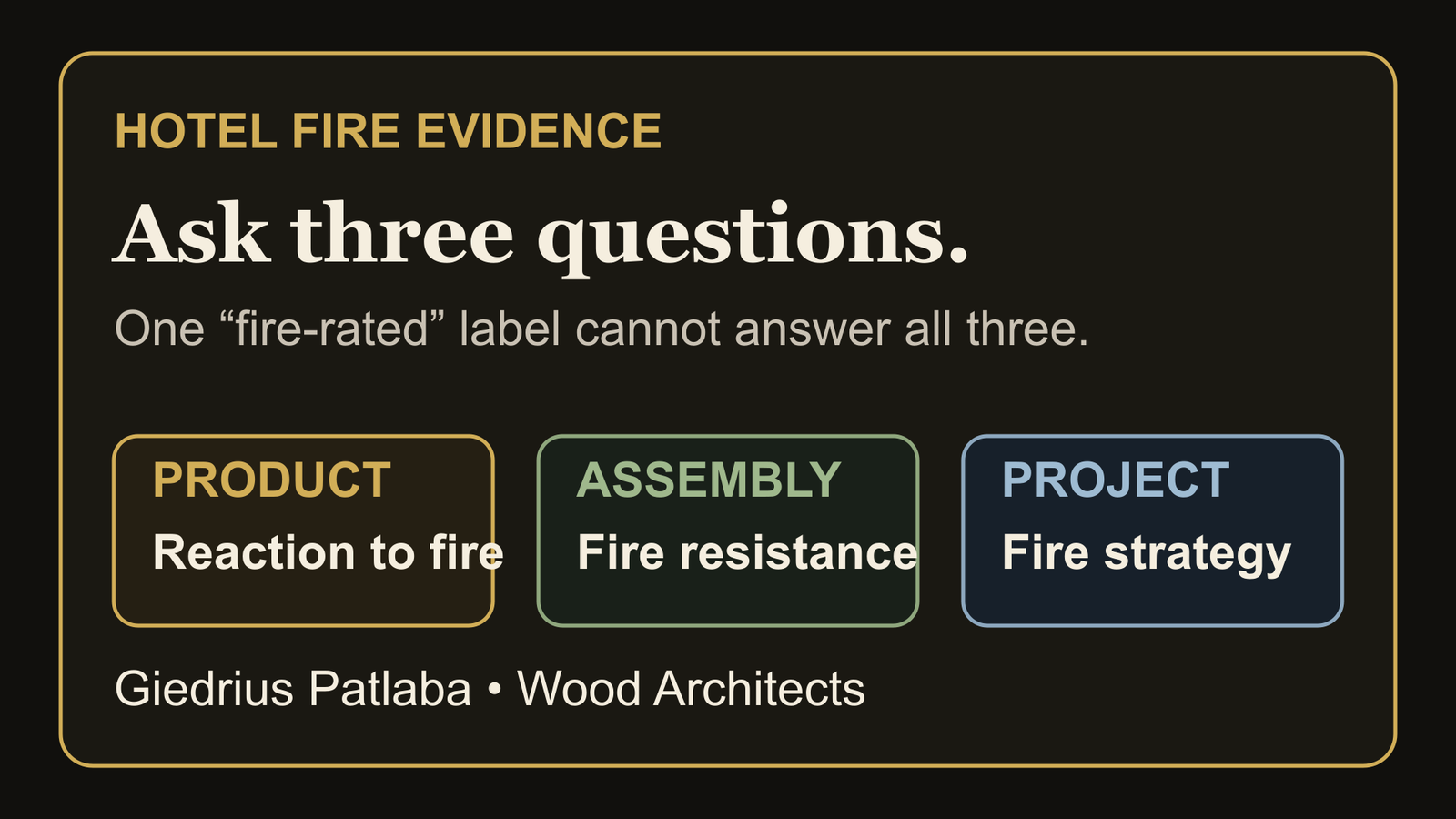
Ask for fire evidence against an exact product, intended use and installed configuration.
Reaction to fire describes a construction product's contribution to fire, not a complete sauna's fire resistance.
Fire resistance, where required, concerns an assembly or element and cannot be inferred from one material class.
A local fire strategy must reconcile the sauna with its site, distances, escape, access and authority requirements.
A CE mark or Declaration of Performance states declared product performance within its route. It is not whole-installation approval.
Close every evidence request with an owner, revision, installation condition and acceptance decision.
Hotel teams often receive one confident phrase: “the sauna is fire rated”. That phrase compresses several different questions into one answer. By the end of this article, you will have a practical request list that separates product evidence from assembly evidence and the local fire strategy.
What Fire Evidence Should a Hotel Request for an Outdoor Sauna?
A hotel should request evidence for each relevant construction product in its exact intended use, including product identity, declared reaction-to-fire performance and the assessment route behind it. Where an assembly must provide fire resistance, request evidence for that complete tested or assessed build-up. Then require the project fire strategy to confirm how the installed sauna fits the site, separation, escape, access and local authority requirements. No single class, brochure or CE mark answers all three layers.
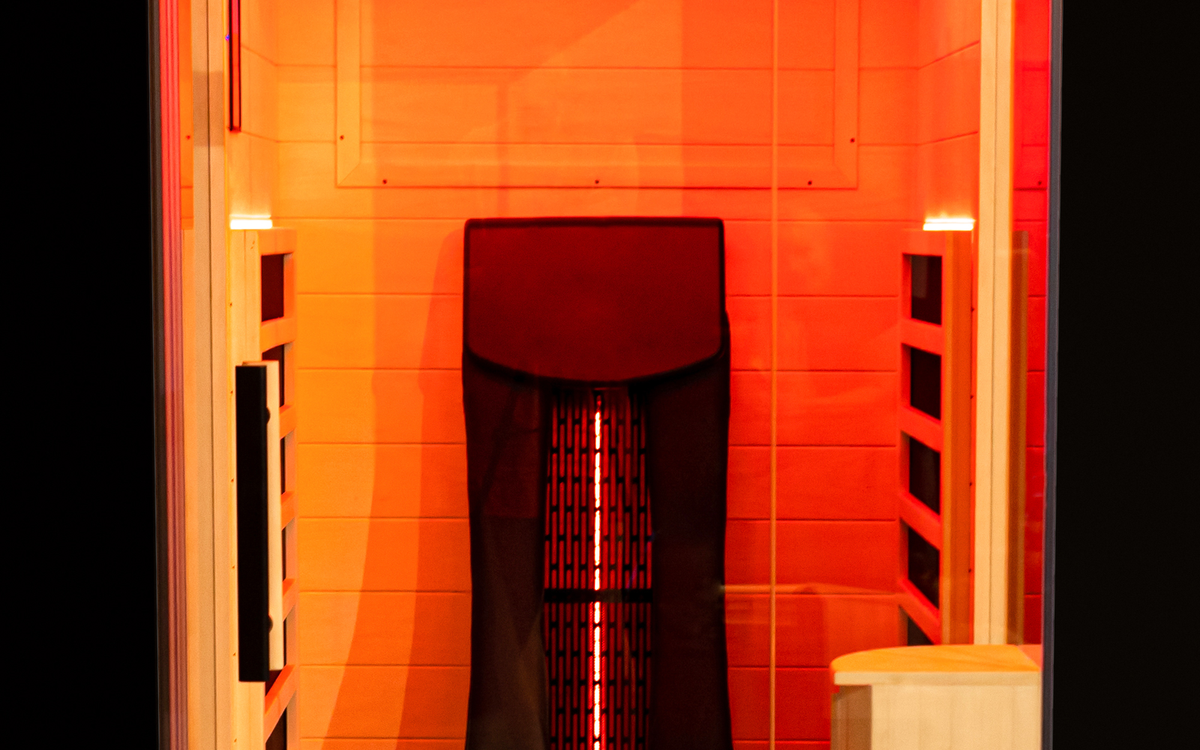
This photographed view shows a visible heat-source, timber and glass interface only. It is not an outdoor sauna or a current Wood Architects cube, and it proves no fire class, test, clearance, performance or compliance.
Why is “fire rated” the wrong starting point?
The phrase does not tell a buyer what was classified, which characteristic was assessed, which configuration was covered or where the evidence applies. It may refer to the reaction to fire of a lining product, the fire resistance of an element, a heater's safety instructions, or simply a marketing description. Those are not interchangeable.
From a manufacturer's perspective, the useful question is narrower: which exact product, in which intended use and installed build-up, needs which declared or project-specific evidence? That wording exposes gaps early. It also avoids asking a product document to settle a site-design decision.
The European Commission's construction-products standards guidance treats reaction to fire, resistance to fire and external fire performance as distinct essential characteristics. A tender return should preserve those distinctions.
What does reaction-to-fire evidence actually tell you?
Commission Delegated Regulation (EU) 2016/364 provides the classification system for construction products by reaction to fire. It applies where a product's intended use means it may contribute to the generation and spread of fire and smoke within the works. The classification belongs to the construction product and its assessed conditions.
Do not convert that into a universal request for one “best” class. The required performance depends on the product's intended use, the project and national or local rules. A wall lining, insulation product, roofing component, floor finish and door may have different evidence routes and requirements. A hotel should ask its fire adviser which characteristics and performance levels are required for the actual location.
For every product where reaction to fire is relevant, request a small identification block:
manufacturer, product name, type and revision.
intended use and the harmonised standard or European Technical Assessment route, where applicable.
the declared class and any smoke or flaming-droplet additions that form part of it.
the substrate, thickness, fixing, joints, coatings or treatments covered by the classification.
the Declaration of Performance, classification report or assessment reference supporting the declaration.
the person who confirms that the proposed installation remains within those conditions.
A timber species, “charred finish” or material sample is not a classification. Neither is a photograph. If the proposed coating, treatment, substrate or fixing differs from the assessed configuration, record that difference for competent review rather than assuming equivalence.
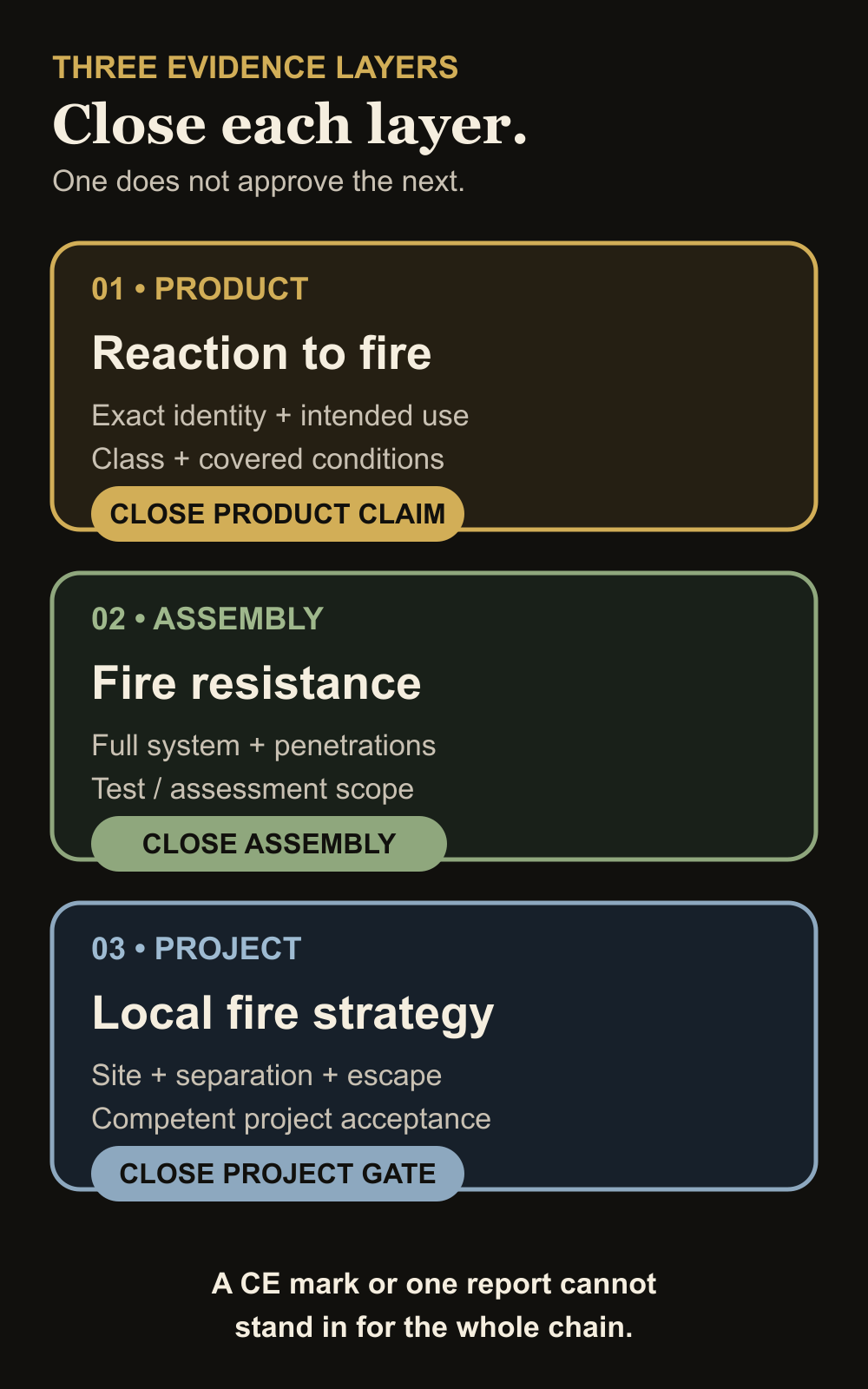
Keep three evidence layers open: product performance, assembly performance where required, and the project fire strategy. Closing one does not close the others.
When does fire resistance become a separate request?
Reaction to fire concerns how a product contributes to fire. Fire resistance concerns the ability of an element or assembly to perform specified functions during fire for a stated period under the relevant classification route. If the project requires a wall, floor, roof, door or other element to provide fire resistance, the evidence must address that complete element.
A lining class cannot prove the fire resistance of a wall. A board certificate cannot prove a wall assembled with different studs, insulation, fixings, joints and penetrations. Ask for the tested, classified or properly assessed build-up, its field of application and a drawing that matches the proposed construction. Openings, services and interfaces should be reconciled rather than hidden behind the headline rating.
This is also where scope discipline matters. Wood Architects can return product identity, construction information and the evidence within our declared sauna-package scope. The appointed project fire adviser and relevant designers determine whether a fire-resisting element is required and whether the actual assembly and interfaces satisfy that requirement.
What does a Declaration of Performance or CE mark prove?
The European Commission's Declaration of Performance and CE-marking guidance explains that a DoP is required when a construction product is covered by a harmonised European standard or conforms to a European Technical Assessment. The CE mark connects the product to that declared performance and assessment route.
That is useful evidence, but the boundary is important. It does not state that a complete outdoor sauna is approved for every hotel, site or fire strategy. It does not select a national requirement, prove a fire-resisting assembly that was not assessed, or confirm that the installer preserved every condition behind the declaration.
Request the current DoP by exact product code, then reconcile its declared use and performance with the specification. If the product is not covered by such a route, ask what other directly applicable technical evidence supports the claim. Do not demand a DoP where the legal route does not require one, and do not accept a generic certificate for a different product.
Why must the local fire strategy remain a separate gate?
The European Commission's construction-products FAQ notes that Member States retain competence to set technical requirements for products' performance in specific uses, including fire-safety requirements. Product classification gives a common language. The project still has to apply the right requirement.
An outdoor sauna can interact with buildings, boundaries, vegetation, terraces, canopies, fuel or electrical equipment, access routes and guest escape. The project fire strategy should identify the applicable site conditions, separation assumptions, detection or alarm interfaces where relevant, fire-service access, operational controls and the evidence required before opening. Those decisions are jurisdiction and site specific.
For wood-fired equipment, product-standard evidence is another defined line, not a substitute for the wider strategy. My earlier article, Which Standard Covers Your Wood-Fired Sauna Stove?, explains why a stove's exact product route matters. It does not establish cladding performance, fire resistance or acceptance of the whole hotel installation.
Use one fire-evidence return schedule
A useful schedule has one row per evidence question, not one folder labelled “fire”. I would include these columns:
Item and exact identity: the product, assembly or site decision being reviewed.
Characteristic: reaction to fire, fire resistance, external fire performance, heater-product safety or local strategy input.
Required performance: set by the competent project team for the intended use.
Evidence route: DoP, classification report, ETA, test or assessment, manual, drawing or fire-strategy reference.
Covered configuration: substrate, thickness, fixings, joints, treatments, penetrations and limits.
Proposed configuration: the actual project selection and revision.
Gap and owner: the person responsible for resolving any difference.
Acceptance: who checked it, when, against which strategy revision and with what decision.
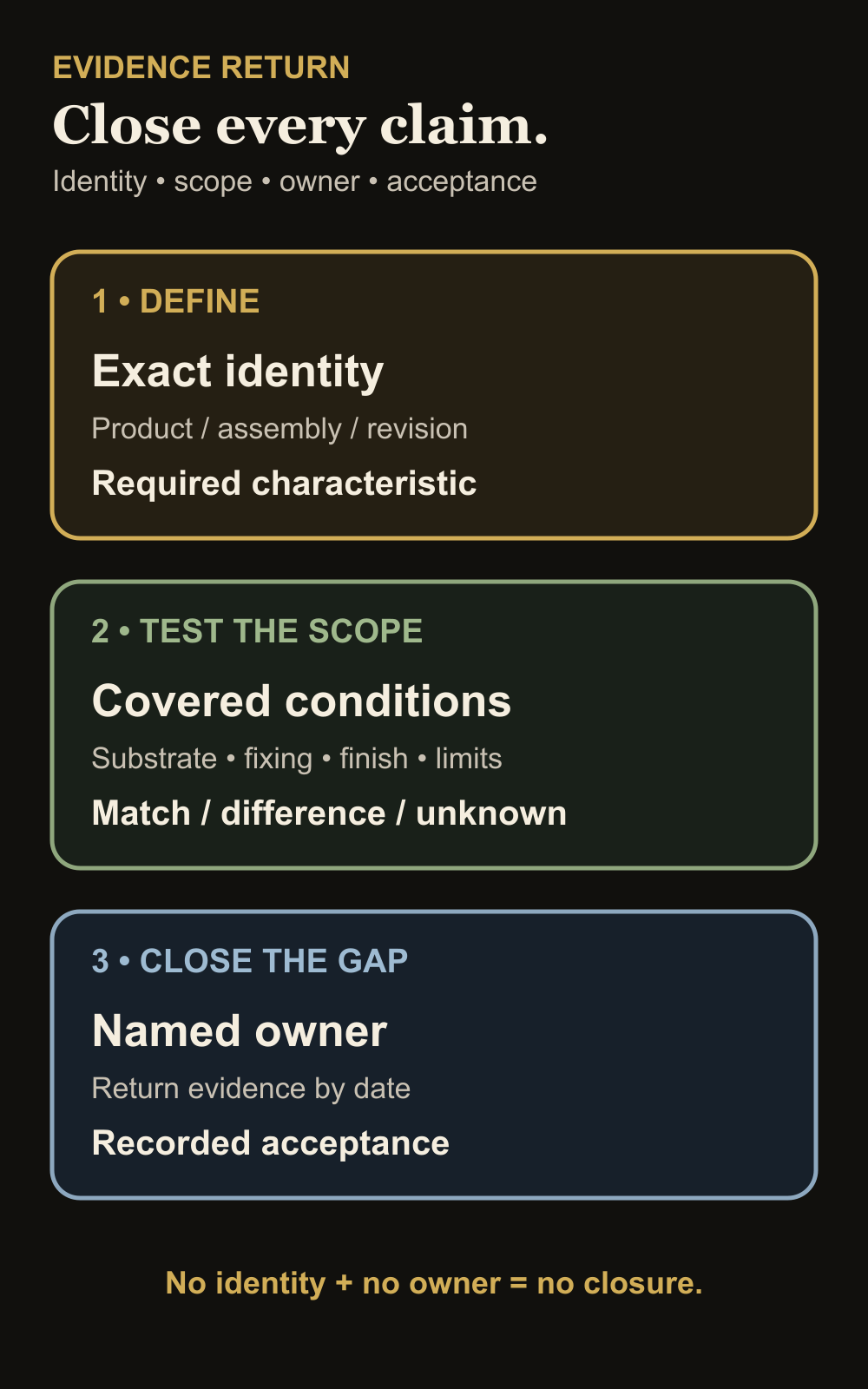
A useful return schedule links each claim to exact identity, covered conditions, the proposed build-up, a named gap owner and a recorded acceptance decision.
The schedule prevents a common handover failure: several impressive PDFs with no documented link to what was installed. It also makes changes visible. If a lining, coating, door, roof build-up or heater changes, reopen the affected row and review the downstream strategy assumptions.
What should the hotel reject at tender stage?
Reject “fireproof”, “non-combustible sauna” or “fully fire rated” claims that have no exact scope. Reject a class without a product identity and intended-use condition. Reject a test report for one build-up presented as evidence for another. Reject a CE mark used as shorthand for site approval. And reject a fire strategy that lists an outdoor sauna but has no returned product or interface information.
The aim is not to maximise paperwork. It is to make each decision traceable. A shorter, current evidence set tied to the actual installed configuration is stronger than a large archive of unrelated certificates.
Is there one reaction-to-fire class every hotel sauna should achieve?
No. The required class depends on the product's intended use, location, project fire strategy and applicable national or local rules. Ask the competent fire adviser to define the requirement, then request evidence for the exact product and assessed installation conditions. Do not invent a universal threshold.
Does a CE mark mean the complete sauna is fire approved?
No. For a construction product within the relevant route, CE marking connects that product to its declared performance under a harmonised standard or European Technical Assessment. It does not approve every assembly, heater interface, site layout, escape arrangement or local fire strategy for a complete outdoor sauna.
Can a reaction-to-fire report prove fire resistance?
No. Reaction to fire and fire resistance answer different questions. A reaction-to-fire classification addresses a product's contribution to fire. Fire resistance, where required, must be supported for the complete element or assembly, including the relevant build-up, joints, fixings, openings and field of application.
Should the hotel ask the sauna manufacturer for the fire strategy?
The manufacturer should return accurate product, construction and interface information within its scope. The appointed fire adviser and project designers own the site-specific fire strategy under their appointments. The hotel should require a documented hand-off showing that manufacturer evidence was reviewed against the current strategy.
What is the fastest way to spot weak fire evidence?
Check whether every claim names an exact product or assembly, intended use, assessed configuration, current document and acceptance owner. If a certificate cannot be matched to the proposed specification and drawing, or if one product class is presented as whole-installation approval, the evidence chain is incomplete.
Conclusion
A hotel does not need one sweeping fire certificate. It needs three connected evidence layers: declared performance for relevant products, complete assembly evidence where fire resistance is required, and a local fire strategy that applies those facts to the real site. Keep the identities, conditions, revisions and acceptance owners visible, and “fire rated” becomes a checkable decision rather than a sales phrase.
1reading now
Get an email when Giedrius publishes