Why Distance No Longer Protects Your Fertiliser Price

A conflict at a strait in the Persian Gulf just moved the price a farmer pays in Thailand. A few years ago that sentence would have sounded like a stretch. Today it is simply how the fertiliser market works — and it marks the end of an old assumption: that being far from the trouble keeps you safe from it.
The shock travels everywhere
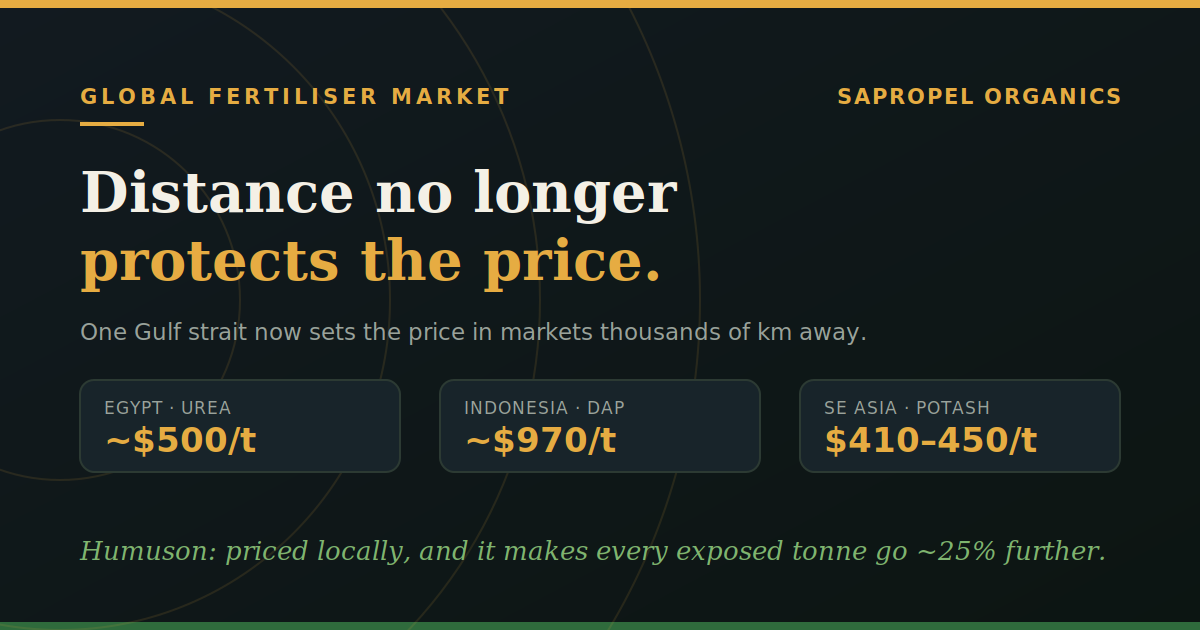
Look at the latest regional picture and the reach is obvious. Market updates put Egyptian urea around $500/t, DAP purchases into Indonesia near $970/t, and Southeast Asian potash fluctuating roughly in the $410–450/t range — all moving on the same drivers: tension around the Strait of Hormuz, Chinese export policy, and the tenders coming out of India, Indonesia and Bangladesh. Southeast Asia sits thousands of kilometres from the Gulf, yet it is pricing the Gulf's risk. The chokepoint is somewhere else; the bill arrives locally.
Distance used to be a buffer
There was a time when regional fertiliser markets were partly insulated from one another — a disruption in one basin took time, if ever, to reach another. Concentrated global supply and tightly-coupled logistics have erased that cushion. When a quarter of the world's traded urea normally moves through a single strait, and a handful of countries dominate exports, a problem anywhere becomes a price everywhere. As the WTO's data on the Hormuz disruption shows, the transmission is fast and broad. Geography is no longer a hedge.
Demand doesn't retreat — it pays
The uncomfortable part is that buyers can't simply wait it out. Even as prices climbed, Thailand's cumulative ammonium sulphate imports for January–July ran about 42% higher year on year. Farmers still need the nutrient, so when the price rises they largely absorb it — and the cost flows onward into thinner margins and, eventually, food prices. A globally transmitted shock plus inelastic demand is precisely the combination that turns a shipping-lane headline into a farm-level squeeze half a world away.
The only real insulation is local
Here is the strategic conclusion. You cannot diversify away geopolitical transmission by switching origins, because every commodity origin is exposed to the same four signals. Buying Egyptian instead of Gulf urea, or Chinese instead of Middle Eastern phosphate, changes who you depend on — not whether you are exposed. The only genuine insulation is supply that is produced locally and priced outside the commodity chain entirely.
Sapropel is priced locally, absorbed efficiently
That is the position Humuson Complex occupies. Made from sapropel, extracted from certified lakes and manufactured within the EU, its cost and availability do not ride on Hormuz transit, Gulf gas, sulphur, or the next Asian tender. Its composition is identical batch to batch. It is, in effect, insulated from the transmission that now reaches every corner of the commodity market. And because it lifts nutrient-use efficiency by around 25%, it also stretches whatever globally-priced fertiliser you still have to buy — so the exposure you can't avoid does less damage.
The takeaway
The lesson of this market is not that prices are high. It is that no one is far enough away to be safe. A fertiliser strategy built on the hope that your region will stay quiet is a strategy built on an assumption that no longer holds. The resilient move is to add supply that isn't wired into the global shock at all, and to make every exposed tonne go further. That is the same logic behind our earlier piece on why the market now prices access, not fertiliser.
If you're a distributor, importer or buyer — anywhere on the map — planning through a market where distance no longer protects you, let's talk.
1reading now
Get an email when Aurimas publishes